Multi-Tenant SaaS Architecture on Azure: Silo, Pool, Bridge
How to choose silo, pool or bridge isolation for identity, compute and data on Azure, what each costs per tenant, and how to keep noisy neighbours quiet.
Microsoft revised its Azure Architecture Center multitenancy guidance for storage in August 2026 and for Azure SQL Database and Cosmos DB in October. For premium B2B tiers, the Cosmos DB page recommends a database account per tenant, with fleet pools sharing throughput between them, rather than one big shared container. Meanwhile the EU Data Act's ban on switching charges arrives on 12 January 2027, and it applies to SaaS too.
So the oldest question in SaaS is back on the table: how much do we share, and where? This guide is for the people who make that call and then live with it: CTOs, chief architects, platform leads and the engineers who get paged when one tenant's month-end report slows everyone down. We map silo, pool and bridge across identity, compute and data on Azure, cost each one per tenant in a model you can rerun, and list the controls that keep noisy neighbours quiet.
TL;DR / Key takeaways
- Isolation is a per-tier decision. Pool compute, bridge data, silo only the tenants who pay for it.
- The control plane is never siloed. One tenant catalogue, one onboarding pipeline and one identity platform serve every model.
- Dedicated capacity is where cost jumps. In our illustrative model a pooled tenant costs about €34 a month, a siloed one about €467. A database per tenant in an elastic pool costs the same as a shared one.
- Noisy neighbours are a governance problem. Meter per tenant, rate-limit at the edge, cap in the data tier, promote tenants who dominate.
- EU rules reward knowing where each tenant lives. The Data Act, DORA and GDPR assume you can export, place and protect one tenant's data on its own.

Download: Editable draw.io file · Open in diagrams.net · Chart data (CSV)
Why the isolation question matters again
Gartner's November 2024 forecast put worldwide SaaS end-user spending at roughly $299 billion for 2025. In our experience, regulated European buyers now ask about isolation in the first sales call. Three things have shifted.
The middle of the spectrum got better. Cosmos DB fleets let each B2B tenant have its own account while sharing a throughput pool. Priority-based execution and throughput buckets (the latter still in preview) give you real levers inside a shared container.
The regulatory floor rose. The Data Act treats SaaS as a data processing service with switching rights. DORA makes financial entities write data locations and exit strategies into ICT contracts, and those clauses flow down to you.
AI features made tenants less predictable. A single tenant running a bulk embedding job or a runaway agent loop can briefly outweigh the load of everyone else on a shared tier.
The model: one control plane, three isolation levels, four tiers
Two vocabularies describe the same idea. The AWS SaaS Lens uses silo (dedicated resources), pool (shared resources) and bridge (a mix, tier by tier). Microsoft's Azure Architecture Center speaks of automated single-tenant, fully multitenant, and vertically or horizontally partitioned deployments. We use the shorter terms. The numbers below match the diagram's callouts.
① The control plane: one catalogue, every model
Every multitenant system needs a tenant catalogue: a durable record of each tenant's model, deployment, region and commercial tier. Microsoft calls the deployments stamps and describes mapping every request to the stamp that holds the tenant's data. Around the catalogue sit onboarding (infrastructure as code per tenant or per stamp), routing (typically Azure Front Door plus a tenant lookup) and per-tenant metering.
This layer is shared even in a full silo; the SaaS Lens notes that a silo without shared identity, onboarding and operations is a managed service, not SaaS. The most common mistake we see is building the catalogue last, then discovering that moving one tenant needs a project. Build it on day one.
② Identity: shared IdP, tenant context in every token
Identity is the tier you almost never silo. Microsoft calls building your own identity provider an antipattern. Use Microsoft Entra ID as a multitenant app for B2B customers with their own directory, or Microsoft Entra External ID for customer sign-up. Azure AD B2C stopped being sold to new customers on 1 May 2025.
- Pool: the IdP adds a tenant identifier claim to every token, and the app authorises against it. Map tenants to immutable IDs, not email domains.
- Bridge: the same IdP federates per tenant with the customer's Entra ID or SAML/OIDC provider, so they keep MFA and conditional access.
- Silo: still one IdP and one onboarding flow. Add a dedicated app registration only where a contract demands it.
Keep entitlements out of the IdP. Microsoft recommends tracking licences in the application or an entitlements service and injecting them as claims at sign-in. For service-to-service calls, use federated workload identities, as in our workload identity federation guide.
③ Compute: shared plans, dedicated pools, dedicated stamps
Compute is where pooling pays best, because stateless tiers scale out and recover quickly.
- Pool: one App Service plan, Container Apps environment or AKS cluster for everyone (how to choose). On AKS, Microsoft recommends a namespace per tenant with RBAC, network policies and resource quotas. That is soft multitenancy, fit for tenants who don't run untrusted code.
- Bridge: a shared front end and API, with dedicated workers or node pools for heavy or premium tenants. For tenant-supplied code on shared nodes, AKS pod sandboxing runs each pod in a Kata VM with its own kernel (Azure Linux node pools on Generation 2 VM sizes that support nested virtualisation).
- Silo: a dedicated stamp, with its own plan or cluster and, where required, its own subscription. Deploy it from the same template as every other stamp. A hand-tuned silo is a fork, and forks do not scale.
④ Data: where isolation actually lives
Data is where tenants feel isolation and where auditors look for it. Microsoft names three triggers for dedicated storage: the tenant's own encryption keys, its own backup and restore policy, or a different storage location.
- Pool: a shared database with
tenant_idin every tenant-owned table. Microsoft's SQL guidance: propagate the tenant context into the database on every request, re-establish it when a pooled connection is reused, and use row-level security as the backstop. In Cosmos DB, use a partition key per tenant, and hierarchical keys (/TenantId, then/id) before a tenant outgrows one logical partition's 20 GB and 10,000 RU/s. - Bridge: a database per tenant in an elastic pool, with its own backup, restore and schema version on shared compute. In Cosmos DB, the premium equivalent is an account per tenant with fleet pools.
- Silo: a dedicated database or account with per-tenant customer-managed keys, backup and region. Cosmos DB sets CMK only per account; Azure SQL supports CMK TDE keys per database.
Avoid Microsoft's listed antipatterns: a table per tenant, tenant-specific columns and manual schema changes.
⑤ Noisy neighbours: govern, don't hope
Microsoft's Noisy Neighbor antipattern page is plain: sharing a resource always carries noisy-neighbour risk. You can only measure it, limit it and price it.
- Meter per tenant. Log the tenant ID with every request; in Cosmos DB, log the request units too.
- Limit at the edge. API Management's
rate-limit-by-keyandquota-by-keypolicies can key on the tenant claim and return429withRetry-After. Microsoft warns the counter is never exact and is kept per gateway: a guard rail, not a billing meter. - Cap in the data tier. Per-database min/max vCores in SQL elastic pools; priority-based execution and throughput buckets in shared Cosmos DB containers.
- Shape the work. Push heavy, non-urgent jobs to off-peak queues and cap expensive queries.
- Promote or rebalance. A tenant that dominates shared capacity month after month belongs on dedicated capacity and a higher price tier.
Retries without backoff and jitter turn one noisy tenant into a storm. Our resilience patterns cheat sheet covers the client side.
⑥ Tenant placement: moving tenants along the spectrum
The model is a placement decision per tenant, recorded in the catalogue. Microsoft's vertically partitioned model describes exactly this: most tenants shared, some on dedicated deployments because they need isolation or will pay for it.
That only works if promotion is routine: export the tenant's rows into a new database, verify, switch the catalogue entry, drain connections. Rehearse it on a test tenant every quarter. A promotion path you have never run is a promise you cannot keep. Stamps and cells are close cousins; for the blast-radius angle, read our cell-based architecture guide.
What the numbers say
Isolation has a price; the useful question is where it jumps. We built a deliberately simple model from public list prices so you can see the shape and rerun it.
Method. We took pay-as-you-go prices for Germany West Central in euros from the public Azure Retail Prices API on 15 November 2026: App Service Premium v3 P1v3 on Linux (€0.1598 per hour), Azure SQL Database General Purpose Gen5 compute (€0.1503 per vCore-hour) plus the SQL licence meter (€0.0897 per vCore-hour), and the zone-redundancy meter (€0.0902 per vCore-hour). An average tenant needs 0.1 vCore of database and 0.05 app instances; shared databases are sized at 1.5 times demand, rounded up to the next available vCore size, and dedicated ones at 2 vCores; the shared app tier never drops below two instances. Storage, networking, backup, discounts and people cost are excluded. All inputs and outputs are in the CSV.
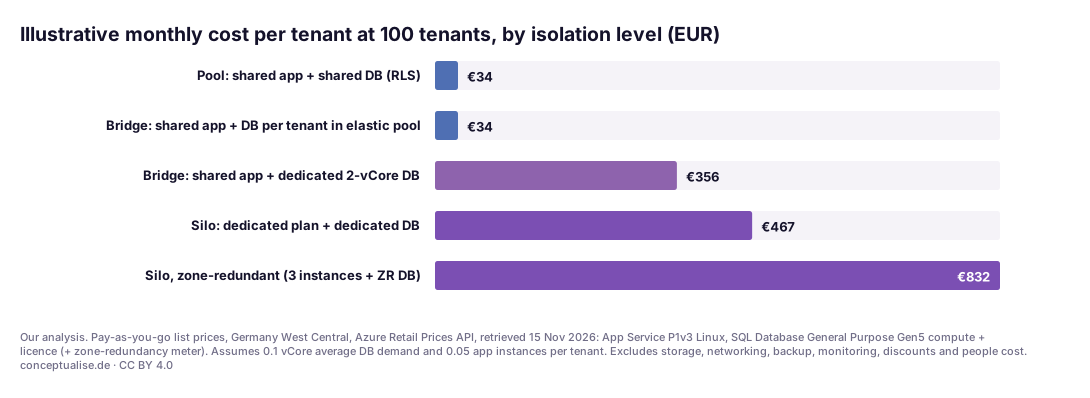
Three readings stand out. First, a database per tenant in an elastic pool costs the same as a shared database here, about €34 per tenant per month. That is not a trick: Microsoft states that in the vCore model a pooled vCore costs the same as a single-database vCore. The elastic-pool bridge buys per-tenant backup, restore and export at almost no infrastructure premium. You pay in operations instead: schema deployments across hundreds of databases and per-database monitoring.
Second, the jump comes from dedicated provisioned capacity. A 2-vCore database per tenant costs about €356, roughly ten times the pooled figure, because it is sized for one tenant's peak while a pool is sized for the aggregate. A full silo's own App Service plan (about €117 a month) takes it to about €467.
Third, resilience multiplies the silo bill, not the pool bill. A zone-redundant silo lands at about €832 per tenant per month. In the pool, everyone shares that redundancy.
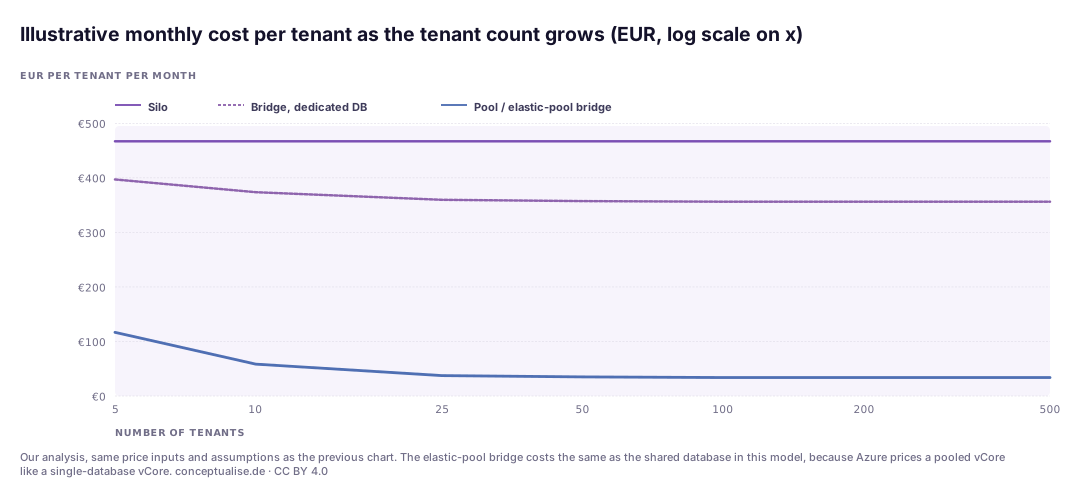
The pooled line falls from about €117 per tenant at five tenants to about €37 at 25, then flattens: a shared platform has a minimum size. The silo line never moves. Silo is a premium product with a premium price, not a default.
In a recent engagement…
A European B2B software vendor asked us to review their platform before moving upmarket. They had started, sensibly, with one shared Azure SQL database and a tenant ID on every table. Over the years the largest customers had asked for "their own database", and each got one, provisioned by hand, with its own tier, its own schema drift and a connection string in a configuration file.
Nothing was broken, but nothing was repeatable. The shared database got noisy at month end when a few large tenants ran exports together. The dedicated databases were mostly idle and paid for at peak. Nobody could say how long a new dedicated database would take, because nobody had done it the same way twice.
The fix was not a new architecture but a deliberate bridge. We introduced a tenant catalogue for routing, moved the hand-made databases into elastic pools with per-database caps, deployed schema changes through one pipeline, added per-tenant rate limits in API Management and moved month-end exports to a queue. The team feared large tenants would starve small ones in the pools; the caps and a weekly per-tenant utilisation report settled it. The longest discussion was commercial: which product tier includes a dedicated database.
The decision table
Read it per tier: a typical answer is "pool compute, bridge data, silo for two named customers".
| Requirement | Identity | Compute | Data |
|---|---|---|---|
| Thousands of small tenants, low price point (B2C or SMB) | Pool | Pool | Pool (RLS, partition key per tenant) |
| Customer wants SSO with its own IdP | Bridge (federation) | Any | Any |
| Independent backup, restore or point-in-time recovery per tenant | Pool | Pool | Bridge (DB per tenant) |
| Customer-managed encryption keys | Pool | Pool or bridge | Silo at the key boundary (SQL DB-level TDE key, Cosmos account) |
| Data must stay in a specific country or region | Pool | Bridge (regional stamp) | Bridge or silo per region |
| Contractual performance guarantee or premium SLA | Pool | Bridge (dedicated workers or node pool) | Bridge with per-DB minimum, or silo |
| Tenant runs its own code or untrusted plug-ins | Pool | Bridge (pod sandboxing) or silo | Bridge |
| Regulator or customer requires a dedicated environment | Pool | Silo (stamp, own subscription) | Silo |
Governance for European enterprises
Four regimes shape tenant isolation.
GDPR. As a SaaS provider you are usually a processor under Article 28, and Article 32 requires security appropriate to the risk. A cross-tenant leak involving personal data is a personal data breach for your customer. Document your isolation per tier in the technical and organisational measures, and test it: Microsoft recommends verifying that data cannot leak between tenants and that noisy-neighbour effects stay acceptable, for example with Azure Chaos Studio.
EU Data Act. Regulation (EU) 2023/2854 has applied since 12 September 2025, and its switching rules cover SaaS. Providers must remove obstacles to switching, cap the notice period at two months and complete the switch within a 30-day transitional period by default. From 12 January 2027, switching charges are banned. Architecturally that means a per-tenant export path that works without a project.
DORA. For EU financial entities, Article 30 of Regulation (EU) 2022/2554 requires ICT contracts to state where data is processed and stored and, for critical or important functions, to include exit strategies. Those clauses flow down to you as their provider. Regional stamps and a rehearsed tenant export answer both.
NIS2. Recital 33 of Directive (EU) 2022/2555 includes SaaS among cloud computing service models, and cloud computing service providers appear in Annex I. Whether you are in scope depends on size and on national law, in Germany the NIS2UmsuCG. If you are, your isolation design is part of your Article 21 evidence. German buyers will often also ask for a BSI C5 attestation.
A pragmatic adoption path
- Weeks 1–2: build the catalogue. Record model, stamp, region and tier for every tenant and route every request through it, even if everything is pooled today.
- Weeks 3–4: meter per tenant. Put the tenant ID on every log line, trace and metric, and feed it into showback, as in our chargeback and showback model.
- Month 2: guard the pool. Per-tenant rate limits and quotas in API Management, row-level security in shared databases, priority-based execution in Cosmos DB and a queue for heavy jobs.
- Month 3: build the bridge. Offer a database per tenant in elastic pools, deployed by one pipeline with per-database caps. Rehearse promoting a test tenant.
- Month 4 onwards: productise the silo. Define a dedicated stamp as code with subscription, key and region options. Price it as a tier.
The verdict
Multi-tenant SaaS architecture is not a choice between silo and pool. It is a set of per-tier decisions held together by one control plane. Get the catalogue, identity and metering right and any tenant can move along the spectrum as its contract changes. Get them wrong and every large customer becomes a custom project.
Our view: pool compute and identity. Make a database per tenant in an elastic pool your B2B default, because it costs about the same as a shared database and buys per-tenant restore and export. Keep full silos for tenants who need them and pay for them. And treat noisy neighbours as governance you measure and limit, not a performance bug you fix later.
If you want a second pair of eyes on your tenancy model, our software architecture team runs a fixed-scope review: your tiers against the decision table, one rehearsed tenant promotion, and a costed target model.
FAQ
What is the difference between the silo, pool and bridge models?
In the silo model a tenant gets dedicated resources, such as its own database or stack. In the pool model tenants share resources and your code enforces isolation through a tenant identifier. The bridge model mixes the two, for example a shared app tier with a database per tenant. The terms come from the AWS SaaS Lens; the Azure Architecture Center describes the same spectrum in its own tenancy models.
Which tenancy models does the Azure Architecture Center describe?
Four: automated single-tenant deployments, fully multitenant deployments, vertically partitioned deployments (most tenants shared, some on dedicated or regional deployments) and horizontally partitioned deployments (some tiers shared, others per tenant). Microsoft asks you to treat isolation as a spectrum, decide it per component, and test both data leakage and noisy-neighbour effects.
How do we stop noisy neighbours in a pooled Azure SaaS?
Treat it as resource governance. Meter consumption per tenant, rate-limit per tenant at the edge with API Management's rate-limit-by-key and quota-by-key policies, cap tenants in the data tier with per-database vCore limits in SQL elastic pools or priority-based execution and throughput buckets in Cosmos DB, move heavy jobs off-peak, and promote tenants that persistently dominate.
Is row-level security enough to isolate tenants in Azure SQL Database?
It is a strong backstop, not a complete model. Microsoft positions RLS as the database-enforced safeguard behind tenant context that the application sets on every request. Tenants still share compute, backup, restore and region, so RLS does nothing for noisy neighbours, per-tenant restore or customer-managed keys.
When does a tenant need its own Cosmos DB account or SQL database?
When it needs something that only exists at that boundary. In Cosmos DB, customer-managed keys, regions and guaranteed throughput are account-level, so Microsoft recommends an account per tenant for premium B2B tiers and a partition key per tenant for B2C. In Azure SQL, a database per tenant gives independent backup and restore, database-level customer-managed TDE keys and clearer cost attribution.
Does the EU Data Act affect multi-tenant SaaS providers?
Yes. Its switching rules cover data processing services, including SaaS. Since 12 September 2025 providers must remove obstacles to switching, cap the notice period at two months and complete the switch within 30 days by default. From 12 January 2027 switching charges are banned. Architecturally, you need a clean per-tenant export path.
Sources
All sources checked on 15 November 2026. Prices are list prices from the public Azure Retail Prices API on that date and change over time.
Tier A: primary, vendor documentation and regulatory
- Microsoft, Azure Architecture Center, "Tenancy models for a multitenant solution": https://learn.microsoft.com/en-us/azure/architecture/guide/multitenant/considerations/tenancy-models
- Microsoft, Azure Architecture Center, "Architectural approaches for storage and data in multitenant solutions" (revised August 2026): https://learn.microsoft.com/en-us/azure/architecture/guide/multitenant/approaches/storage-data
- Microsoft, Azure Architecture Center, "Multitenancy and Azure SQL Database" (revised October 2026): https://learn.microsoft.com/en-us/azure/architecture/guide/multitenant/service/sql-database
- Microsoft, Azure Architecture Center, "Multitenancy and Azure Cosmos DB" (revised October 2026): https://learn.microsoft.com/en-us/azure/architecture/guide/multitenant/service/cosmos-db
- Microsoft, Azure Architecture Center, "Use AKS in a multitenant solution": https://learn.microsoft.com/en-us/azure/architecture/guide/multitenant/service/aks
- Microsoft, Azure Architecture Center, "Architectural considerations for identity in a multitenant solution": https://learn.microsoft.com/en-us/azure/architecture/guide/multitenant/considerations/identity
- Microsoft, Azure Architecture Center, "Noisy Neighbor antipattern": https://learn.microsoft.com/en-us/azure/architecture/antipatterns/noisy-neighbor/noisy-neighbor
- Microsoft Learn, "Manage multiple databases with elastic pools" (vCore pricing parity): https://learn.microsoft.com/en-us/azure/azure-sql/database/elastic-pool-overview
- Microsoft Learn, "Fleet pools – Azure Cosmos DB": https://learn.microsoft.com/en-us/azure/cosmos-db/fleet-pools
- Microsoft Learn, API Management "rate-limit-by-key" policy reference: https://learn.microsoft.com/en-us/azure/api-management/rate-limit-by-key-policy
- Microsoft Learn, Azure AD B2C FAQ (end of sale to new customers): https://learn.microsoft.com/azure/active-directory-b2c/faq
- Azure Retail Prices API: https://prices.azure.com/api/retail/prices
- Regulation (EU) 2023/2854 (Data Act), Articles 23, 25, 29 and 50: https://eur-lex.europa.eu/eli/reg/2023/2854/oj/eng
- Regulation (EU) 2022/2554 (DORA), Article 30: https://eur-lex.europa.eu/eli/reg/2022/2554/oj/eng
- Directive (EU) 2022/2555 (NIS2), recital 33, Article 21 and Annex I: https://eur-lex.europa.eu/eli/dir/2022/2555/oj/eng
- Regulation (EU) 2016/679 (GDPR), Articles 28 and 32: https://eur-lex.europa.eu/eli/reg/2016/679/oj/eng
Tier B: frameworks and analysis
- AWS Well-Architected SaaS Lens, "Silo, pool, and bridge models": https://docs.aws.amazon.com/wellarchitected/latest/saas-lens/silo-pool-and-bridge-models.html
- Kubernetes documentation, "Multi-tenancy": https://kubernetes.io/docs/concepts/security/multi-tenancy/
- Gartner, "Gartner forecasts worldwide public cloud end-user spending to total $723 billion in 2025" (19 November 2024): https://www.gartner.com/en/newsroom/press-releases/2024-11-19-gartner-forecasts-worldwide-public-cloud-end-user-spending-to-total-723-billion-dollars-in-2025
Tier C: our analysis
- conceptualise.de cost model: inputs, assumptions and outputs in the chart data CSV; build script
mk_multi_tenant_saas_azure_isolation_models.py.
Topics