Agentic AI Threat Model: STRIDE for Agents, 14 Attack Points
An agentic AI threat model on one page: STRIDE applied to agents, 14 numbered attack points from prompt to A2A peer, and the controls that break each one.
On 1 May 2026, six national cyber security agencies, among them CISA, the NSA and the UK's NCSC, published joint guidance called Careful Adoption of Agentic AI Services. One of its recommendations is formal threat modelling before an agent reaches production. OWASP had released its Top 10 for Agentic Applications five months earlier. In early February, Gartner named agentic AI oversight and identity for machine actors among its top cybersecurity trends for 2026. Everyone agrees agents need a threat model. Almost nobody has published one you can put on a whiteboard.
This article is that whiteboard. It is for the people who sign off an agent going live: CISOs, security architects, platform leads and the CTOs who will be asked what happens when it goes wrong. We take STRIDE, the vocabulary most security teams already use, and apply it to a reference agent with a user channel, an orchestrator, memory, MCP tools and A2A peers. The result is one diagram with 14 numbered attack points, a heat map of which control breaks which point, and a crosswalk to the OWASP list.
TL;DR / Key takeaways
- STRIDE still works, with one change of assumption. Treat the planner LLM as an authorised but untrusted user. Anything it reads can become an instruction, so no security decision may live inside the model.
- Fourteen attack points, four trust boundaries. From direct prompt injection to repudiation in the audit trail. Every one of the ten OWASP Agentic risks maps onto at least one of them.
- Policy at the tool call does the most work. In our analysis it touches 11 of 14 attack points, and it still holds when the model is fully hijacked.
- Ten of fourteen attack points rest on a single primary control. Detection touches all fourteen but is primary for only one. That is the gap to close before production.
- The tool supply chain is already dirty. Koi Security flagged 341 of 2,857 ClawHub skills as malicious in February 2026. Pin and review agent tools like any other dependency.

Download: Editable draw.io file · Open in diagrams.net · Chart data (CSV)
Why agents need their own threat model now
A chatbot's worst day is an embarrassing answer. An agent that reads your mail, queries your CRM, opens pull requests and asks another agent to book a payment has the attack surface of a privileged employee, with none of the judgement. The industry spent 2025 learning this.
In May 2025, Invariant Labs showed that a malicious issue in a public GitHub repository could steer an agent using the official GitHub MCP server into leaking private repository data through a public pull request. Invariant called it an architectural problem, not a server bug. In June, Aim Labs disclosed EchoLeak (CVE-2025-32711), a zero-click flaw in which a crafted email pulled into Microsoft 365 Copilot's context could make it leak organisational data. Microsoft fixed it server-side. In September, an unofficial postmark-mcp package on npm shipped a run of clean releases, then added one line in 1.0.16 that blind-copied every outgoing email to an attacker. In November, Anthropic reported disrupting GTG-1002, a campaign it attributes to a Chinese state-sponsored group, which used Claude Code and MCP tools against roughly thirty targets. Anthropic estimated AI did 80–90% of the tactical work. Outside researchers have questioned that figure, but not the direction.
2026 added scale. Hasan et al. studied 1,899 open-source MCP servers and found 5.5% with tool poisoning and 7.2% with general vulnerabilities. Li and Gao scanned 67,057 servers across six registries and flagged 833 as vulnerable. Koi Security audited 2,857 skills on OpenClaw's ClawHub marketplace and flagged 341 as malicious.
The standards caught up too. NIST's NCCoE published a concept paper on identity and authorisation for AI agents in February 2026. Germany's BSI and France's ANSSI had already published joint design principles for LLM-based systems with zero trust in August 2025. The MCP 2026-07-28 revision forbids token passthrough and documents confused-deputy, SSRF and scope-minimisation risks. A2A reached 1.0 on 12 March 2026, with Agent Card signing in the core specification. What is missing is one reference picture that ties these together.
STRIDE, adapted for agents
STRIDE comes from Loren Kohnfelder and Praerit Garg at Microsoft, 1999. At every trust boundary it asks whether someone can Spoof an identity, Tamper with data, Repudiate an action, cause Information disclosure, cause Denial of service or Elevate privilege. It survives because it is boring and complete.
Agents break one assumption STRIDE relies on. In a normal system, each process enforces its own logic. A web server does not change its routing because a request body asks it to. A language model does exactly that, because instructions and data arrive in the same channel. So the planner is not a trusted process. It is closer to a well-meaning employee who will do whatever a convincing email says.
That gives us three working rules:
- Treat the planner as an authorised but untrusted user. It may request actions. It may not decide whether they are allowed.
- Put every security decision outside the model. Authorisation, data classification, rate limits and approval routing live in deterministic components the model cannot rewrite.
- Model boundary crossings, not components. Most agent attacks are not "break component X". They are "make the agent carry something across a boundary".
CSA's MAESTRO framework (February 2025) argues that STRIDE has gaps for agents and adds a seven-layer view. We agree with the diagnosis. In practice, teams that already review in STRIDE get further by drawing the agent's real boundaries than by learning a new taxonomy. Use MAESTRO as a cross-check.
The 14 attack points, boundary by boundary
The numbers match the warm circles in the diagram. The control letters match the heat map further down.
① Direct prompt injection
STRIDE: Tampering, Elevation. The user, or whoever has taken over the user's channel, tells the agent to ignore its instructions. GTG-1002's operators split their attack into "small, seemingly innocent tasks" and claimed to be a security firm. That is direct injection at industrial scale.
You will not prevent this inside the model. The control that matters is policy at the tool call (D). If the agent cannot invoke a tool the user is not entitled to, a jailbreak buys the attacker nothing the user did not already have.
② Indirect prompt injection
STRIDE: Tampering. The instruction arrives in content the agent reads: an email, a PDF, a web page, a ticket, a tool result. It is the most important point on the list, because the attacker needs no access to your systems. EchoLeak and the GitHub MCP case are both indirect injection.
The primary control is content isolation (A): mark untrusted content as data and route it through a constrained component that can summarise but not call tools. No isolation scheme is perfect, which is why this point has more partial controls than any other. Our prompt injection and tool abuse post covers the mechanics.
This is the "toxic agent flow" Invariant Labs described: read untrusted, read private, write public. Classifying each tool as untrusted-read, private-read or public-write lets the gateway break the last step. It is the cheapest data-flow policy we know.
③ Identity spoofing and delegation abuse
STRIDE: Spoofing, Elevation. Who is the agent acting for, and can that be faked? Typical failures are one shared service account for every user, tokens that do not record the user, and replayable consent. The MCP security guidance describes a confused-deputy attack in which a proxy with a static client ID lets an attacker obtain an authorisation code via a consent cookie the user set earlier.
The primary control is agent identity with on-behalf-of delegation (B): a distinct identity per agent, token exchange so every downstream token carries agent and user, and short lifetimes. NIST's concept paper argues for agents as identifiable entities rather than anonymous automation on shared credentials. Our agent identity guide walks through the flows.
④ Approval-gate manipulation
STRIDE: Spoofing, Tampering. OWASP calls this human-agent trust exploitation (ASI09). The approver sees the agent's own summary of what it is about to do. A hijacked agent writes a reassuring summary. Approval fatigue does the rest.
Human approval (E) works only if the approver sees the actual tool call, rendered by the gateway from the real parameters. Keep approvals rare so they stay meaningful. Our post on human-in-the-loop approval gates has the patterns.
⑤ Memory poisoning
STRIDE: Tampering. Long-term memory turns a one-off injection into a persistent one. An instruction written to memory today is retrieved as trusted context next month, for a different task and sometimes a different user.
The primary control is memory governance (G): provenance on every write, validation of writes from untrusted sources, per-user partitions and expiry. A memory that came from an email must never come back with the authority of a system instruction.
⑥ Context and memory leakage
STRIDE: Information disclosure. Retrieval returns something the current user should not see, because the index was built with an all-seeing service account or memory is shared across sessions. Most Copilot oversharing is this point, triggered by accident.
Two primary controls: agent identity (B), so retrieval runs with the user's permissions, and memory governance (G), so partitions hold.
⑦ Tool and skill supply chain
STRIDE: Tampering. Agents load MCP servers from npm or PyPI, skills from marketplaces and tool descriptions from remote servers. The postmark-mcp rug pull, the ClawHub campaign and CVE-2025-6514 in mcp-remote (CVSS 9.6, fixed in 0.1.16) all sit here. So does tool poisoning, where the malicious instruction hides in a tool's description.
The primary control is a pinned, reviewed registry (C): approved servers and skills pinned to versions and hashes, with tool descriptions captured at approval and compared on every load. A changed description is a changed dependency.
⑧ Tool misuse and excessive agency
STRIDE: Elevation. The agent uses a legitimate tool with legitimate credentials for an illegitimate purpose: deleting instead of archiving, emailing the whole customer list. This is ASI02, and it is what most incident reports describe once you strip away how the agent was persuaded.
Two primary controls: policy at the tool call (D) checks parameters, volumes and data classes before anything runs, and human approval (E) covers the few irreversible actions.
⑨ Confused deputy and token passthrough
STRIDE: Elevation, Spoofing. An MCP server forwards a caller's token downstream, or holds one powerful static credential for all callers. Whoever reaches the server inherits its authority. The MCP specification is blunt: servers "MUST NOT accept any tokens that were not explicitly issued for the MCP server".
The primary control is agent identity and token exchange (B): audience-bound tokens via resource indicators, a narrowly scoped token per downstream call, progressive scopes and no passthrough. See our MCP authorisation deep dive.
⑩ Unexpected code execution
STRIDE: Elevation. Agents run code: interpreters, shell tools, local MCP servers launched over stdio from a configuration file. CVE-2025-49596 in MCP Inspector (CVSS 9.4) and the stdio launch flaw OX Security disclosed in April 2026, where configuration flows straight into command execution, show that the tooling itself is attack surface.
The primary control is a sandbox with egress control (F): ephemeral containers or microVMs, no ambient credentials and a network allow-list.
⑪ Exfiltration via outputs
STRIDE: Information disclosure. Data leaves through the agent's own outputs: a markdown image whose URL encodes a secret, a link the client prefetches, a summary posted to a public channel, an HTTP call from a sandbox. EchoLeak used the output channel.
Two primary controls: output filtering (J) neutralises remote images and untrusted links, and sandbox and egress control (F) stops tools calling arbitrary hosts.
⑫ A2A peer spoofing and tampering
STRIDE: Spoofing, Tampering. When your agent delegates, it trusts the peer's identity, its Agent Card and its answers. A spoofed or compromised peer can return poisoned results or request tasks your agent will perform. OWASP calls this insecure inter-agent communication (ASI07).
Two primary controls: agent identity (B) for mutual authentication using the schemes the Agent Card declares, and a pinned registry (C) of peers whose card signatures you have verified. Agent Card signatures have been in the A2A specification since v0.3 (July 2025), so there is no excuse. Treat everything a peer returns as untrusted content, which takes you back to ②.
⑬ Runaway loops and denial of wallet
STRIDE: Denial of service. An agent retrying a failing tool forever, two agents delegating to each other, or an attacker sending work designed to maximise token use. The result is a large invoice or an exhausted quota for everyone else. OWASP files this under cascading failures (ASI08).
The primary control is budgets and circuit breakers (H): limits on steps, tokens, tool calls and spend per task and per user, plus a kill switch operators can pull without a deployment.
⑭ Repudiation and rogue agents
STRIDE: Repudiation. After an incident, can you prove which agent did what, for whom, with which tool version, approved by whom? Without that you cannot investigate or report properly. Rogue agents (ASI10) belong here too: drift outside scope is only visible if you record the scope and watch it.
The primary control is tamper-evident tracing and detection (I): an append-only log of every tool call with identity chain, parameters and tool version, traces across agents, and SIEM detections. Detection touches all 14 attack points. It is primary for this one alone.
What the numbers say
We scored ten controls against the 14 attack points as primary (prevents or breaks the attack), partial (limits or detects) or no material effect. This is our analysis of the reference architecture, not external data. Download the CSV and rescore it for your own agent.
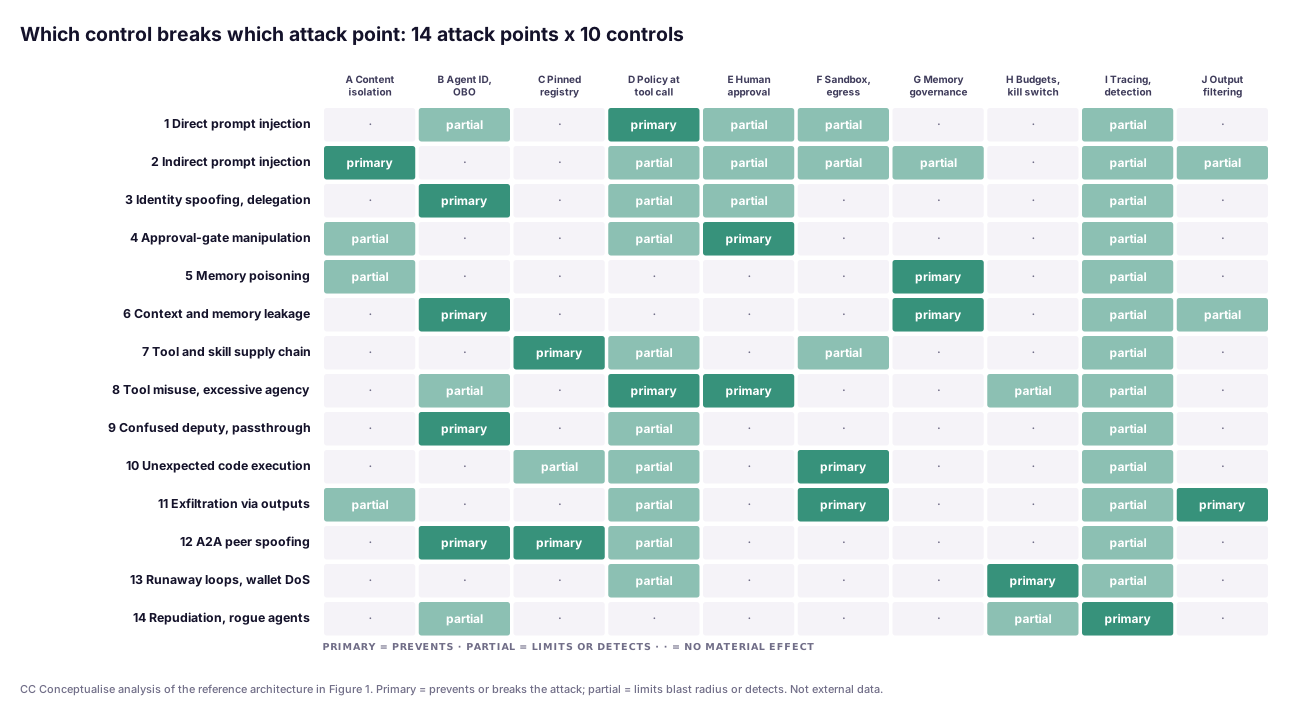
Three readings matter. First, ten of the fourteen attack points rest on exactly one primary control. If that control is missing, you rely on partial controls and detection. Acceptable for a pilot, not for an agent with write access to anything important.
Second, policy at the tool call is the workhorse. It touches 11 of 14 points and keeps working when the model is fully compromised, because it does not care why the model asked. If you build one thing before production, build the gateway.
Third, detection is everywhere and decisive nowhere. Tracing touches all 14 points and is primary for one. Teams that buy an observability platform and call it agent security usually discover this during their first incident.
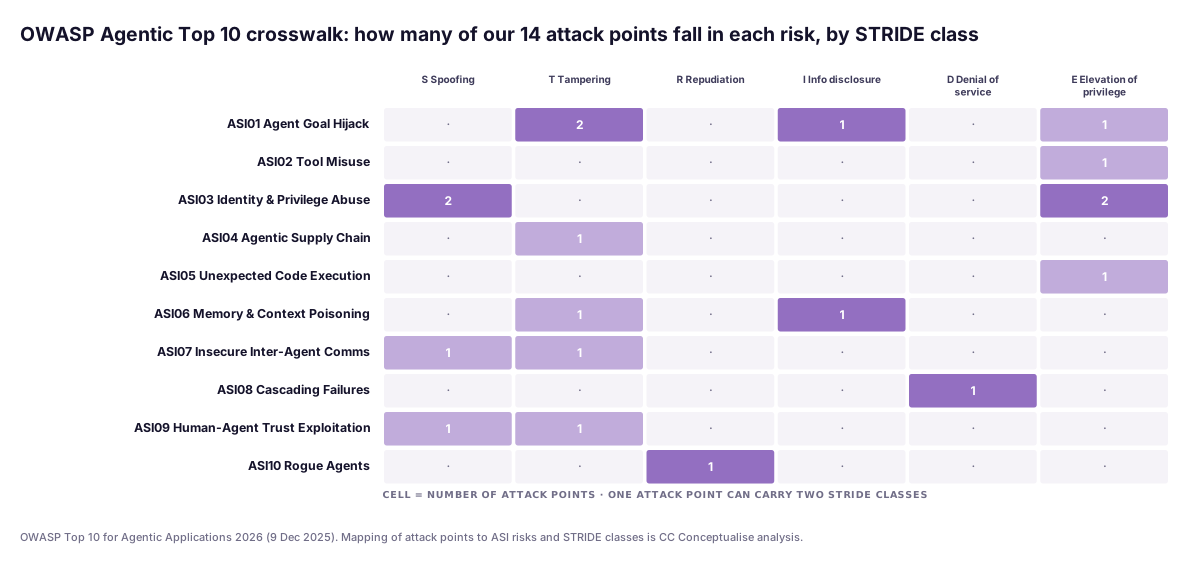
The two vocabularies cover the same ground. Tampering (six points) and elevation of privilege (five) dominate, as you would expect when the core weakness is a component that obeys its input. Repudiation and denial of service have one point each. They are rarely the way in, but they decide whether an incident is investigable and what it costs.
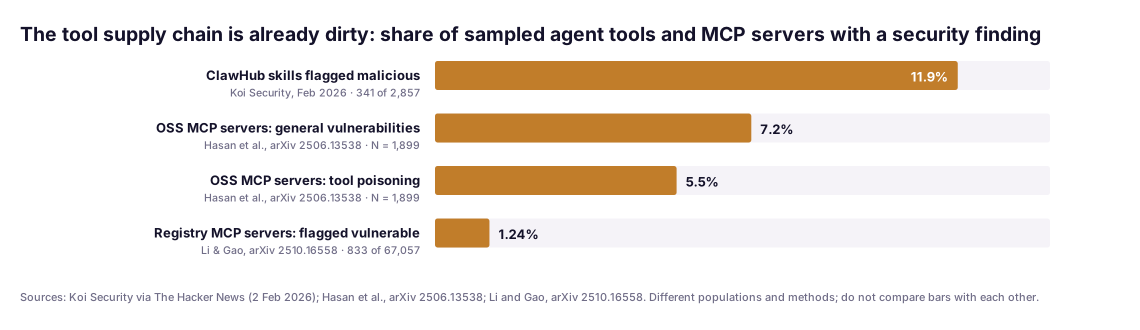
The last chart uses published data, one named source per bar. Populations and methods differ, so do not compare bars. The point is simpler: in every published sample, a measurable share of agent tools is vulnerable or malicious. Attack point ⑦ is not hypothetical.
| OWASP risk (2026) | Our attack points | STRIDE | First control to implement |
|---|---|---|---|
| ASI01 Agent Goal Hijack | ① ② ⑪ | T, E, I | Content isolation plus output filtering |
| ASI02 Tool Misuse | ⑧ | E | Policy at the tool call |
| ASI03 Identity & Privilege Abuse | ③ ⑨ | S, E | Agent identity with token exchange |
| ASI04 Agentic Supply Chain | ⑦ | T | Pinned, reviewed tool registry |
| ASI05 Unexpected Code Execution | ⑩ | E | Sandbox with egress allow-list |
| ASI06 Memory & Context Poisoning | ⑤ ⑥ | T, I | Memory provenance and partitions |
| ASI07 Insecure Inter-Agent Communication | ⑫ | S, T | Mutual auth, signed Agent Cards |
| ASI08 Cascading Failures | ⑬ | D | Budgets and circuit breakers |
| ASI09 Human-Agent Trust Exploitation | ④ | S, T | Gateway-rendered approvals |
| ASI10 Rogue Agents | ⑭ | R | Tamper-evident tool-call log |
The mapping is ours. Some attack points touch more than one OWASP risk; we placed each where it fits best.
In a recent engagement…
This year we ran this exercise for a European financial-services firm about to put a claims-handling agent into production. The agent read customer emails, looked up policies, drafted replies and could trigger small goodwill payments. The pilot had gone well. Nobody had drawn the trust boundaries.
Drawing them took one working session and changed the plan. Customer emails, attacker-controlled by definition, flowed straight into the planner and into long-term memory (② and ⑤). Every tool ran under one service account that could read all policies (⑥ and ⑨). Payments needed approval, but the approver saw the agent's one-line summary, not the parameters (④). And the tool-call log lived in debug output that was rotated within days (⑭).
None of the fixes was exotic. Inbound email went to a summariser that could not call tools. Retrieval moved to on-behalf-of tokens scoped to the customer in the conversation. The approval screen showed payee, amount and policy number from the gateway. Tool calls went to an append-only store. Go-live slipped by a few weeks. The slowest part was agreeing who owns the gateway's policy rules after the project team moves on.
The design-review checklist
This is the screenshot-able part. Use it before an agent gets production credentials. Every row needs a named owner and evidence, not a "yes".
| # | Question for the design review | Minimum control before production | Evidence to keep |
|---|---|---|---|
| ① | If the model obeys the user completely, what is the worst tool call it can make? | Gateway allow-list per user role | Red-team results per release |
| ② | Which inputs are attacker-controlled, and do they reach the planner? | Untrusted content tagged and isolated | Data-flow diagram |
| ③ | Does every downstream token carry both agent and user? | Per-agent identity, OBO token exchange | IdP config, token samples |
| ④ | What exactly does the approver see, and who renders it? | Gateway-rendered parameters | Approval log |
| ⑤ | Can untrusted content be written to long-term memory? | Provenance and validation on writes | Memory write audit |
| ⑥ | Whose permissions does retrieval run with? | User-scoped retrieval, partitions | Cross-user access test |
| ⑦ | Who approved each MCP server and skill, at which version? | Pinned registry, description hashes | Registry export |
| ⑧ | Which tools are irreversible or bulk? | Parameter and volume rules, approvals | Policy-as-code repo |
| ⑨ | Does any MCP server forward tokens or hold a static superuser key? | Audience-bound tokens, no passthrough | Token validation tests |
| ⑩ | Where does generated code run, with which credentials? | Ephemeral sandbox, no ambient credentials | Sandbox config |
| ⑪ | Can outputs render remote images or call arbitrary hosts? | Output sanitising, egress allow-list | Egress logs |
| ⑫ | How do we verify a peer agent, and what do we accept from it? | Mutual auth, signed Agent Cards | Peer registry |
| ⑬ | What stops a task at 100× its normal cost? | Budgets and kill switch | Budget alerts |
| ⑭ | Can we reconstruct any action a year from now? | Append-only log with identity chain | Retention policy, sample trace |
Two warnings. An allow-list the agent team can change without review is not a control, so put gateway policy under the same change control as firewall rules. And a red-team pass at launch is a snapshot. Run the injection suite on every model or prompt change, as in our LLM red-teaming playbook.
Governance for European enterprises
There is no single EU "agent law". Several regimes apply, depending on what the agent does and who runs it.
GDPR. Most enterprise agents process personal data, so Article 32 (security of processing) and Article 25 (data protection by design) apply. Attack points ⑥ and ⑪ are personal-data breaches waiting to happen, with Article 33's 72-hour notification clock.
NIS2. Article 21(2) of Directive (EU) 2022/2555 requires risk analysis and security policies (a), supply-chain security (d), access control and asset management (i) and multi-factor authentication (j). Agents touch all four. In Germany the NIS2UmsuCG has applied since 6 December 2025 with no transition period. An agent with production credentials belongs in your risk analysis, and this threat model is a good way to put it there.
DORA. For financial entities, a hosted model API or agent platform is an ICT third-party service that belongs in the register of information. An agent incident that disrupts a critical function can be a major ICT-related incident.
EU AI Act. Most enterprise agents are not high-risk. If yours is, for example in creditworthiness or recruitment under Annex III, Article 15 requires accuracy, robustness and cybersecurity, and Article 15(5) names data poisoning, model poisoning, adversarial examples and confidentiality attacks. Regulation (EU) 2026/1744 deferred these obligations to 2 December 2027. That is a deadline, not a reprieve. Article 14's human oversight maps onto attack point ④.
Cyber Resilience Act. If you sell an agent as, or inside, a product with digital elements, Article 14 reporting of actively exploited vulnerabilities and severe incidents has applied since 11 September 2026.
For DACH organisations, the BSI–ANSSI design principles for LLM-based systems are the closest thing to a national baseline. Their six principles (authentication and authorisation, input and output restrictions, sandboxing, monitoring, threat intelligence and awareness) line up with controls A, B, F, I and J in our heat map. Cite them in your design documentation.
A pragmatic adoption path
- Week 1: draw your agent. Take the draw.io file, delete what you do not have, add what you do, and mark every input as trusted or untrusted. Most teams find their first two problems here.
- Weeks 2–3: build the gateway before adding tools. Route every MCP and A2A call through one policy enforcement point with an allow-list, parameter rules and an append-only log. That covers ①, ⑧ and ⑭ and gives you an evidence trail.
- Weeks 3–4: fix identity. One identity per agent, on-behalf-of token exchange with audience binding, no passthrough and no static superuser keys on MCP servers. That closes ③, ⑥ and ⑨.
- Month 2: isolate the untrusted. Route attacker-controllable content through a constrained component, add provenance to memory writes, sanitise outputs, sandbox code execution and pin your tool registry.
- Month 3: test and rehearse. Red-team one test case per attack point, set budgets and a kill switch, and rehearse the agent incident runbook with security operations. Re-run the threat model whenever the agent gains a tool, a memory store or a peer.
The verdict
Agent security is not a new discipline. It is access control, supply-chain hygiene, sandboxing and logging, applied to a component that obeys its input. The mistake we see most often is not underestimating the model. It is overestimating it, and putting security decisions inside the one component that cannot hold them.
Our recommendation is plain. Draw the trust boundaries, assume the planner is hijacked, and give every attack point a primary control that does not depend on the model behaving. If you fund one thing this quarter, fund the gateway that enforces policy at the tool call. Then fix identity. Everything else makes the next incident smaller and easier to investigate.
If you want a second pair of eyes, our AI engineering team runs this threat model as a fixed-scope workshop for one agent. You leave with the diagram filled in for your architecture, the heat map scored for your controls and an owner for every gap.
FAQ
What is an agentic AI threat model?
A structured list of the ways an AI agent can be attacked, drawn on a picture of its components and trust boundaries: the user channel, the orchestrator and its model, memory, the tools it calls (usually over MCP) and the agents it talks to (for example over A2A). At each boundary crossing you ask what can be spoofed, tampered with, repudiated, disclosed, overloaded or escalated, and you name the control that breaks it. Our reference model has 14 attack points across four trust boundaries.
Does STRIDE still work for AI agents?
Yes, if you change one assumption. Classic STRIDE treats each process as enforcing its own logic. An LLM planner cannot: anything it reads can become an instruction. Treat the planner as an authorised but untrusted user, apply STRIDE at every boundary it crosses, and keep every security decision outside the model. CSA's MAESTRO adds agent-specific layers and is a useful cross-check.
How does this map to the OWASP Top 10 for Agentic Applications?
Every one of the ten OWASP risks, from ASI01 Agent Goal Hijack to ASI10 Rogue Agents, maps to at least one of our 14 attack points. Goal hijack covers three of them, identity and privilege abuse two, and memory and context poisoning two. The crosswalk table above lists the mapping and the first control to implement for each risk.
What is the single most important control for AI agents?
If we had to pick one, it is policy enforcement at the tool-call boundary: a gateway that checks every tool invocation against an allow-list, the caller's identity and parameter rules before it runs. In our heat map it touches 11 of the 14 attack points, and it still works when the model has been fully hijacked, which is the case you have to design for.
Which EU rules apply to the security of AI agents?
GDPR Articles 25 and 32 apply whenever an agent processes personal data. NIS2 Article 21 applies to essential and important entities, in Germany through the NIS2UmsuCG since 6 December 2025. DORA applies to financial entities. For high-risk AI systems, AI Act Article 15 applies from 2 December 2027 after Regulation (EU) 2026/1744 deferred the Annex III deadline. If you sell the agent as a product, Cyber Resilience Act reporting has applied since 11 September 2026.
How long does an agent threat-modelling exercise take?
For one agent with a defined scope, we plan a half-day workshop with the product owner, an engineer who knows the tool integrations and someone from identity and security operations, then a day of write-up. The output is the diagram filled in for your agent, a ranked list of attack points and an owner for each control. Re-run it whenever the agent gains a tool, a memory store or a peer.
Sources
All sources checked on 15 November 2026. Where a figure comes from a secondary report, we name the reporter.
Tier A: primary, standards and regulatory
- CISA, ASD's ACSC, NSA, Canadian Centre for Cyber Security, NCSC-NZ, NCSC-UK, "Careful Adoption of Agentic AI Services" (1 May 2026): https://www.cisa.gov/resources-tools/resources/careful-adoption-agentic-ai-services
- OWASP GenAI Security Project, "OWASP Top 10 for Agentic Applications" (9 Dec 2025): https://genai.owasp.org/2025/12/09/owasp-top-10-for-agentic-applications-the-benchmark-for-agentic-security-in-the-age-of-autonomous-ai/
- Model Context Protocol, Security Best Practices (2026-07-28): https://modelcontextprotocol.io/specification/2026-07-28/basic/security_best_practices
- Model Context Protocol, Authorization (2026-07-28): https://modelcontextprotocol.io/specification/2026-07-28/basic/authorization
- A2A Protocol specification (release v1.0.0, 12 Mar 2026): https://a2a-protocol.org/latest/specification/
- NIST NCCoE, "Accelerating the Adoption of Software and AI Agent Identity and Authorization" concept paper (Feb 2026): https://www.nccoe.nist.gov/publications/other/accelerating-adoption-software-and-ai-agent-identity-and-authorization-concept
- BSI and ANSSI, "Design Principles for LLM-based Systems with Zero Trust" (11 Aug 2025): https://www.bsi.bund.de/SharedDocs/Downloads/EN/BSI/Publications/ANSSI-BSI-joint-releases/LLM-based_Systems_Zero_Trust.html
- JFrog security advisory, CVE-2025-6514 (mcp-remote): https://research.jfrog.com/vulnerabilities/mcp-remote-command-injection-rce-jfsa-2025-001290844/
- Regulation (EU) 2024/1689 (AI Act), Articles 14 and 15: https://eur-lex.europa.eu/eli/reg/2024/1689/oj/eng
- Directive (EU) 2022/2555 (NIS2), Article 21: https://eur-lex.europa.eu/eli/dir/2022/2555/oj/eng
- Regulation (EU) 2022/2554 (DORA): https://eur-lex.europa.eu/eli/reg/2022/2554/oj/eng
- Regulation (EU) 2024/2847 (Cyber Resilience Act), Article 14: https://eur-lex.europa.eu/eli/reg/2024/2847/oj/eng
- Regulation (EU) 2016/679 (GDPR), Articles 25, 32 and 33: https://eur-lex.europa.eu/eli/reg/2016/679/oj/eng
Tier B: research and analysis
- Anthropic, "Disrupting the first reported AI-orchestrated cyber espionage campaign" (Nov 2025): https://www.anthropic.com/news/disrupting-AI-espionage
- Hasan et al., "Model Context Protocol (MCP) at First Glance", arXiv 2506.13538 (v5, Apr 2026): https://arxiv.org/abs/2506.13538
- Li and Gao, "A First Look at the Security Issues in the Model Context Protocol Ecosystem", arXiv 2510.16558 (v2, Apr 2026): https://arxiv.org/abs/2510.16558
- Invariant Labs, GitHub MCP toxic agent flow disclosure (26 May 2025): https://invariantlabs.ai/blog/mcp-github-vulnerability
- OX Security, "The Mother of All AI Supply Chains" (Apr 2026): https://www.ox.security/research-news/the-mother-of-all-ai-supply-chains-critical-systemic-vulnerability-at-the-core-of-the-mcp/
- Cloud Security Alliance, "MCP Security: Tool Poisoning and the Confused Deputy Problem" (16 May 2026, AI-assisted rapid research): https://labs.cloudsecurityalliance.org/wp-content/uploads/2026/05/CSA_whitepaper_mcp_security_agentic_attack_surface_20260516-csa-styled.pdf
- Cloud Security Alliance, "Agentic AI Threat Modeling Framework: MAESTRO" (Feb 2025): https://cloudsecurityalliance.org/articles/agentic-ai-threat-modeling-framework-maestro
- Gartner, "Gartner Identifies the Top Cybersecurity Trends for 2026" (Feb 2026): https://www.gartner.com/en/newsroom/press-releases/2026-02-05-gartner-identifies-the-top-cybersecurity-trends-for-2026
Tier C: vendor and news, directional
- The Hacker News, EchoLeak zero-click flaw in Microsoft 365 Copilot (June 2025): https://thehackernews.com/2025/06/zero-click-ai-vulnerability-exposes.html
- The Hacker News, first malicious MCP server found (postmark-mcp, Sept 2025): https://thehackernews.com/2025/09/first-malicious-mcp-server-found.html
- The Hacker News, 341 malicious ClawHub skills (Koi Security, 2 Feb 2026): https://thehackernews.com/2026/02/researchers-find-341-malicious-clawhub.html
- SecurityBrief UK, summary of Gartner's 2026 cybersecurity trends: https://securitybrief.co.uk/story/ai-regulation-quantum-top-gartner-cyber-trends-for-2026
Topics