AI Lateral Movement: How a Compromised Agent Pivots
How a hijacked AI agent pivots from Microsoft 365 through MCP tools into cloud APIs, which log sees each of the six hops, and the controls that stop them.
On 9 March 2026 the Cloud Security Alliance published a research note arguing that lateral movement now has a third dimension. Next to east-west and north-south sits movement through AI agents, which span network segments, trust domains, API scopes and inter-agent channels at once. Its most uncomfortable line is about detection: agent-mediated movement is "architecturally indistinguishable from legitimate operation", because the agent does exactly what its permissions allow.
We think that framing is right, and that few security teams have drawn the picture for their own estate. An agent with delegated access to mail and files, a handful of MCP tools and a cloud identity is a pre-positioned pivot. This article is for the people who decide what to log, scope and block: CISOs, identity and platform architects, and SOC leads. We map one composite kill chain across Microsoft 365, the MCP tool layer and cloud APIs, show which telemetry sees each hop, and list the controls that stop it.
TL;DR / Key takeaways
- The agent is the pivot. A subverted agent moves with its own tokens, tools and trust relationships. The attacker steals nothing up front; they only write content the agent reads.
- Six hops, three planes. Ingest, collect, tool pivot, harvest, cloud pivot and act, across Microsoft 365, MCP and the cloud control plane. Each plane usually has a different owner.
- No single log sees the whole chain. In our analysis, Defender's agent protection covers four hops well but is blind to the cloud pivot. Only identity and control-plane logs see hop five.
- Identity is the correlation key. Only 28% of organisations can reliably trace agent actions, per a CSA/Strata survey. Without a per-agent identity, the SOC cannot join the hops.
- Scope and gate, then detect. Short-lived, audience-bound tokens limit how far a hijacked agent travels. Approval gates stop the last hop. Detection is the third layer, not the first.

Download: Editable draw.io file · Open in diagrams.net · Chart data (CSV)
Why this matters now
Three things changed in the last twelve months.
First, attackers are already using agents to do the walking. In November 2025, Anthropic reported that a group it tracks as GTG-1002, assessed as Chinese state-sponsored, used Claude Code with tools reached "via the open standard Model Context Protocol" against roughly thirty targets. Anthropic says the actor used AI "to perform 80-90% of the campaign", with humans stepping in at perhaps four to six decision points. That was an attacker's own agent. The next step is to borrow yours.
Second, defenders' time keeps shrinking. CrowdStrike's 2026 Global Threat Report puts average eCrime breakout time, from initial access to lateral movement, at 29 minutes, and the fastest at 27 seconds. An agent chaining tool calls needs neither.
Third, injection research matured into a kill chain. The "Promptware Kill Chain" paper by Brodt, Feldman, Schneier and Nassi (arXiv, revised February 2026) found at least 21 documented attacks that traverse four or more stages, with lateral movement as an explicit stage. OWASP's Top 10 for Agentic Applications (December 2025) opens with Agent Goal Hijack, Tool Misuse and Identity and Privilege Abuse. Those are hops one, three and five below.
The kill chain, hop by hop
The chain is a composite. Each hop is documented in public research or vendor guidance, but we have not seen all six in one published incident. Numbers match the warm callouts in the diagram; letters match the green detection tags.
① Ingest: poisoned content reaches the agent
The attacker sends an email, shares a document or files a ticket with instructions the agent will read as context. EchoLeak (CVE-2025-32711, CVSS 9.3) showed this in Microsoft 365 Copilot in June 2025: a crafted external email, later retrieved by Copilot, could make it pull internal data into a response and leak it. Microsoft fixed it server-side and reported no exploitation in the wild. Aim Labs called the class an "LLM scope violation", where untrusted input makes the model act on trusted data. Invariant Labs showed the same pattern with a public GitHub issue and the GitHub MCP server.
Detection A. Prompt Shields and Defender's real-time agent protection inspect content entering the agent loop, and Defender records blocked Prompt Shields events as behaviours. For local coding agents, Defender for Endpoint's runtime protection (preview) inspects tool responses for injected instructions.
② Collect: the agent reads what its user can read
The hijacked agent searches mail, SharePoint and Teams with the user's delegated permissions. No escalation is needed, which is why oversharing clean-ups matter more with Copilot: the agent finds in seconds what a human never would.
Detection B. Purview Audit records CopilotInteraction events, including which files and messages Copilot accessed. Microsoft Graph activity logs record the API calls. A burst of retrievals across unrelated sites is a signal, but only against a baseline.
③ Tool pivot: from the tenant into the MCP layer
The agent calls tools: GitHub, ticketing, file servers. The CSA note warns that MCP and similar frameworks "can function as lateral movement infrastructure": one client session reaches code, tickets and documents. Two design flaws turn this into real lateral movement. Token passthrough, which the MCP specification forbids: servers "MUST NOT accept or transit any other tokens". And omnibus scopes, which the MCP security guidance lists as a common mistake.
Detection C. An MCP gateway in front of every remote server, such as Azure API Management, gives you one tool-call log with caller identity, tool and arguments. Defender's real-time protection also evaluates tool invocations for Agent 365 tools and, in preview, Copilot Studio and Foundry agents.
④ Harvest: secrets in the agent's reach
Local MCP servers using the stdio transport take their credentials from the environment, as the specification says. So do coding agents. Whatever sits in .env files, CLI token caches or environment variables is one tool call away. In cloud agents, a connection string in a tool's configuration does the same job.
Detection D. Defender's "secret exfiltration" scenario blocks cloud-agent interactions that try to move keys, credentials or tokens. On endpoints, Defender for Endpoint catches the injected instruction instead, such as one telling a coding agent to post .env externally. Key Vault diagnostic logs and CloudTrail show who read which secret.
⑤ Cloud pivot: the agent's identity meets the control plane
With a token, the chain leaves SaaS. The agent's identity, or a credential it found, calls Azure Resource Manager, Key Vault, storage or AWS IAM. This hop turns a data leak into an infrastructure incident.
Detection E. Only identity and control-plane telemetry sees it: Entra sign-in logs for agent identities and service principals, ID Protection for agents, and Activity Log or CloudTrail. Microsoft Entra Agent ID is generally available, with Conditional Access templates that block high-risk agent identities. If your agents run as shared app registrations, this hop looks like any other automation.
⑥ Act and spread: exfiltrate, persist, propagate
The final hop does the damage: an email to an external domain, a pull request on a public repository, a new credential for persistence, or instructions passed to another agent over A2A. The Promptware paper's "AI worm" example shows self-replication through an email-connected assistant.
Detection F. Defender's "unsafe email domain" rule blocks agent email to untrusted domains before the tool runs. DLP and an egress allow-list on agent runtimes cover the rest. The CSA note also makes human approval a mandatory gate above defined risk thresholds, backed by automated circuit breakers.
What the numbers say
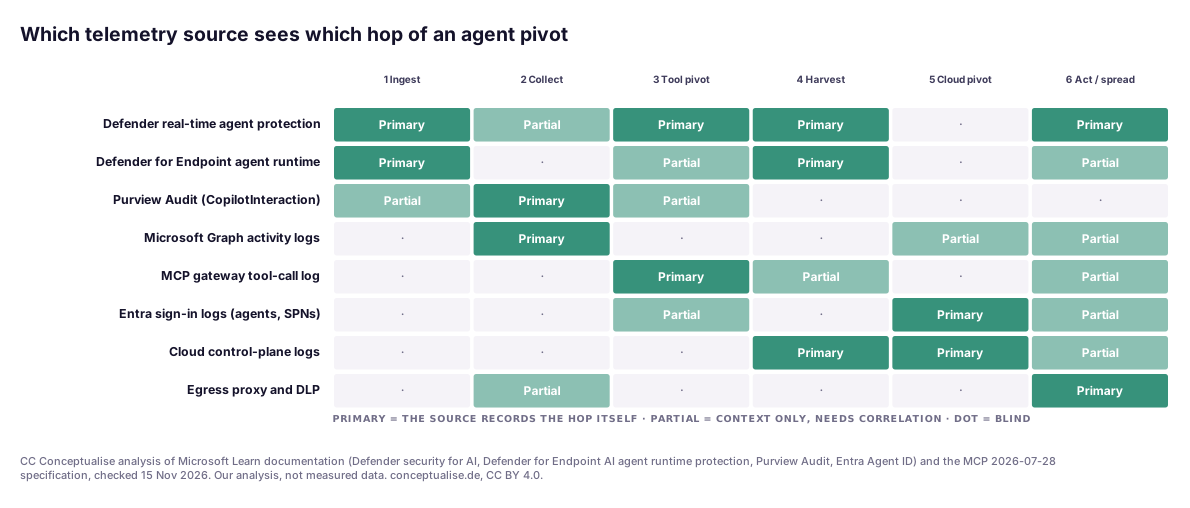
This matrix is our analysis of current Microsoft documentation and the MCP specification, not measured telemetry. Defender's real-time agent protection is the broadest single source, primary on four of six hops, yet blind to hop ⑤. Hop ⑤ is visible only in Entra sign-in and control-plane logs, which usually belong to the identity or cloud platform team. And every hop has at least one primary source. The gap is not telemetry. It is correlation, which needs a stable agent identity to join on.
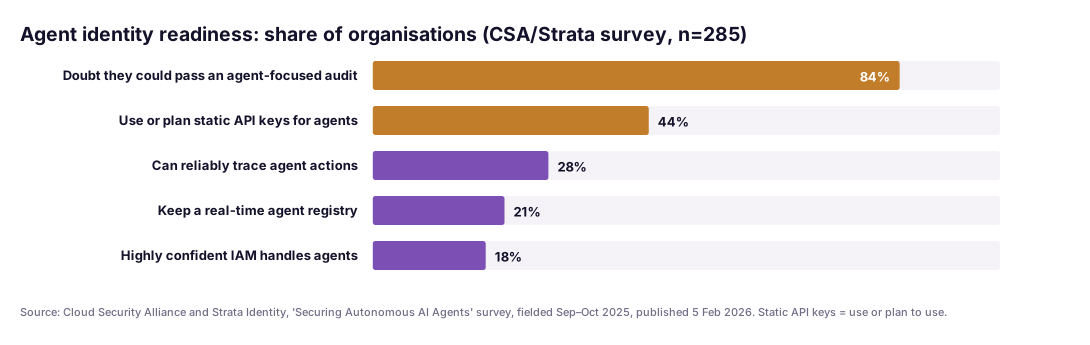
The CSA and Strata Identity survey explains why correlation fails. Only 21% keep a real-time agent registry, so the SOC often cannot tell which identities are agents. Only 28% can reliably trace agent actions. And 44% use or plan to use static API keys, so the identity seen at hop ⑤ may be shared by several agents, or a human.
In a recent engagement…
During an agent-readiness review this year for a European industrial company, we walked one internal assistant through the six hops with its owners. It was a Copilot Studio agent with SharePoint knowledge, a ticketing connector and a custom MCP server that read build logs. Each integration had been approved on its own.
The problems sat at the seams. The MCP server used one service account for every caller, so the tool log showed a single identity for all users. The build-log server's cloud credential could also read deployment secrets, because that was the quickest way to make it work. And Purview Audit, the gateway log and the Activity Log went to three different teams. "What did this agent do last Tuesday?" took two days to answer, incompletely.
The fixes were unglamorous: a dedicated agent identity, per-user audience-bound tokens on the MCP server, and a cloud credential that could read logs and nothing else. All three log sources now land in one Sentinel workspace, joined on the agent identity. The hardest conversation was not technical. It was agreeing who owns an agent's identity when the business owns the agent.
The hop-by-hop control table
Detection letters match the diagram.
| Hop | What the attacker gets | Detect (letter) | Prevent | Typical owner |
|---|---|---|---|---|
| ① Ingest | Instructions in the agent's context | A: Prompt Shields, Defender real-time protection | Treat retrieved content as untrusted; limit external sources for privileged agents | AI platform |
| ② Collect | Everything the user can read | B: Purview Audit, Graph activity logs | Oversharing clean-up; labels and DLP for Copilot | Data governance |
| ③ Tool pivot | Code, tickets, files | C: MCP gateway log, Defender tool rules | Gateway for every remote MCP server; per-tool scopes; no token passthrough | Platform / API |
| ④ Harvest | Tokens and secrets | D: Defender secret rule, vault logs | No secrets in agent environments; sandbox local MCP servers | DevSecOps |
| ⑤ Cloud pivot | Control-plane access | E: Entra agent sign-ins, Activity Log / CloudTrail | Per-agent identity; short-lived, audience-bound tokens; Conditional Access for agents | Identity |
| ⑥ Act and spread | Exfiltration, persistence | F: unsafe-domain block, DLP, egress logs | Approval for external sends and config changes; egress allow-list | SOC + business |
Two warnings. A gateway that authenticates with one shared identity hides more than it shows, so insist on the caller's identity in every tool-call record. And approval gates fail when they fire too often; our human-in-the-loop approval gates guide shows how to keep them meaningful.
Governance for European enterprises
NIS2. Article 21 requires risk-management measures including access control policies and asset management. An agent with delegated access is both, so it belongs in the inventory and in access reviews. Article 23 sets the clock for significant incidents: early warning within 24 hours, notification within 72 hours, final report within one month. In Germany, the NIS2 implementation act has applied since 6 December 2025, with risk-management duties in § 30 and reporting duties in § 32 BSIG.
GDPR. Hop ② usually touches personal data. If a hijacked agent exfiltrates it, Article 33 requires notifying the supervisory authority within 72 hours of becoming aware.
DORA. Financial entities must classify and report major ICT-related incidents. Treat agent identities as privileged automation under your ICT access-management policy, not as end-user software.
EU AI Act. Rarely the driver here. Annex III high-risk obligations, including Article 15 on cybersecurity, were deferred to 2 December 2027 by Regulation (EU) 2026/1744. If your agent is high-risk, the table above is a practical start on Article 15 evidence.
A pragmatic adoption path
- Week 1: inventory agents and their reach. List every agent, including Copilot Studio agents, coding agents and departmental tools, with identity, delegated scopes, MCP servers and secrets in reach. Our agentic AI threat model gives you a trust-boundary template.
- Weeks 2–3: give every agent its own identity. Move agents off shared app registrations and static keys to per-agent identities with short-lived tokens. Our AI agent identity and token exchange guide covers on-behalf-of and token exchange patterns.
- Weeks 3–5: put a gateway in front of MCP. Route every remote MCP server through a gateway that validates audience, enforces per-tool scopes and logs the caller. See our MCP authorization deep dive for resource indicators and scope challenges.
- Month 2: agent detections in audit mode. Enable Defender's real-time agent protection and endpoint runtime protection in audit mode. Send Purview Audit, gateway logs, Entra sign-ins and Activity Log to one workspace, joined on the agent identity. Then switch high-confidence rules to block.
- Month 3: gate the last hop and rehearse. Add approval gates for external sends and infrastructure changes. Then run an exercise with a poisoned document, using our prompt injection and tool abuse guide, and time how long reconstructing all six hops takes.
The verdict
AI-induced lateral movement is not an exploit class waiting for a patch. It is what happens when software with broad delegated access reads content from strangers. The traffic looks legitimate, which is why detection alone will disappoint.
Our view is blunt. Scope first: one identity per agent, short-lived audience-bound tokens, no secrets in agent environments. Gate second: human approval for actions that leave the organisation or change infrastructure. Detect third, across planes, because the cloud pivot is invisible to every AI-specific tool we reviewed. If your SOC cannot say what agent X did yesterday within an hour, start there.
If you want a second pair of eyes on your agent estate, our Zero Trust team runs this six-hop walkthrough as a short, fixed-scope review. You leave with the control table filled in for your own agents.
FAQ
What is AI-induced lateral movement?
It is lateral movement carried out by an AI agent on the attacker's behalf. The attacker subverts the agent, usually through indirect prompt injection in content the agent reads. The agent then crosses systems using its own delegated tokens, tool connections and trust relationships. The Cloud Security Alliance's March 2026 research note calls it a third dimension of traversal next to east-west and north-south movement, because the agent already holds credentials for many systems.
How is it different from classic lateral movement?
A human intruder has to steal credentials, discover hosts and move between them, and each step creates noise that EDR and identity analytics are tuned to catch. An agent has already been granted access to mail, files, tools and cloud APIs, so the pivot uses legitimate tokens and legitimate API calls. The CSA note describes this traffic as architecturally indistinguishable from legitimate operation. Detection therefore has to rely on intent and sequence across systems, not on a single anomalous login.
Can Microsoft Defender detect a compromised AI agent?
Partly, and the coverage depends on the agent type. As of November 2026, Defender's real-time agent protection evaluates tool invocations for Agent 365 tools, and in preview for Copilot Studio and Foundry agents. It has rules for secret exfiltration, malicious content, evasion techniques and unsafe email domains, and records audited and blocked actions in the BehaviorInfo table. Defender for Endpoint has a preview runtime protection for local agents such as Claude Code, Codex CLI and GitHub Copilot CLI. None of these sees the cloud control-plane hop, which still needs Entra sign-in logs and Activity Log or CloudTrail.
Does MCP make lateral movement easier?
It makes it more uniform, which helps both sides. A single MCP client can reach many tools, so one subverted agent can touch mail, code and tickets in a single session. The 2026-07-28 MCP specification requires servers to accept only tokens issued for them and forbids passing other tokens through, and its security guidance warns against omnibus scopes. Local stdio servers are different: they read credentials from the environment, so whatever sits in that environment is in the agent's reach.
What is the single most effective control against agent pivots?
Give each agent its own identity with short-lived, audience-bound, narrowly scoped tokens. Then require human approval for high-risk actions such as sending data outside the organisation or changing cloud configuration. Identity scoping limits how far a hijacked agent can move. Approval gates stop the final hop, where the damage happens. Detection then gets a fixed identity to correlate on, which is what most organisations are missing today.
Does a compromised agent trigger reporting under NIS2 or GDPR?
It can. If the incident is significant for an essential or important entity, NIS2 Article 23 requires an early warning within 24 hours, an incident notification within 72 hours and a final report within one month. In Germany this runs through the BSI under the amended BSIG. If the agent exposed personal data, GDPR Article 33 requires notifying the supervisory authority within 72 hours. Agent logs that tie actions to an identity and a sponsor make both assessments much faster.
Sources
All sources checked on 15 November 2026. Product features marked "preview" were in preview on that date.
Tier A: primary, specification and regulatory
- Model Context Protocol, Authorization (specification 2026-07-28): https://modelcontextprotocol.io/specification/2026-07-28/basic/authorization
- Model Context Protocol, Security Best Practices (token passthrough, scope minimisation, local servers): https://modelcontextprotocol.io/specification/2025-11-25/basic/security_best_practices
- Microsoft Learn, Protect AI agents in real time using Microsoft Defender: https://learn.microsoft.com/en-us/defender-xdr/security-for-ai/ai-agent-real-time-protection
- Microsoft Learn, AI agent runtime protection with Microsoft Defender for Endpoint (preview): https://learn.microsoft.com/en-us/defender-endpoint/ai-agent-runtime-protection-overview
- Microsoft Learn, Audit logs for Copilot and AI applications (Purview): https://learn.microsoft.com/en-us/purview/audit-copilot
- Microsoft Learn, What's new in Microsoft Entra Agent ID: https://learn.microsoft.com/en-us/entra/agent-id/whats-new-agent-id
- NVD, CVE-2025-32711 (Microsoft 365 Copilot, EchoLeak): https://nvd.nist.gov/vuln/detail/CVE-2025-32711
- Directive (EU) 2022/2555 (NIS2), Articles 21 and 23: https://eur-lex.europa.eu/eli/dir/2022/2555/oj/eng
- Regulation (EU) 2016/679 (GDPR), Articles 32 and 33: https://eur-lex.europa.eu/eli/reg/2016/679/oj/eng
Tier B: research
- Cloud Security Alliance, "AI-Induced Lateral Movement" research note (9 Mar 2026): https://labs.cloudsecurityalliance.org/research/csa-research-note-ai-induced-lateral-movement-20260309/
- Cloud Security Alliance and Strata Identity, agent identity survey press release (5 Feb 2026): https://cloudsecurityalliance.org/press-releases/2026/02/05/cloud-security-alliance-strata-survey-finds-that-enterprises-are-in-time-to-trust-phase-as-they-build-ai-autonomy-foundations
- Brodt, Feldman, Schneier, Nassi, "The Promptware Kill Chain" (arXiv 2601.09625): https://arxiv.org/abs/2601.09625
- Anthropic, "Disrupting the first reported AI-orchestrated cyber espionage campaign" (13 Nov 2025): https://www.anthropic.com/news/disrupting-AI-espionage
- Invariant Labs, GitHub MCP toxic agent flow (May 2025): https://invariantlabs.ai/blog/mcp-github-vulnerability
- OWASP GenAI Security Project, Top 10 for Agentic Applications for 2026: https://genai.owasp.org/resource/owasp-top-10-for-agentic-applications-for-2026/
Tier C: vendor and news, directional
- CrowdStrike, 2026 Global Threat Report press release (24 Feb 2026): https://www.crowdstrike.com/en-us/press-releases/2026-crowdstrike-global-threat-report/
- Microsoft Security blog, "From runtime risk to real-time defense: Securing AI agents" (23 Jan 2026): https://www.microsoft.com/security/blog/2026/01/23/runtime-risk-realtime-defense-securing-ai-agents/
- The Hacker News, EchoLeak zero-click vulnerability in Microsoft 365 Copilot (Jun 2025): https://thehackernews.com/2025/06/zero-click-ai-vulnerability-exposes.html
Topics