AI Context Platforms: The Layer After RAG, Explained
Gartner named AI context platforms a top trend for 2027. We explain the layer after RAG for architects: semantics, context graph, policy, adoption path.
On 20 October 2026, Gartner opened its IT Symposium/Xpo in Orlando with its Top 10 Strategic Technology Trends for 2027. Number four on the list was AI context platforms. Gartner's framing was blunt: fragmented operational knowledge causes hallucinations and prohibitive computing costs. Gene Alvarez, a distinguished VP analyst, warned that without a dedicated context layer, organisations face "overprivileged agents", compliance failures, low trust and excessive token consumption.
The first RAG assistant demoed well. The third one gave three different answers to "how many active customers do we have?" The agent pilot stalled in security review because nobody could say which documents it might read on behalf of which user. Those are context problems, not model problems, and the layer that solves them now has a name. This explainer is for the people who must decide whether it is a product to buy, a pattern to build or a rebrand to ignore: CTOs, chief data officers, architects and platform teams.
TL;DR / Key takeaways
- A context platform is a governed layer, not a bigger vector index. It combines a semantic layer, a context graph with live operational state and provenance, and a policy decision point, then serves the result to agents through an API or MCP.
- RAG does not go away; it moves down a level. Similarity search becomes one retrieval method inside the platform. The platform decides what is true, what is current, and what this user and this agent may see.
- Gartner's numbers are forecasts, not benchmarks. "Up to 80%" more accuracy and "up to 60%" lower cost are upper bounds from a May 2026 prediction. Measure your own baseline before you promise either.
- Policy per request is the part most teams skip. Indexing documents with the permissions of a service account is how agents become overprivileged. Evaluate access with user and agent identity on every call.
- Start with semantics you already own. BI semantic models, metric definitions and master-data IDs are most of a context platform's first release. Buy delivery and catalogue features; own the definitions.

Download: Editable draw.io file · Open in diagrams.net · Chart data (CSV)
Why this matters now
Three things changed between 2025 and late 2026.
First, agents moved from answering to acting. A chatbot that misreads "active customer" writes a wrong sentence. An agent that misreads it sends the wrong renewal offer to the wrong segment. Gartner groups AI context platforms with AI agent identity, the agent coding harness and autonomous exposure remediation under one theme: governing the autonomous agent platform. Context is now a control, not just a quality lever.
Second, the evidence that "more context" is not "better context" became hard to ignore. In July 2025, Chroma's "context rot" report tested 18 models and found performance became increasingly unreliable as input length grew, even on simple tasks. That echoed the earlier "lost in the middle" finding. Anthropic's engineers drew the conclusion in September 2025: context is a finite resource with an "attention budget", so find the smallest set of high-signal tokens that gets the outcome. Stuffing the top 20 chunks into a prompt is the opposite.
Third, the delivery plumbing standardised. The Model Context Protocol, released by Anthropic in November 2024, moved to the Linux Foundation's Agentic AI Foundation in December 2025. Its 2026-07-28 specification made the protocol stateless and added routing headers and cache hints for gateways. Once every agent can call a context source the same way, the bottleneck moves from "how do we connect" to "what do we serve, and to whom".
Gartner put a number on the stakes. Its 11 May 2026 press release predicted that by 2027, organisations that prioritise semantics in AI-ready data will increase agentic AI accuracy by up to 80% and reduce costs by up to 60%. Rita Sallam, the analyst quoted, put it memorably: "Context with semantic coherence will become a cost-control and trust strategy, not a nice-to-have."
What an AI context platform is, and what it is not
Gartner describes AI context platforms as unifying scattered corporate knowledge so agents can "interpret inputs, make decisions and act in alignment with business objectives." It names three core components: semantics, operational state and provenance. An architect must also design who may see what, and how context reaches the agent.
Our working definition, which the hero diagram draws:
An AI context platform is the governed layer between enterprise sources and AI consumers. It gives every agent request one agreed meaning for business terms, the current state of the entities involved, the provenance of every fact, and only what the requesting user and agent are entitled to see, assembled within a token budget and delivered through a standard interface.
It helps to say what it is not.
- It is not a vector database. Vector search is one retrieval method inside it, with no notion of meaning, freshness or rights.
- It is not a data catalogue with a chatbot. Catalogues describe data for humans. A context platform serves facts to machines at request time, under policy.
- It is not agent memory. Memory is what one agent recalls about its own sessions. The platform is shared, governed knowledge many agents read.
- It is not one product, yet. Catalogue vendors, data platforms and hyperscalers market parts of it. Atlan says Gartner lists it as a sample vendor; Microsoft's Fabric IQ ontology is in preview. Expect to assemble the layer from parts for at least two years.
The difference from RAG is easiest to see side by side.
| Question | Naive RAG | Curated RAG | Context platform |
|---|---|---|---|
| What gets retrieved? | Top-k similar chunks | Chunks from vetted collections, reranked | Facts, definitions and entities, plus chunks where text is the right answer |
| What does a term mean? | Whatever the chunk says | Whatever the curated docs say | One governed definition, versioned |
| How fresh is it? | As fresh as the last re-index | Re-indexed on a schedule | Live operational state where it matters |
| Who may see it? | Index-level, often a service account | Collection-level ACLs | Per request, user and agent identity, purpose |
| Can you prove where it came from? | Chunk ID, maybe | Source document link | Source, owner, version and serving log per fact |
| Who owns it? | The app team | The app team plus content owners | Data and domain owners, run as a platform |
Most enterprises we work with sit in the middle column. The question is where the jump to the right pays for itself.
The architecture, layer by layer
The numbers below match the callouts in the hero diagram. A typical request runs like this.
① Sources and connectors
Everything starts with the systems that hold the truth: systems of record, documents and wikis, the lakehouse and its BI models, event streams, and work systems such as tickets and approvals.
The design decision is not "which connectors" but copy or reference. Classic RAG copies everything into an index. That suits slow-changing manuals, not order status or open incidents, which are stale the minute you copy them. A context platform reads operational state at request time through APIs or change data capture. Anthropic calls this "just in time" context.
The risk here is stale or conflicting copies, each one more store to secure and delete from under GDPR. Our rule of thumb: if a value changes more often than you re-index, reference it.
② The semantic layer
Gartner's May 2026 release was really about this layer: schema-based data models alone are not enough for agentic AI because they lack business meaning. A column called status with values 1 to 7 means nothing to an agent. "An active customer is one with a paid subscription and a login in the past 90 days, excluding internal test tenants" means a lot.
A semantic layer gives the platform four things:
- A glossary and, where it earns its keep, an ontology. What each business term means here, with synonyms and the terms people confuse.
- Metrics and business rules as definitions, not prose. Revenue, churn, margin and SLA breach defined once and used by BI and agents alike.
- Entity resolution. One identifier for a customer, asset or supplier across systems. Without it, the context graph in ③ cannot join anything.
- Definitions as code. Versioned, reviewed and testable, ideally in an open format. The Open Semantic Interchange initiative, started in September 2025 by Snowflake with dbt Labs, Salesforce and others, released a first YAML specification under the Apache 2.0 licence around the turn of 2026; in July 2026 it entered the Apache Incubator as Apache Ossie. dbt's semantic layer and Power BI semantic models are the formats most enterprises already have.
That last point hides most of the value. In Microsoft estates, Power BI semantic models already encode most of the metric logic an agent needs. Our guide to Power BI semantic models built for Copilot shows how to clean them up for machine consumers. Microsoft's direction points the same way: Arun Ulag, its corporate vice president for Azure Data, has described upgrading Power BI semantic models into a full Fabric IQ ontology, and Fabric can now generate an ontology (still in preview) from an existing semantic model.
③ The context graph
The context graph connects resolved entities: this customer has these contracts, these assets, these open tickets, and these policies apply to them. It also carries two things that make it more than a knowledge graph.
Operational state. The graph knows which facts are live and fetches them at request time. An agent asking about a customer's open incidents should get the incident system's answer now, not last night's export.
Provenance and decision traces. Every node and edge records where it came from, who owns it and which version it is. In December 2025, Jaya Gupta and Ashu Garg of Foundation Capital argued that the missing layer for agents is not more data but decision traces: the record of what context was used, which policy applied, which exception was granted and who approved it. Over time, those traces become searchable precedent. We agree, with one caveat: traces contain personal data and business secrets, so they sit inside the same policy boundary.
You do not need a graph database to start; resolved IDs and a relationships table in your lakehouse will do. Graph-native retrieval pays off when questions cross sources: "which customers with a contract renewal in Q1 have more than three open priority incidents?" Our forthcoming GraphRAG vs. vector RAG vs. agentic retrieval benchmark looks at when that complexity earns its cost.
④ Policy enforcement
This layer separates a context platform from a search index, and it is where Gartner's "overprivileged agents" warning points.
The common anti-pattern: an ingestion job runs as a service account, reads everything and writes one index. The app filters by a group claim, if at all. The agent's effective read access is the service account's, not the user's, and the pilot stalls in security review.
A context platform evaluates policy per request, using three inputs:
- Who is asking. The human user, passed through as a delegated token, not a shared key.
- Which agent is asking. A distinct workload identity for each agent, so you can scope an "invoice agent" differently from a "sales assistant" acting for the same user. Our article on agent identity and token exchange covers the OAuth mechanics.
- For what purpose. A declared purpose and the data classification of each fact. That is where GDPR's purpose limitation becomes an engineering control rather than a policy document.
The policy decision point returns scopes and filters, not yes or no. Assembly in ⑤ applies them before anything reaches the model. If the platform cannot prove a filter was applied, the fact does not leave.
⑤ Context assembly and delivery
Assembly turns candidate facts into prompt-ready context. It filters by policy, ranks by relevance to the task, compresses long documents into the passages that matter, cites every fact with its source and version, and enforces a token budget. That budget is the lever behind Gartner's "excessive token consumption" warning: in our experience a few hundred well-chosen, cited tokens beat thousands of neighbouring chunks, on the invoice and, per the context-rot evidence, on quality.
Delivery is the easy part: an API and one or more MCP servers. Three features of the 2026-07-28 MCP specification help. Statelessness lets you scale servers like any HTTP service. The Mcp-Method and Mcp-Name headers let a gateway route and meter calls without parsing the body. And ttlMs and cacheScope hints on list and read responses let you cache definitions safely while keeping live state uncached. Our enterprise MCP server design guide covers the server side in depth.
Every response also goes to the audit log: what was served, to whom, for what purpose, under which policy version.
⑥ The feedback loop
This is what turns a project into a platform. Corrected answers, disputed definitions, unused facts and reversed decisions flow back as decision traces and evaluation cases. Three loops matter most:
- Definition disputes go to a named owner. When an agent and a finance analyst disagree about "active customer", the fix is a change to the semantic layer with a reviewer, not a prompt tweak.
- Unused context gets pruned. If a source never contributes to a good answer, stop paying to index and serve it.
- Every incident becomes a regression test. The query, the context served and the expected answer go into the evaluation set, so the next model or definition change is tested against it.
What the numbers say
No independent benchmark yet compares naive RAG, curated RAG and a context platform on the same enterprise workload, and vendor case studies measure their own products. So we offer a dated record of how the category formed, and a qualitative scorecard labelled as our analysis.
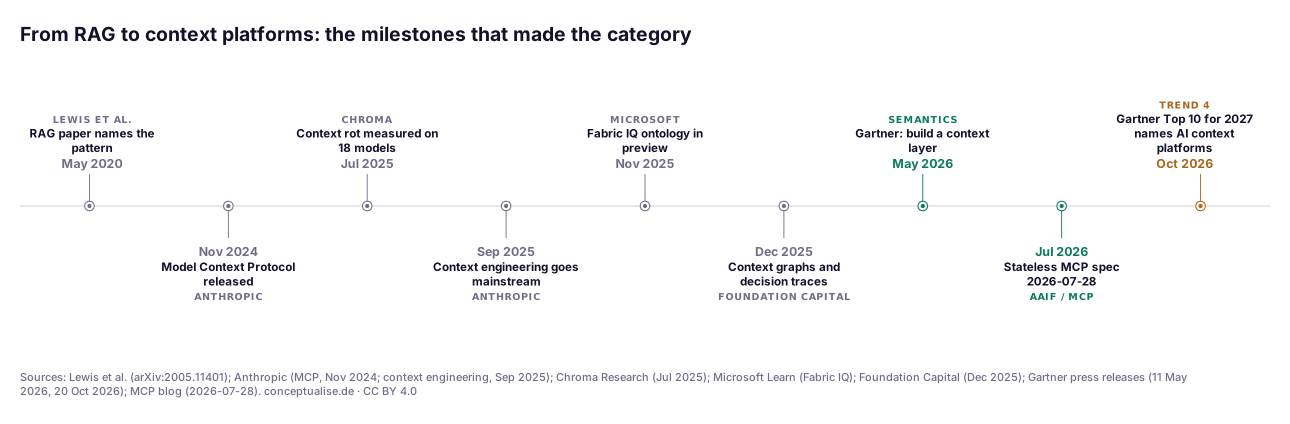
The retrieval technique is six years old. The idea that context needs engineering and governance took about fifteen months, from Chroma's report in July 2025 to Gartner's list in October 2026. That is a category being named while it is still being built, which is why we would not sign a five-year "context platform" contract today.
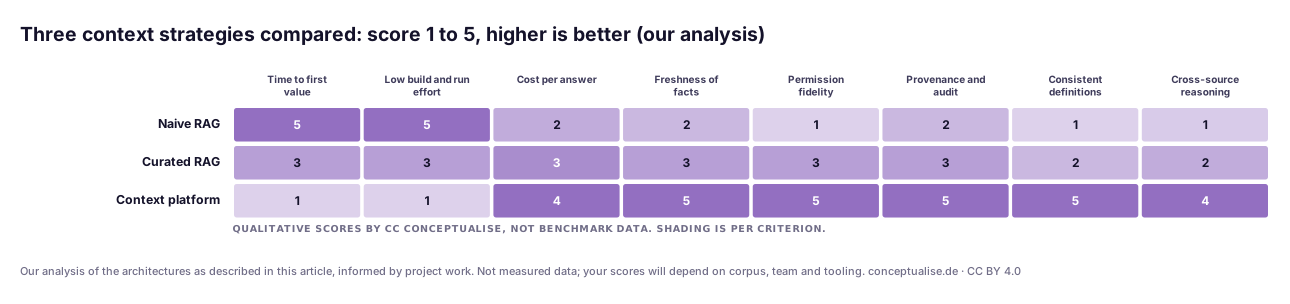
Three readings from the scorecard:
- A context platform loses on speed and effort, by design. For one team's Q&A over a few hundred stable documents, curated RAG is the right answer; a platform would be over-engineering.
- It wins on the criteria that block production. Permission fidelity, provenance and consistent definitions are what security and audit ask about before an agent may act, and where naive RAG scores worst.
- Cost per answer improves, but not for free. Fewer tokens per answer are paid for with build and run costs, so break-even depends on volume. That is why the adoption path starts with your highest-volume use case.
Gartner's "up to" figures are an upper bound, not a measured average, and not about any product. Use them to justify measuring your own baseline (accuracy on a fixed question set, tokens per answer, policy violations caught), not as the business case.
In a recent engagement…
Earlier this year we reviewed the agent roadmap of a European industrial group. They had three production RAG assistants and a fourth, an order-management agent, stuck in pre-production. The assistants worked; that was the problem. Each team had its own index and its own idea of an "open order". Sales counted orders awaiting credit release; service did not. Both matched their source documents.
The agent that was stuck needed to act on orders, not describe them. Security review had asked two questions nobody could answer: which data could the agent read on behalf of a regional sales manager, and how would anyone reconstruct, a month later, why it had changed a delivery date? The ingestion jobs for all three indexes ran under one service account with broad read rights.
We did not recommend a platform purchase. We recommended four changes, in order. Publish the finance team's existing semantic model for orders and customers as the single definition, behind an API. Replace the copied order data in the indexes with live lookups for status fields. Give each assistant and the agent its own workload identity, and pass the user's delegated token through to a policy check before retrieval. Log every served fact with its source and policy version. The manuals and process documents stayed in curated RAG, because they were the right fit.
The technical work was the smaller part. The longer conversation was about who decides what "open order" means. Once finance named an owner, the disputes between the three teams resolved in one meeting. That is the part nobody demos, and it is most of the work.
Decision guide: which context strategy, where
Use it per use case, not per company.
| Signal in your use case | Naive RAG | Curated RAG | Context platform |
|---|---|---|---|
| Read-only Q&A over stable documents | Prototype only | Yes | Overkill |
| Answers depend on metrics or KPIs | No | Risky | Yes |
| Facts change daily or faster | No | Risky | Yes, with live state |
| Agent writes, approves or sends something | No | No | Yes |
| Mixed audiences with different rights | No | With per-collection ACLs | Yes, per-request policy |
| Questions join several systems | No | Rarely works | Yes, via the graph |
| Regulated decision (credit, HR, health) | No | No | Yes, plus human oversight |
| One team, one small corpus | Fine for a pilot | Yes | No |
Build-versus-buy checklist for the platform itself:
- Own the definitions. Glossary, metrics and entity IDs live in your repository, in an open format, whatever tool renders them.
- Buy connectors and catalogue features. Crawling 40 SaaS systems is not a differentiator.
- Keep policy decisions in your identity stack. The policy decision point must understand your users, groups, agent identities and classifications. A vendor's own ACL model alone is not enough.
- Insist on MCP and plain APIs. Any context product you buy should serve through open interfaces, so you can swap it later.
- Demand provenance per fact. If a product cannot tell you the source, version and owner of each fact it served, it is a search engine.
- Check data residency and sub-processors. This is the most concentrated copy of your business knowledge you will ever create.
Governance for European enterprises
A context platform decides what agents see, which makes it the natural enforcement point for three European regimes.
GDPR. If the platform stores or serves personal data, and it will, Regulation (EU) 2016/679 applies directly. Three articles shape the design. Article 5(1)(b), purpose limitation, is why the policy layer takes a declared purpose as an input. Article 5(1)(c), data minimisation, is a legal argument for the token budget and per-request filtering: serve the fields the task needs, not the whole record. Article 25, data protection by design and by default, is the reason to build policy into the platform rather than leave it to each agent team. A bonus: for an Article 15 access request, the audit log shows which agents were served someone's data, and when.
EU AI Act. The AI Act regulates AI systems by risk, not context platforms as such. The high-risk obligations for Annex III use cases, including logging under Article 12, were deferred to 2 December 2027 by Regulation (EU) 2026/1744, in force since 27 July 2026. That is no reason to wait. If an agent will support a high-risk decision in credit or employment, the platform's provenance and serving logs are the evidence you will need, and far cheaper to build now than to reconstruct in late 2027. Article 10's data-governance duties target training, validation and testing data, but expect auditors to ask the same questions of retrieval context.
DORA. For financial entities, Regulation (EU) 2022/2554 has applied since 17 January 2025. A third-party context platform is an ICT third-party arrangement: it belongs in the register of information, with exit planning, and possibly in scope of critical or important functions.
A pragmatic adoption path
- Weeks 1–2: pick one high-volume agent use case and baseline it. Ideally one that already exists as a RAG assistant. Build a fixed question set with expected answers; record accuracy, tokens per answer and every permission question security has asked.
- Weeks 3–6: publish the semantic core. Take the 20 to 50 terms and metrics that use case depends on. Agree one definition each with a named owner, starting from existing BI models and master data. Store them as code; expose them via API and MCP. Best return per day of effort.
- Weeks 6–10: move volatile facts to live lookups. Replace copied operational fields in your indexes with request-time reads from the system of record, behind the same API. Keep stable documents in curated RAG. Our enterprise RAG pipeline guide still applies to that part.
- Weeks 8–12: put policy in the path. Give each agent its own workload identity, pass the user's delegated token through, and evaluate access per request before retrieval. Log every served fact with source, version and policy version. This is usually the step that unblocks security review.
- Quarter 2: close the loop and add a second use case. Route disputes to owners, feed incidents into evaluation and re-measure. Then onboard a different use case. If it reuses most of the semantic core, you have a platform. If not, you have two projects, and that is worth knowing early.
The verdict
AI context platforms are not a rebrand of RAG, and they are not a product you can buy whole in 2026. They are the recognition that once agents act, the questions that matter are no longer "can we find a relevant paragraph?" but "what does this term mean here, is this fact current, where did it come from, and is this agent allowed to see it on behalf of this person?" Gartner named the layer in October 2026; the engineering evidence had pointed there for over a year.
Our view is pragmatic. Keep curated RAG wherever the job is answering questions over stable documents. Build a context platform where agents act, where answers depend on metrics, or where several audiences share one corpus. And build it in the order that pays: semantics first, live state second, policy third, graph when cross-source questions demand it. The vendors will consolidate. Your definitions, your identities and your audit trail should outlast whichever one you choose.
If you want help deciding where a context platform pays off in your estate, our AI architecture team runs a short, fixed-scope assessment. It baselines one agent use case, maps your existing semantic assets, and leaves you with a build-and-buy plan for the layer.
FAQ
What is an AI context platform?
An AI context platform is the governed layer that gives AI agents the business knowledge they need to act correctly: what terms mean, the live state of the things they act on, where each fact came from, and what the requesting user and agent may see. Gartner listed AI context platforms among its Top 10 Strategic Technology Trends for 2027. It sits between your sources and your agents and serves context through an API or MCP server.
How is an AI context platform different from RAG?
RAG is a retrieval technique: find similar text chunks and paste them into the prompt. A context platform is a governed layer that RAG runs inside. It adds a semantic layer so terms mean one thing, a context graph with live operational state, a per-request policy check on user and agent identity, and provenance on every fact. Vector search becomes one retrieval method, not the architecture.
Do we need a knowledge graph to build a context platform?
Not on day one. A context graph can start as resolved entity IDs and a relationships table you already have. What you need from the start is one agreed meaning per business term and metric, and stable identifiers for the entities agents act on. Publishing existing BI semantic models usually gets you further than a graph-database project.
What did Gartner predict about semantics and AI agents?
On 11 May 2026 Gartner predicted that by 2027, organisations that prioritise semantics in AI-ready data will increase agentic AI accuracy by up to 80% and reduce costs by up to 60%, and advised establishing a context layer. These are forecasts with an upper bound, not measured averages. Use them as a reason to measure your own baseline.
Is MCP an AI context platform?
No. The Model Context Protocol is the delivery interface that lets agents call tools and read resources. A context platform decides what those return, for whom and with what provenance, and usually exposes one or more MCP servers. MCP without a governed layer behind it gives agents faster access to inconsistent data.
Which EU regulations apply to an AI context platform?
GDPR applies to the personal data it stores or serves, so purpose limitation, data minimisation and data protection by design shape the policy layer. The AI Act's Annex III high-risk obligations were deferred to 2 December 2027 by Regulation (EU) 2026/1744, but the platform's provenance and logs are the evidence they will need. Under DORA, an external context platform is an ICT third-party service.
Sources
All sources checked on 15 November 2026. Gartner's own pages block automated access, so for Gartner wording we also cite syndicated copies of the press releases; quotations were cross-checked across at least two of them.
Tier A: primary, standards and regulatory
- Gartner, "Gartner Identifies the Top Strategic Technology Trends for 2027" (press release, 20 Oct 2026): https://www.gartner.com/en/newsroom/press-releases/2026-10-20-gartner-identifies-the-top-strategic-technology-trends-for-2027
- Gartner, "Gartner Says Lack of Semantics Causes Inaccurate AI Agents and Wasted Spending" (press release, 11 May 2026): https://www.gartner.com/en/newsroom/press-releases/2026-05-11-gartner-says-lack-of-semantics-causes-inaccurate-artificial-intelligence-agents-and-wasted-spending
- Model Context Protocol, "The 2026-07-28 Specification" (release post): https://blog.modelcontextprotocol.io/posts/2026-07-28/
- Linux Foundation, formation of the Agentic AI Foundation (9 Dec 2025): https://www.linuxfoundation.org/press/linux-foundation-announces-the-formation-of-the-agentic-ai-foundation
- Anthropic, "Introducing the Model Context Protocol" (25 Nov 2024): https://www.anthropic.com/news/model-context-protocol
- Microsoft Learn, "What is Fabric IQ?": https://learn.microsoft.com/en-us/fabric/iq/overview
- Regulation (EU) 2016/679 (GDPR), Articles 5, 15 and 25: https://eur-lex.europa.eu/eli/reg/2016/679/oj/eng
- Regulation (EU) 2024/1689 (AI Act), Articles 10 and 12: https://eur-lex.europa.eu/eli/reg/2024/1689/oj/eng
- Regulation (EU) 2022/2554 (DORA): https://eur-lex.europa.eu/eli/reg/2022/2554/oj/eng
Tier B: research and analysis
- Lewis et al., "Retrieval-Augmented Generation for Knowledge-Intensive NLP Tasks" (arXiv:2005.11401, 2020): https://arxiv.org/abs/2005.11401
- Liu et al., "Lost in the Middle: How Language Models Use Long Contexts" (arXiv:2307.03172; TACL 2024): https://arxiv.org/abs/2307.03172
- Chroma Research, "Context Rot: How Increasing Input Tokens Impacts LLM Performance" (14 July 2025): https://www.trychroma.com/research/context-rot
- Anthropic Engineering, "Effective context engineering for AI agents" (29 Sep 2025): https://www.anthropic.com/engineering/effective-context-engineering-for-ai-agents
- Network World, summary of Gartner's 2027 trends, with the Alvarez quotations: https://www.networkworld.com/article/4238030/gartners-top-tech-trends-for-2027-expand-and-accelerate.html
- IT-Online, syndicated Gartner release on semantics, with the Sallam quotations (12 May 2026): https://it-online.co.za/2026/05/12/lack-of-semantics-causes-inaccurate-ai-agents-wasted-spending/
- TechEdgeAI, syndicated Gartner 2027 trends release (list of all ten trends): https://techedgeai.com/gartner-identifies-the-top-strategic-technology-trends-for-2027/
Tier C: vendor and opinion, directional
- Jaya Gupta and Ashu Garg (Foundation Capital), "AI's trillion-dollar opportunity: Context graphs" (Dec 2025): https://ashugarg.substack.com/p/ais-trillion-dollar-opportunity-context
- dbt Labs, "The OSI spec updates": https://www.getdbt.com/blog/the-osi-spec-updates
- Snowflake, "Open Semantic Interchange specs finalized": https://www.snowflake.com/en/blog/open-semantic-interchanges-specs-finalized/
- Apache Ossie, "Apache Ossie (Incubating): The New Name for Open Semantic Interchange" (10 Jul 2026): https://ossie.apache.org/updates/ossie-enters-apache-incubator/
- Be Informed, on Gartner's context components (semantics, operational state, provenance): https://www.beinformed.com/gartners-top-10-technology-trends-for-2027-why-context-matters-for-trusted-ai/
- Atlan, "AI context platform" explainer (vendor; cites Gartner sample-vendor listing): https://atlan.com/know/ai-agent/context-layer/ai-context-platform/
- VentureBeat, interview on Microsoft Fabric IQ ontology: https://venturebeat.com/data/microsofts-fabric-iq-teaches-ai-agents-to-understand-business-operations-not
Topics