GraphRAG vs RAG vs Agentic Retrieval: What Benchmarks Show
We compare GraphRAG, vector RAG and agentic retrieval across six published benchmarks, show where each wins, and share a harness to test on your own data.
On 24 April 2024, Microsoft Research published the GraphRAG paper. Its headline was hard to ignore: on corpus-wide "sensemaking" questions, answers built from an LLM-generated knowledge graph beat conventional vector RAG on comprehensiveness in 72–83% of head-to-head comparisons. Within months, every vector database, graph database and AI platform vendor had a GraphRAG story. By 2026, buyers were asking us a simpler question: should we rebuild our retrieval on a graph, or let an agent do the searching?
Eighteen months of independent benchmarks tell a more interesting story than the launch slides. Graph-based retrieval wins clearly on some question types and loses clearly on others. Agentic retrieval lifts accuracy on hard questions, but only as far as the search underneath allows. Some of the most-quoted win rates measure the judge as much as the system. This article is for the people who have to choose and fund a retrieval architecture: CTOs, heads of AI platform and enterprise architects. We synthesise the published evidence, cite every number, and give you a reproducible method to run the same comparison on your own documents. We do not publish numbers of our own here. Nobody should trust a consultancy's benchmark of its own preferred stack, including ours.
TL;DR / Key takeaways
- No architecture wins everywhere. Across GraphRAG-Bench and Han et al., tuned vector RAG matches or beats GraphRAG on single-hop fact questions. Graph methods win on multi-hop, temporal and corpus-wide summary questions.
- Question type predicts the winner better than vendor or library. On MultiHop-RAG temporal questions, GraphRAG local search scored 49.1% against 25.7% for vector RAG. On simple inference questions, vector RAG was ahead at 94.9% against 92.0%.
- Hybrids beat purists. Merging vector and graph retrieval reached 77.6% on MultiHop-RAG, against 71.2% for the best single method. Routing each question to one method reached 72.3%.
- Agentic retrieval amplifies the retriever, it does not replace it. In BrowseComp-Plus, GPT-5 scored 55.9% with BM25 and 70.1% with a strong embedding retriever, at roughly 22 search calls per question.
- Be sceptical of win rates. One evaluation study found an LLM judge giving identical systems a 90/10 split. Insist on ground-truth answers, swapped answer order and repeated trials before you fund a rebuild.

Download: Editable draw.io file · Open in diagrams.net · Chart data (CSV)
Why this decision matters now
Three things changed between the GraphRAG paper and today.
First, the tools matured and moved into platforms you already pay for. Microsoft's open-source graphrag library reached v3.3.0 on 8 October 2026. Amazon Bedrock Knowledge Bases has offered GraphRAG with Neptune Analytics as a generally available feature since 7 March 2025. Azure AI Search made agentic retrieval generally available through its 2026-04-01 REST API, and it now sits under Foundry IQ, Microsoft's managed knowledge layer for agents. The choice is now a configuration decision inside a platform, often made by whoever reads the product page first.
Second, the independent evidence arrived, and it is mixed. The GraphRAG-Bench authors start from a blunt reading of the earlier literature: studies report that "GraphRAG often fails to outperform vanilla RAG on many NLP tasks". Yet their own results, like others', show consistent graph advantages on reasoning and summarisation. Both are true, for different questions.
Third, evaluation itself became the weak point. Zeng et al. showed in 2025 that the standard LLM-as-a-judge protocol used in several GraphRAG papers handed one of two identical systems a 90% win rate. Once they corrected for position, length and trial bias, GraphRAG's gains were "much more moderate than reported previously". If your business case rests on a win-rate chart, check how that chart was produced.
Retrieval architecture is now a portfolio decision, made per question type, on your own measurements. Our earlier enterprise RAG pipeline guide covers the vector baseline in depth. This article is about when to go beyond it.
The three pipelines, side by side
The hero diagram puts all three approaches over the same corpus, the same question set and the same answer model. That is the only fair way to compare them, and it is how the benchmarks below were built. The numbered sections match the callouts.
① Vector RAG: chunks, embeddings and hybrid search
At index time, documents are split into chunks of a few hundred tokens, each chunk is embedded, and the vectors go into an index. In serious enterprise deployments that index is hybrid: vector similarity plus keyword (BM25) search, with access-control fields so results can be trimmed to what the user may see. At query time, the question is embedded, the top-k chunks are retrieved, a reranker reorders them, and the model answers from the chunks with citations.
Its strengths are boring and valuable: cheap indexing, incremental updates, low latency and easy debugging, because you can see exactly which chunks were retrieved. Its weakness is structural. Each chunk is retrieved on its own merits. If the answer needs facts from five documents that never mention each other, or a theme across a thousand tickets, top-k similarity cannot assemble it.
Two details matter more than most teams expect. Reranking is not optional: in GraphRAG-Bench it lifted vector RAG on seven of eight task columns. Retriever quality matters just as much, as the BrowseComp-Plus results below show.
② GraphRAG: an LLM-built knowledge graph plus community summaries
"GraphRAG" now covers a family of methods. Microsoft's reference implementation works like this. At index time, an LLM reads every chunk and extracts entities, relationships and, optionally, claims. These become a knowledge graph. A community-detection algorithm (Leiden, in the original paper) groups the graph into a hierarchy of communities, and the LLM writes a summary for each community at each level. At query time there are several modes:
- Local search starts from the entities that match the question, then pulls in their neighbours, relationships and source chunks. It suits questions about specific things and how they connect.
- Global search map-reduces over community summaries to answer corpus-wide questions such as "what are the main risk themes across these contracts?". It is the mode the original paper evaluated, and the expensive one.
- DRIFT search combines the two, and appears in the library's documentation alongside local and global search.
Other members of the family make different trade-offs. LightRAG retrieves over entity and relation keywords. HippoRAG 2 combines a graph of entities and passages with Personalized PageRank, and was published at ICML 2025. Microsoft's LazyGraphRAG defers almost all LLM work to query time, so indexing costs about the same as vector RAG. Note one naming trap: "Fast-GraphRAG" is the name of an open-source library evaluated in GraphRAG-Bench, while Microsoft also calls a cheaper NLP-based indexing method in its own library "FastGraphRAG". Check which one a paper means before you compare numbers.
The cost lives at index time. Microsoft's documentation estimates that graph extraction alone is roughly 75% of indexing cost, because a generative model reads the entire corpus. That has a data-protection consequence we come back to in the governance section.
③ Agentic retrieval: the model runs the search
Agentic retrieval does not build a new index. It treats the indexes you already have, whether vector, keyword, graph, SQL or web, as tools. A planner LLM breaks the question into subqueries, runs them in parallel against the right sources, reranks and merges the results, then decides whether the evidence is sufficient. If it is not, it plans again. The output is grounding data with citations and, in good implementations, an activity log showing which queries went where.
This is the approach behind "deep research" agents, and it is now a product feature. In Azure AI Search, a knowledge base orchestrates the pipeline over one or more knowledge sources. Microsoft's documentation is candid that it "adds latency compared to a single-query pipeline", and the billing model changes from per-query to per-token. The generally available 2026-04-01 API covers minimal, extractive retrieval. At minimal reasoning effort the LLM planning step is skipped. LLM query planning, answer synthesis and higher reasoning effort are in the 2026-08-01-preview API. In other words, the GA product today is mostly parallel multi-source retrieval. The fully agentic loop is still preview.
Agentic retrieval's strength is coverage of complex, multi-part questions without rebuilding anything. Its weaknesses are cost and latency that vary per question, and a new class of failure: the planner can search confidently in the wrong place. Our post on when RAG is not enough covers where agents fit in the wider knowledge-architecture decision.
④ The evaluation harness: our method
Benchmarks tell you what is possible, not what will happen on your contracts, tickets and policies. The fourth element in the diagram is the one we consider non-negotiable: a harness that runs every candidate against the same corpus, questions and answer model. This is the method we use, published so you can run it without us.
- Sample real questions. Take 200–400 questions from search logs, help-desk tickets or user interviews, not from an LLM brainstorming session. Synthetic questions are fine as a supplement, never as the base.
- Tag every question by type. Use five tags: single-hop fact, multi-hop, temporal, corpus-wide (summary or theme) and unanswerable. The benchmarks below show that the winner changes by type, so a single average hides the decision.
- Write reference answers as key claims. For each question, list the three to seven claims a correct answer must contain, with their source documents. Claim recall is more robust than judging whole answers.
- Fix everything except retrieval. Same corpus snapshot, same answer model and temperature, same prompt template, same token budget for context where possible.
- Measure five things. Claim recall and citation precision (does the cited passage support the claim?), cost per 1,000 questions including index amortisation, p95 latency, and freshness: how long after a document changes does the right answer appear?
- Judge fairly. Where you need a pairwise LLM judge, run both answer orders, at least three trials, and report ties separately. Spot-check 10% of judgements by hand.
- Test permissions. Ask questions whose answers sit in documents the test user may not see. Any leak is a failing grade, regardless of accuracy.
The harness itself is ordinary engineering. Our AI agent evaluation harness post covers golden datasets, tracing and CI gates. The loop looks like this:
What the benchmarks say
We selected benchmarks that compare at least two of the three approaches on shared data, and that publish their tables. All figures below are as published. None were run by us. The chart data file lists each value with its source.
| Benchmark | Who ran it | What it compares | Scoring | Main caveat |
|---|---|---|---|---|
| GraphRAG paper (Edge et al., 2024/2025) | Microsoft Research | GraphRAG global vs vector RAG, ~1M and ~1.7M-token corpora | LLM-judged pairwise win rates, plus claim counts | Authors' own method; corpus-wide questions only |
| RAG vs. GraphRAG (Han et al., 2025/2026) | Independent academic | Vector RAG, KG-GraphRAG, Microsoft GraphRAG local/global, hybrids | Accuracy and F1 against ground truth | Open models (Llama 3.1); public QA sets |
| GraphRAG-Bench (Xiang et al., 2025/2026) | Independent academic | Vector RAG and seven graph methods, novel and medical corpora | Accuracy by task type | One generator (GPT-4o-mini) |
| Unbiased GraphRAG evaluation (Zeng et al., 2025) | Independent academic | Microsoft GraphRAG, LightRAG, Fast-GraphRAG, naive RAG | Debiased pairwise judging | Focus is the evaluation method |
| BrowseComp-Plus (Chen et al., 2025) | Independent academic | Search agents × retrievers on a fixed 100,195-document corpus | Accuracy against ground truth, search calls | Web-style research questions, not enterprise documents |
| LazyGraphRAG / BenchmarkQED (2024–2025) | Microsoft Research | LazyGraphRAG vs vector RAG and GraphRAG | LLM-judged win rates | Vendor evaluating its own method |
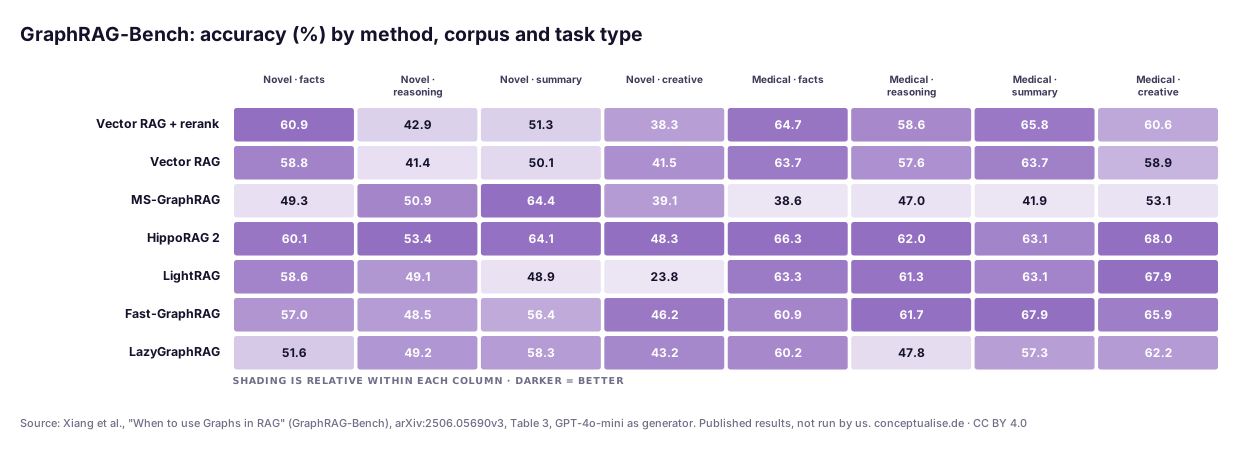
GraphRAG-Bench is the most useful single table for architects, because it splits results by task type. Read it by column, not by row. On fact retrieval, vector RAG with a reranker is at or near the top on both corpora: 60.9% on the novel corpus and 64.7% on the medical one. Microsoft's GraphRAG trails badly on medical facts at 38.6%. On complex reasoning and contextual summaries the picture flips. On the novel corpus, GraphRAG reaches 64.4% on summaries against 51.3% for vector RAG, and HippoRAG 2 leads reasoning at 53.4%. HippoRAG 2 is the most consistent graph method across the board. Its prompt is also close in size to vector RAG's, which matters for cost. The authors' prompt-length analysis shows Microsoft GraphRAG's global mode inflating prompts by orders of magnitude. We do not quote its absolute token figures, because the paper's text and tables disagree on them.
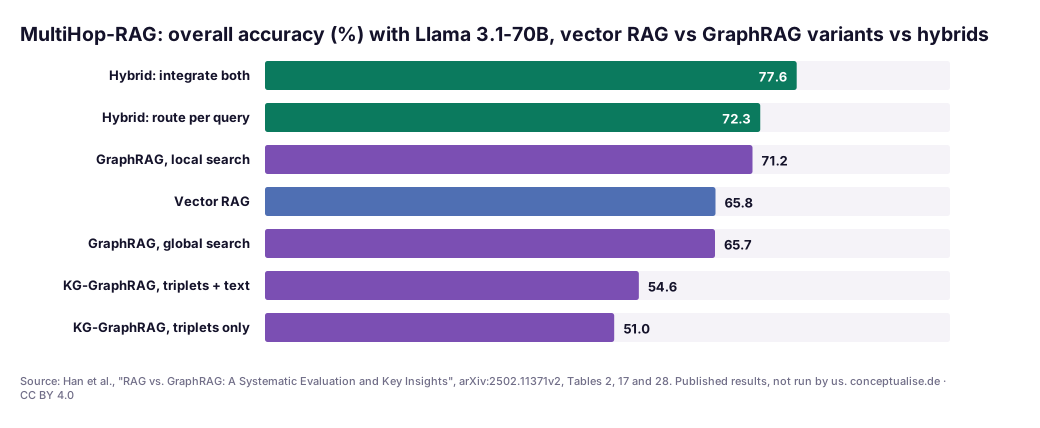
Han et al. ran the cleanest head-to-head on a multi-hop benchmark with ground-truth answers. Three findings stand out. First, Microsoft GraphRAG's local search beat vector RAG overall, 71.2% against 65.8%. Global search, the mode the original paper promoted, was level with vector RAG at 65.7%. Second, retrieving bare knowledge-graph triplets was much worse, at 51.0%. Adding the source text back helped, to 54.6%, but not enough. A graph that throws away the original text loses information. Third, the hybrids won. Routing each question to the better method reached 72.3%, and integrating both retrieval results reached 77.6%.
The breakdown by question type is the most decision-relevant number in this article. On temporal questions, GraphRAG local search scored 49.1% against vector RAG's 25.7%. On comparison questions it led 60.2% to 56.3%. On inference questions vector RAG led 94.9% to 92.0%, and on unanswerable ("null") questions 91.4% to 88.7%. On the general-knowledge QA sets the order reversed. On Natural Questions, vector RAG reached an F1 of 68.2 against 65.4 for GraphRAG local search, and on NovelQA 61.4% against 57.3% accuracy. If most of your traffic is lookup questions, a graph will not help.
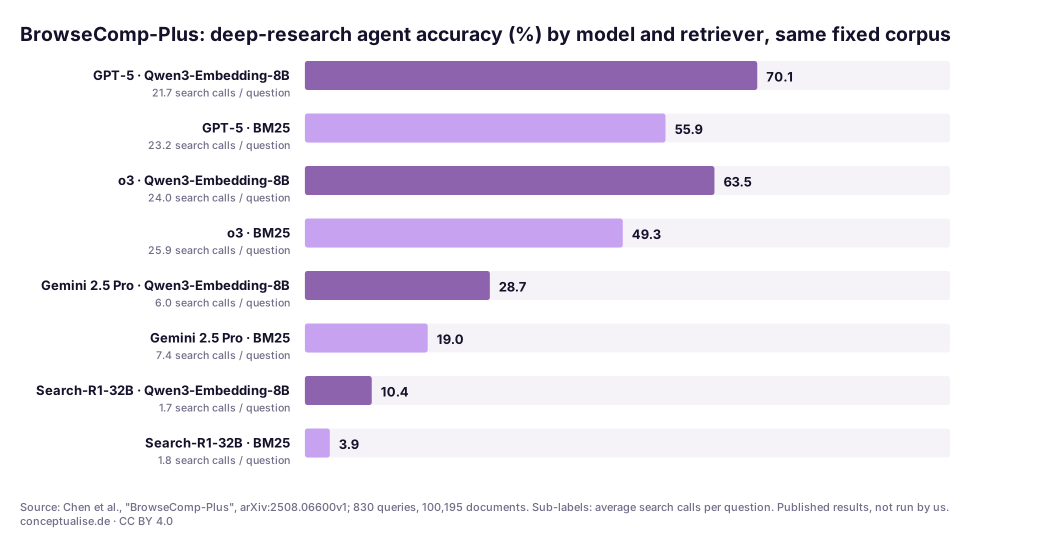
For agentic retrieval, BrowseComp-Plus is the best controlled evidence we found. It fixes the corpus at 100,195 documents and 830 hard research questions, so the model and the retriever can be varied independently. Two readings matter. The retriever matters enormously even with a strong agent. GPT-5 went from 55.9% with BM25 to 70.1% with the Qwen3-Embedding-8B retriever, and o3 from 49.3% to 63.5%. Agentic retrieval is a multiplier on your index, not a substitute for it. And the agentic loop is expensive. The two strongest agents issued about 22 to 26 search calls per question. Weaker agents searched less and scored far lower. Older evidence points the same way: IRCoT, which interleaves retrieval with chain-of-thought, improved retrieval by up to 21 points and QA by up to 15 points on four multi-hop datasets. On Google's FRAMES benchmark, a multi-step retrieval pipeline raised accuracy from 0.41 without retrieval to 0.66.
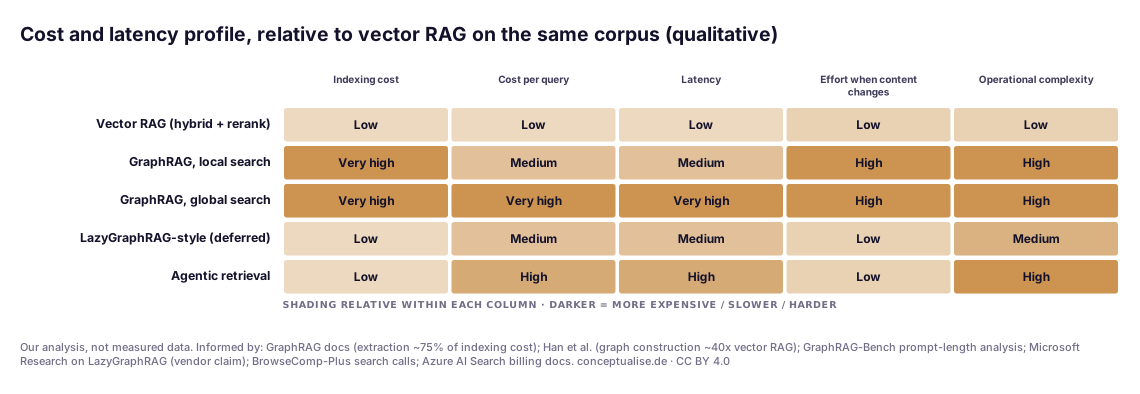
The last chart is our judgement, and it is labelled as such. It draws on the sources above. Graph extraction is about 75% of GraphRAG indexing cost. Han et al. report graph construction taking roughly 40 times as long as vector indexing on MultiHop-RAG. GraphRAG-Bench documents the prompt growth. Agents make many search calls. Microsoft claims LazyGraphRAG indexes at the cost of vector RAG, and matches GraphRAG global search quality at more than 700 times lower query cost. That last figure is a vendor measuring its own method. Microsoft's BenchmarkQED study, in which LazyGraphRAG won all 96 comparisons against competing conditions, including vector RAG with 8k and 120k context windows and GraphRAG's own search modes, has the same caveat. We consider the deferred-graph idea promising and the numbers unproven until someone else reproduces them.
Finally, the original GraphRAG win rates: 72–83% on comprehensiveness and 62–82% on diversity, judged by an LLM on corpus-wide questions. The same paper notes that vector RAG gave the most direct answers in every comparison. The results answer a narrow question, whether map-reduce over community summaries is more comprehensive than top-k chunks for "what are the themes?" questions, and the answer is yes. They do not show that GraphRAG is better retrieval in general.
In a recent engagement…
Earlier this year, a European industrial client asked us to evaluate a GraphRAG proof of concept. A vendor had built it over their engineering change documentation, and the demo had been impressive. Asked "which design changes across all product lines were driven by supplier quality issues?", it produced a structured, well-cited overview that the existing vector-based assistant could not match.
We ran the harness above on real questions from their engineering help desk, tagged by type. The pattern matched the benchmarks. Most questions were specific lookups: part numbers, approval status, "which document defines X?". Here the graph pipeline was no better than the existing hybrid search, and sometimes worse, because entity extraction had merged near-identical part names. A small share were genuinely corpus-wide or chronological, and there the graph was clearly better. But indexing the full corpus would have cost far more than the vector index, and every nightly batch of changes meant re-extraction.
The decision was a router, not a rebuild. Lookups stay on hybrid search with a reranker. Corpus-wide or chronological questions go to a graph built over a scoped subset: change notices and supplier reports, not every drawing. The most valuable deliverable turned out to be the tagged question set, which now runs in CI and catches regressions whenever someone changes chunking or prompts.
Decision table: which retrieval for which question
This is the screenshot-able part. Use it with your own tagged question mix, not instead of it.
| Your dominant question type | Default choice | Why (evidence) | Watch out for |
|---|---|---|---|
| Single-hop fact lookup ("what is the notice period in contract X?") | Hybrid vector RAG + reranker | Ties or wins on fact retrieval in GraphRAG-Bench and Han et al. | Chunking and metadata quality, not architecture |
| Multi-hop across documents ("which suppliers of part A also failed audit B?") | GraphRAG local search, or vector + graph hybrid | Local search 71.2% vs 65.8% on MultiHop-RAG; integration 77.6% | Entity resolution errors silently merge things |
| Temporal / chronological ("what changed after the 2025 policy update?") | Graph with dated entities, or agentic with date filters | 49.1% vs 25.7% on MultiHop-RAG temporal questions | Dates must be extracted and normalised at index time |
| Corpus-wide themes ("main risks across all audit reports") | GraphRAG global or a deferred-graph approach | Original GraphRAG comprehensiveness win rates; GraphRAG-Bench summary tasks | Query cost of global map-reduce; judge-based evidence only |
| Multi-part, open-ended research questions | Agentic retrieval over your best existing indexes | BrowseComp-Plus, IRCoT and FRAMES gains from iterative search | Latency, per-question cost variance, planner errors |
| Mixed traffic (most enterprises) | Router: classify the question, then dispatch | Han et al. selection and integration results | Router accuracy needs its own test set |
| Unanswerable or out-of-scope questions | Vector RAG with an abstain threshold | Vector RAG ahead on null questions (91.4% vs 88.7%) | Agents may keep searching instead of abstaining |
Two rules sit above the table. Never adopt a graph for a corpus you cannot afford to re-extract when it changes. And never adopt an agent without a per-question cost and step limit.
Governance for European enterprises
Retrieval architecture is not only an accuracy decision for EU organisations. Three regimes genuinely apply.
GDPR. GraphRAG changes your data-protection picture in a way vector RAG does not. At index time, a generative model reads the entire corpus and writes new artefacts: entity descriptions, relationship descriptions and community summaries. If the corpus contains personal data, those artefacts are new personal data derived from it, often combining facts about a person from many documents. Three questions follow. Is that processing covered by the original purpose and legal basis (Article 5(1)(b) and Article 6)? Can you honour access and erasure requests (Articles 15 and 17) when a person appears in extracted entities and community summaries? Does the extraction LLM run in a region and under a data processing agreement you have assessed? For HR, customer or health corpora, a data protection impact assessment under Article 35 is the sensible default. Vector RAG has the same issues in milder form, because chunks are easier to trace to a source document and delete.
Permissions and oversharing. Every pipeline must enforce the user's document permissions at query time, and graph summaries make this harder: one community summary can combine facts from documents with different access rights. Build separate graphs per permission boundary, or index only content everyone in scope may see. Agentic retrieval should call sources on behalf of the user, never with a broad service identity. The same oversharing failure that hits Copilot deployments applies here; see our Microsoft 365 Copilot oversharing playbook.
EU AI Act. For most internal knowledge assistants, the relevant obligations today are transparency and AI literacy. The Article 50 transparency obligations have applied since 2 August 2026, and users must know when they are interacting with an AI system. If a retrieval system feeds a use case listed in Annex III, for example employment decisions, the high-risk obligations now apply from 2 December 2027, following the deferral in Regulation (EU) 2026/1744. Either way, the activity logs and citations that a well-built pipeline produces are exactly the record-keeping evidence you will want. Agentic retrieval's activity log is a governance feature, not just a debugging aid.
A pragmatic adoption path
- Weeks 1–2: build the question set. Pull 200–400 real questions, tag them by type and write reference claims. This is the step most teams skip and the one that decides everything else.
- Weeks 3–4: fix the baseline. Make sure your vector RAG is actually good: hybrid search, a reranker, sensible chunking, metadata filters and permission trimming. Many "GraphRAG wins" are really wins over a weak baseline.
- Weeks 5–6: run the bake-off. Run the baseline, one graph method and one agentic configuration through the harness on the same corpus snapshot, with a scoped corpus for the graph to bound indexing cost. Report results per question type, with cost and p95 latency.
- Weeks 7–8: decide the routing. Most enterprises end with a router: vector RAG by default, graph for the question types where it measurably wins, agentic retrieval for multi-part questions, each with step and cost limits. Write down the thresholds.
- Ongoing: keep the harness in CI. Re-run it on every change to chunking, models, prompts or graph schema, and retire whatever stops earning its cost. For where this is heading architecturally, see our piece on AI context platforms after RAG.
The verdict
GraphRAG is not a better RAG. It is a different tool that is very good at some questions. The independent evidence is consistent once you split it by question type. Graphs help when answers depend on connections, chronology or corpus-wide themes. They add cost and noise for lookups. Agentic retrieval helps when questions are multi-part and open-ended, and its accuracy is capped by the quality of the indexes it searches.
Our position is blunt. Do not migrate to a graph because of a win-rate chart. First make your hybrid vector baseline excellent. Then measure your own question mix by type. Add a graph only where it wins on your data and you can afford to re-extract when the corpus changes. Add agents where questions are genuinely multi-step, with hard limits. The winners will not have the most sophisticated pipeline. They will be able to show, per question type, why each pipeline is there.
If you want help running this comparison on your own corpus, our AI architecture team runs the harness described here as a fixed-scope assessment. You keep the tagged question set, the results by question type and a routing recommendation you can defend to your CFO and your data protection officer.
FAQ
Is GraphRAG better than vector RAG?
Not in general. Independent benchmarks published in 2025 and 2026 show that a well-tuned vector RAG pipeline matches or beats GraphRAG on single-hop fact questions, while graph-based methods win on multi-hop, temporal and corpus-wide summary questions. In GraphRAG-Bench, vector RAG with reranking scored 60.9% on fact retrieval over a novel corpus against 49.3% for Microsoft's GraphRAG, but GraphRAG led on contextual summaries with 64.4% against 51.3%. The right answer depends on the questions your users actually ask.
When does GraphRAG actually beat vector RAG?
When an answer depends on connecting facts spread across many documents, on ordering events in time, or on summarising themes across a whole corpus. On MultiHop-RAG with Llama 3.1-70B, Han et al. measured 49.1% accuracy for GraphRAG local search on temporal questions against 25.7% for vector RAG, and 71.2% against 65.8% overall. For simple lookups the extra graph context mostly adds noise and tokens.
What is agentic retrieval, and how is it different from agentic RAG?
Agentic retrieval puts a language model in charge of the search itself: it plans subqueries, chooses sources, runs searches in parallel, checks whether the evidence is sufficient and repeats if not. Agentic RAG is the broader pattern in which an agent uses retrieval as one of its tools. Microsoft's Azure AI Search offers agentic retrieval as a product feature. The generally available 2026-04-01 API covers minimal, extractive retrieval, while LLM query planning and answer synthesis remain in preview.
How much more does GraphRAG cost than vector RAG?
Indexing is the big difference. Microsoft's GraphRAG documentation estimates that LLM graph extraction alone is roughly 75% of indexing cost, and Han et al. report graph construction taking about 40 times as long as building a vector index on MultiHop-RAG. Query cost depends on the search mode. Local search adds moderate context, while global search map-reduces over community summaries and can be very expensive. Deferred approaches such as LazyGraphRAG claim indexing costs equal to vector RAG, but that is a vendor claim to verify on your data.
Can we trust LLM-as-a-judge win rates in GraphRAG benchmarks?
Treat them with care. Zeng et al. compared two identical LightRAG instances under a common evaluation protocol and got a 90% versus 10% win rate, caused by length bias, position bias and single-trial judging. After correcting for this, they found GraphRAG gains much more moderate than previously reported. Prefer benchmarks with ground-truth answers. When you must use a judge, swap answer order, run several trials and report ties.
How should we evaluate retrieval approaches on our own documents?
Build a question set from your real traffic, tag each question by type (fact, multi-hop, temporal, corpus-wide, unanswerable), and write reference answers or key claims. Run every pipeline against the same corpus, answer model and questions. Measure claim recall, citation precision, cost per 1,000 questions, p95 latency, and how quickly a changed document shows up in answers. Use position-swapped judging with at least three trials, and break results down by question type, not just one average.
Sources
All sources checked on 15 November 2026. Benchmark figures are reproduced as published; we did not re-run any of them.
Tier A: primary papers, official documentation and regulation
- Edge et al., "From Local to Global: A GraphRAG Approach to Query-Focused Summarization", arXiv:2404.16130 (v1 April 2024, v2 February 2025): https://arxiv.org/abs/2404.16130
- Han et al., "RAG vs. GraphRAG: A Systematic Evaluation and Key Insights", arXiv:2502.11371 (v2 used for tables; v3 March 2026): https://arxiv.org/abs/2502.11371
- Xiang et al., "When to use Graphs in RAG: A Comprehensive Analysis for Graph Retrieval-Augmented Generation" (GraphRAG-Bench), ICLR 2026, arXiv:2506.05690 (v3 February 2026): https://arxiv.org/abs/2506.05690
- Zeng et al., "How Significant Are the Real Performance Gains? An Unbiased Evaluation Framework for GraphRAG", arXiv:2506.06331: https://arxiv.org/abs/2506.06331
- Chen et al., "BrowseComp-Plus: A More Fair and Transparent Evaluation Benchmark of Deep-Research Agent", arXiv:2508.06600: https://arxiv.org/abs/2508.06600
- Trivedi et al., "Interleaving Retrieval with Chain-of-Thought Reasoning for Knowledge-Intensive Multi-Step Questions" (IRCoT), ACL 2023, arXiv:2212.10509: https://arxiv.org/abs/2212.10509
- Krishna et al., "Fact, Fetch, and Reason: A Unified Evaluation of Retrieval-Augmented Generation" (FRAMES), arXiv:2409.12941: https://arxiv.org/abs/2409.12941
- Gutiérrez et al., "From RAG to Memory: Non-Parametric Continual Learning for Large Language Models" (HippoRAG 2), ICML 2025, arXiv:2502.14802: https://arxiv.org/abs/2502.14802
- Microsoft GraphRAG documentation, indexing methods: https://microsoft.github.io/graphrag/index/methods/
- Microsoft GraphRAG releases (v3.3.0, 8 October 2026): https://github.com/microsoft/graphrag/releases
- Microsoft Learn, Agentic retrieval overview, Azure AI Search (updated September 2026): https://learn.microsoft.com/en-us/azure/search/agentic-retrieval-overview
- AWS, "Amazon Bedrock Knowledge Bases supports GraphRAG now generally available" (7 March 2025): https://aws.amazon.com/about-aws/whats-new/2025/03/amazon-bedrock-knowledge-bases-graphrag-generally-available
- Regulation (EU) 2016/679 (GDPR), Articles 5, 6, 15, 17 and 35: https://eur-lex.europa.eu/eli/reg/2016/679/oj/eng
- Regulation (EU) 2024/1689 (AI Act), Article 50 and Annex III: https://eur-lex.europa.eu/eli/reg/2024/1689/oj/eng
Tier B: benchmark resources and research analysis
- GraphRAG-Bench repository: https://github.com/GraphRAG-Bench/GraphRAG-Benchmark
- MultiHop-RAG benchmark (Tang and Yang, 2024), arXiv:2401.15391: https://arxiv.org/abs/2401.15391
Tier C: vendor research, directional
- Microsoft Research, "LazyGraphRAG: Setting a new standard for quality and cost" (25 November 2024, editor's note June 2025): https://www.microsoft.com/en-us/research/blog/lazygraphrag-setting-a-new-standard-for-quality-and-cost/
- Microsoft Research, "BenchmarkQED: Automated benchmarking of RAG systems" (5 June 2025): https://www.microsoft.com/en-us/research/blog/benchmarkqed-automated-benchmarking-of-rag-systems/
Topics