Azure Network Security Architecture for 2027
Reference architecture for Azure network security in 2027: private subnets, explicit egress, Azure Firewall, private endpoints, DNS, hub-spoke vs vWAN.
On 31 March 2026, Azure quietly changed what a new virtual network means. For network API versions released after that date, subnets in new virtual networks are private: virtual machines no longer get a Microsoft-owned public IP for outbound access unless you build an explicit path. Microsoft had first set the retirement of "default outbound access" for 30 September 2025, the day Basic public IPs and the Basic Load Balancer reached end of life. Together, these changes break Terraform modules and landing zones that silently relied on internet access, as soon as they deploy with a newer API version.
This article is for the people who own the redesign: CTOs, CISOs and cloud architects, mostly in DACH organisations with regulated workloads on Azure. It is our reference architecture for 2027: one diagram, seven building blocks, a cost model built from Microsoft's price list and a hub-and-spoke versus Virtual WAN decision table, checked against Microsoft documentation on 15 November 2026.
TL;DR / Key takeaways
- Private by default is now the platform's position: new VNets get private subnets, existing ones keep default outbound access until you change them. Fix the old estate deliberately instead of waiting for a surprise.
- One inspection point, explicit egress: route 0.0.0.0/0 from every spoke to Azure Firewall in the hub, and give the firewall a NAT gateway (StandardV2, zone-redundant) for stable IPs and SNAT scale.
- DNS is the control plane: centralise privatelink zones, the DNS Private Resolver and DNS resolver policy. Most private endpoint outages we see are DNS, not routing.
- Hub-spoke or vWAN is a scale question, not a security one: per inspected gigabyte they cost the same at list price (about USD 0.056); vWAN adds a USD 182.50 monthly hub fee and buys managed transit for many regions and branches.
- Guardrails beat diagrams: AVNM security admin rules evaluated before NSGs, Azure Policy that denies public IPs and non-private subnets, and VNet flow logs before NSG flow logs retire on 30 September 2027.

Download: Editable draw.io file · Open in diagrams.net · Chart data (CSV)
Why this matters now
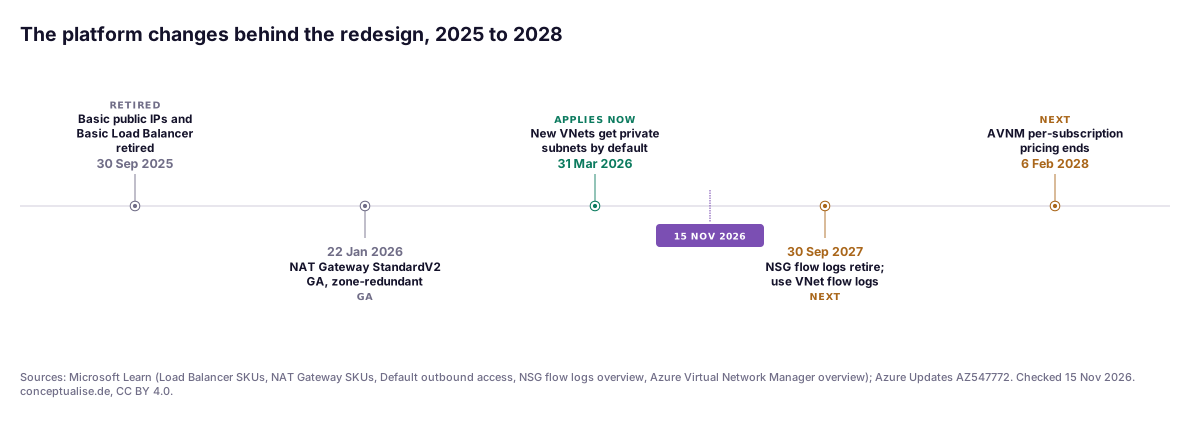
Four platform changes since September 2025 have turned "we should tidy up the network" into scheduled work.
- Default outbound access is gone for new networks. For API versions released after 31 March 2026,
defaultOutboundAccessisfalseby default for subnets in new virtual networks. Microsoft's reasoning is blunt: default internet access "contradicts Zero Trust principles", and the IP isn't yours and can change. - Basic SKUs are retired. Basic public IPs and the Basic Load Balancer were retired on 30 September 2025.
- The explicit egress building block got better. NAT Gateway StandardV2 became generally available on 22 January 2026: zone-redundant by default, up to 100 Gbps, IPv6 and flow logs, at the same price as Standard.
- Telemetry is moving. NSG flow logs retire on 30 September 2027 and no longer accept new configurations; VNet flow logs are the replacement.
Regulation points the same way. For financial entities, DORA's ICT risk management standard (Delegated Regulation (EU) 2024/1774, Article 13) asks for segmentation by criticality, a map of all network connections and data flows, a dedicated administration network and regular firewall rule reviews. That reads like a specification for the diagram above.
The reference architecture, block by block
The numbers match the callouts in the figure. We show a hub VNet; where Virtual WAN differs, we say so.
① Private subnets and explicit egress
Make every workload subnet private, including those in existing VNets. Microsoft lists four explicit outbound methods: a NAT gateway, Standard load balancer outbound rules, an instance-level public IP, or a firewall or NVA reached through a user-defined route (UDR). In our design, spokes send 0.0.0.0/0 to the firewall, and the firewall subnet carries a NAT gateway.
Why a NAT gateway behind the firewall? Azure Firewall gives 2,496 SNAT ports per public IP per backend instance; a NAT gateway gives 64,512 per public IP, allocated dynamically, with up to 16 IPs. Partners also get one stable prefix to allow-list. Use StandardV2 with a zone-redundant firewall, because the Standard SKU is zonal.
Two traps from Microsoft's own documentation:
- Changing a subnet from non-private to private only takes effect on existing VMs after stop and deallocate.
- In private subnets, UDRs with next hop
Internetbreak, including the common pattern of routing service tags around the firewall.
In a secured vWAN hub, NAT gateway is not supported inside the hub. Egress uses the firewall's public IPs, or you attach NAT gateways in the spokes for traffic you decide not to inspect.
② One inspection point: Azure Firewall in the hub
Every flow that crosses a trust boundary passes one policy: spoke to spoke, to on-premises, to the internet and to shared private endpoints. In a hub VNet you build this with UDRs. In Virtual WAN, routing intent does it declaratively: an internet policy advertises 0.0.0.0/0 to all connections, a private policy sends branch, VNet and inter-hub traffic through the firewall. Microsoft calls it "the only mechanism in Virtual WAN to enable inter-hub traffic inspection".
Pick the SKU by what you will actually use:
| Basic | Standard | Premium | |
|---|---|---|---|
| Throughput | up to 250 Mbps | up to 30 Gbps | up to 100 Gbps |
| FQDN filtering in network rules, DNS proxy | No | Yes | Yes |
| Web categories | No | Yes | Yes |
| Threat-intelligence filtering | Alert only | Alert and deny | Alert and deny |
| Outbound TLS inspection, IDPS, full-path URL filtering | No | No | Yes |
| List price, deployment hour / GB processed | USD 0.395 / 0.065 | USD 1.25 / 0.016 | USD 1.75 / 0.016 |
Manage rules as one policy hierarchy in code: a parent policy owned by security and child policies per landing-zone archetype. Draft & Deploy, generally available since March 2026, lets you batch changes in a draft and deploy them together.
③ DNS is the control plane
Private endpoints only work if every client resolves *.privatelink.* to the private IP. The pattern that holds up:
- Private DNS zones for every privatelink namespace you use, created once in the connectivity subscription and linked to the hub (or DNS spoke). A DeployIfNotExists Azure Policy can register the A record whenever a private endpoint is created, so application teams never touch DNS.
- DNS Private Resolver with an inbound endpoint for on-premises forwarders and an outbound endpoint with rulesets for on-premises zones. With vWAN it lives in a spoke, not the managed hub.
- Firewall DNS proxy if you use FQDNs in network rules; otherwise firewall and client may resolve differently. The proxy only sees private DNS zones through its upstream, so point it at the resolver.
- DNS resolver policy (launched as DNS security policy, generally available since July 2025) filters and logs queries per VNet and can block known-malicious domains from Microsoft's threat-intelligence feed.
One subtle option: fallback to internet (resolutionPolicy: NxDomainRedirect) retries public resolution when a privatelink name has no private record. It fixes cross-tenant Private Link access, but a missing record then no longer fails loudly. Enable it per link and on purpose.
④ Private PaaS: private endpoints and the Network Security Perimeter
Disable public network access on PaaS services and reach them through private endpoints in a shared-services spoke. Two settings matter:
- Network policies for private endpoints are disabled by default on a subnet. Enable them so NSGs apply, and so UDRs can steer traffic through the firewall. A UDR has to be equal to or more specific than the VNet address space to override the /32 route a private endpoint injects; a 0.0.0.0/0 route won't do it.
- One endpoint per service, owned centrally, not one per team per service. Each endpoint costs USD 0.01 an hour (about USD 7.30 a month) plus USD 0.01 per GB in each direction at list price. That is cheap per endpoint and expensive as sprawl.
For PaaS-to-PaaS traffic that never touches a VNet, use the Network Security Perimeter. Microsoft Learn lists it as generally available for Storage, Key Vault, AI Search, Event Hubs and Service Bus, among others, while SQL Database and Cosmos DB are still in preview. Microsoft advises against putting storage accounts that use Azure Backup into a perimeter.
⑤ Guardrails at scale
A reference architecture survives contact with 40 application teams only if the platform enforces it.
- AVNM security admin rules apply at the VNet level, are evaluated before NSGs, and can Allow, Deny or Always Allow. Deny the high-risk ports Microsoft lists (22, 3389, 445 and others); Always Allow the platform's monitoring paths so no NSG can break them. By default the rules skip VNets with SQL Managed Instance or Databricks, and subnets holding firewalls, gateways or Bastion.
- Azure Policy denies public IPs on NICs, requires
defaultOutboundAccess = falseon subnets and deploys private DNS records automatically. - IP address management through AVNM's IPAM keeps address space non-overlapping across regions and on-premises.
AVNM costs USD 0.02 per managed VNet per hour (about USD 14.60 a month) at list price. Instances on the old per-subscription model switch automatically after 6 February 2028.
⑥ Inbound and administrative access
Inbound traffic enters through Front Door or Application Gateway with WAF, never through a VM's public IP. Admin access takes a separate path through Azure Bastion from managed workstations, behind Entra ID and PIM, which also evidences DORA's "separate and dedicated network for the administration of ICT assets". DDoS Network Protection suits internet-facing estates, but the plan alone is about USD 2,944 a month at list price.
⑦ Telemetry
Firewall structured logs, VNet flow logs and DNS resolver policy logs go to Log Analytics and Microsoft Sentinel. Migrate NSG flow logs now: they retire on 30 September 2027, after which Microsoft deletes the flow log resources (not the stored records). VNet flow logs also cover what NSG flow logs never did, such as the v6 VM sizes.
Hub-and-spoke or Virtual WAN?
Microsoft's Cloud Adoption Framework gives the criteria, and we agree:
| Situation | Our default | Why |
|---|---|---|
| One or a few regions without full mesh, fewer than 30 IPsec tunnels | Hub-and-spoke (customer-managed) | Full routing control, NAT gateway behind the firewall, no hub fee |
| Several regions needing global mesh, SD-WAN or more than 30 branch sites | Virtual WAN with secured hubs | Managed transit, routing intent, inter-hub inspection |
| VPN-to-ExpressRoute transit required | Virtual WAN | Native transitive routing |
| Third-party NGFW mandated | Either; check vendor support | Routing intent accepts only certain NVAs as next hop |
What the numbers say
We built a cost model from the public Azure Retail Prices API (West Europe or global meters, USD list prices, queried 15 November 2026, 730 hours a month). It excludes gateways, DDoS, AVNM and internet bandwidth, which don't change with the topology. What matters is which line items move when the design changes.
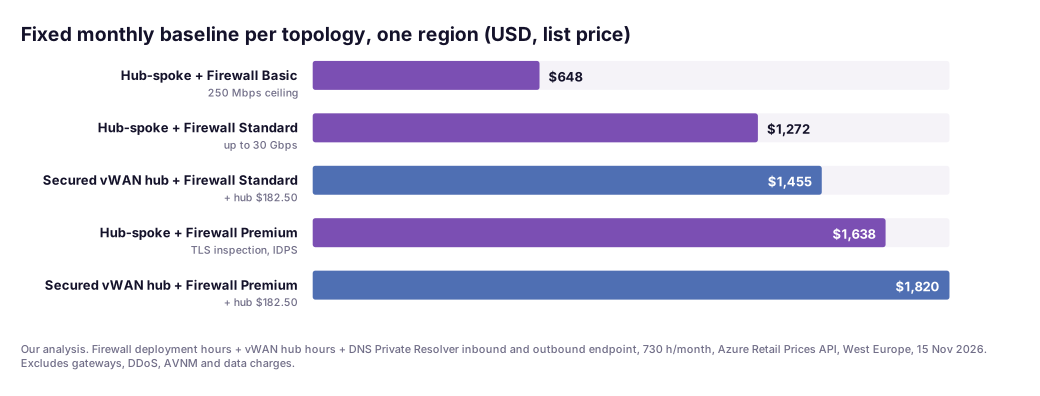
Firewall deployment hours dominate the fixed baseline. Premium costs about USD 365 a month more than Standard; a secured vWAN hub adds USD 182.50. The two DNS Private Resolver endpoints (USD 180 each a month) are often missing from business cases.
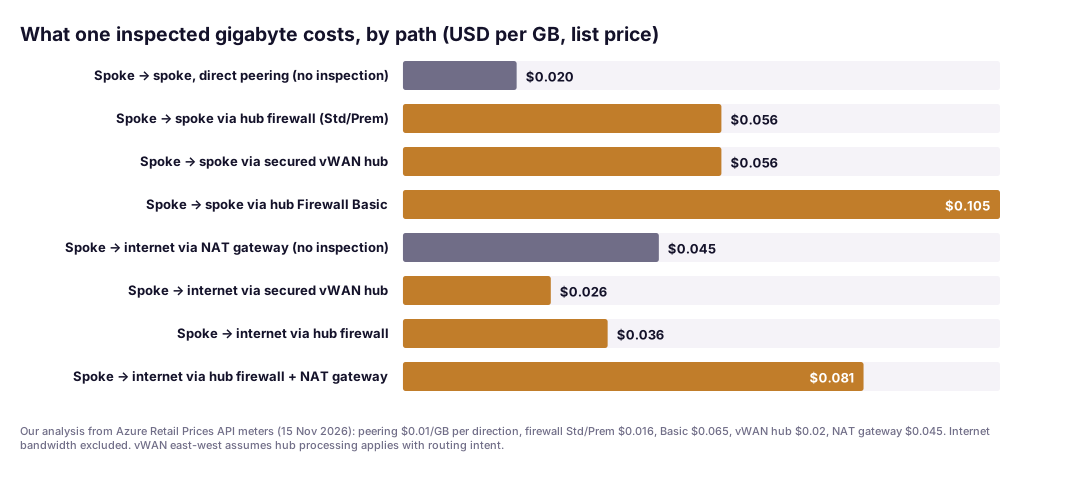
Per gigabyte, the picture is less obvious:
- Spoke-to-spoke through the hub costs about USD 0.056/GB in both topologies. In a hub VNet you pay peering four times (out of the spoke, into the hub, out of the hub, into the other spoke) plus USD 0.016 firewall processing. In vWAN you pay peering twice, plus USD 0.02 hub processing, plus the firewall. We assume the hub router charge also applies when routing intent sends the flow to the firewall; Microsoft's pricing examples don't show that case explicitly.
- Firewall Basic is cheap to own and expensive to use: USD 0.065/GB processed makes inspected east-west traffic nearly twice as expensive as with Standard.
- Adding a NAT gateway behind the firewall more than doubles the per-GB cost of inspected internet egress (USD 0.081 against 0.036), because NAT gateway charges USD 0.045/GB. That is the price of stable IPs and SNAT headroom.
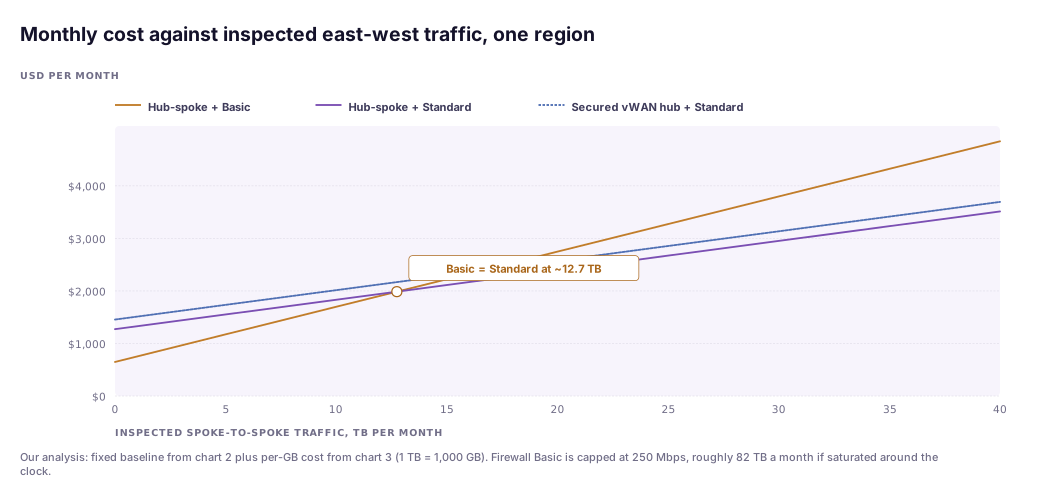
The break-even is a useful number for small estates: at about 12.7 TB of inspected spoke-to-spoke traffic a month, Firewall Standard becomes cheaper than Basic. Basic's 250 Mbps ceiling (about 82 TB a month if saturated around the clock) is rarely what forces the upgrade. Cost and the missing DNS proxy usually do first.
In a recent engagement
In a recent engagement with a DACH financial services group, the first sign of the new default was not a security finding but a failed build. Their Terraform modules used a current provider, so new spoke VNets came up with private subnets. The first VMs could not activate Windows or reach package mirrors, because the spoke route tables still had the old "service tags via next hop Internet" exceptions, which do not work in private subnets. The older VNets, meanwhile, still had default outbound access, so the same module behaved differently by subscription age.
The fix needed no heroics. We made every subnet private on purpose, with a change window for the stop-and-deallocate step, moved egress to the firewall with a StandardV2 NAT gateway behind it, and replaced the bypasses with explicit firewall rules. The bigger win was DORA evidence: for the first time, the team could show every egress path and who approved each rule.
The checklist
- Inventory
defaultOutboundAccessper subnet and the NICs flagged by Azure Advisor's "add explicit outbound method" recommendation. - Remove UDRs with next hop
Internetfrom subnets you make private. - Make subnets private; schedule stop/deallocate for existing VMs.
- Deploy Azure Firewall with one policy hierarchy in code; choose the SKU by TLS inspection and IDPS needs.
- Attach a StandardV2 NAT gateway to the firewall subnet for stable IPs and SNAT scale.
- Centralise privatelink zones, the DNS Private Resolver and DNS resolver policy; automate A records.
- Disable public network access on PaaS; enable private endpoint network policies; use the Network Security Perimeter where GA.
- Enforce AVNM security admin rules and Azure Policy denies for public IPs and non-private subnets.
- Move to VNet flow logs before 30 September 2027; send firewall and DNS logs to Sentinel.
- Review firewall rules at least every six months for critical functions, the architecture yearly.
Governance for European enterprises
- DORA (financial entities): Delegated Regulation (EU) 2024/1774, Article 13, asks for segmentation by criticality, documentation of all connections and data flows, a dedicated administration network, encrypted connections, firewall rule reviews at least every six months for critical or important functions, and an annual architecture review. Blocks ①, ②, ⑤ and ⑥ map to it directly. Our DORA implementation guide for Azure covers the rest of the framework.
- NIS2 (essential and important entities): Article 21(2) requires risk-based technical measures including network and information system security, transposed in Germany as § 30 BSIG. A documented, enforced egress and segmentation model is the most auditable evidence you can produce; see our NIS2 risk management measures on Azure.
- Data sovereignty: private endpoints keep PaaS traffic off public endpoints, but they are not a data-residency control.
A pragmatic adoption path
- Weeks 1–2: discover. Export subnets, route tables, public IPs and private DNS zones with Azure Resource Graph; flag default outbound access and duplicate privatelink zones.
- Weeks 3–4: decide. Choose hub-and-spoke or vWAN with the table above, the firewall SKU and the DNS design. Write them down as landing-zone decisions, as in our Azure landing zone checklist.
- Weeks 5–8: build the platform as code: hub, firewall policy, NAT gateway, resolver, DNS zones, AVNM and policies. Test with one non-production spoke.
- Weeks 9–14: migrate spokes in waves. Make subnets private, move egress, stop and deallocate, verify with flow and firewall logs. Regulated and internet-facing workloads first.
- Ongoing: operate. Run six-monthly rule reviews, measure blocked egress attempts, and feed findings into attack-path analysis, as described in our piece on cloud attack paths from misconfigurations.
The verdict
Microsoft retired a behaviour that was never secure and never under your control. The redesign it forces is the one most estates needed anyway: private subnets, one inspection point, DNS treated as infrastructure, PaaS reachable only privately. Pick hub-and-spoke unless your scale justifies Virtual WAN; per inspected gigabyte they cost about the same at list price. Buy Premium only where you will run TLS inspection. Spend the effort on guardrails, because an architecture that isn't enforced decays within a year.
If you want a second opinion on your target network design, or help migrating a live estate to private subnets without an outage, our cloud architecture practice does exactly this with European enterprises. Where the network is part of a wider Zero Trust programme, our Zero Trust and cybersecurity team connects it to identity and detection.
FAQ
What changed with default outbound access in Azure?
Microsoft first planned to retire default outbound access on 30 September 2025, then moved the change to 31 March 2026. With network API versions released after that date, subnets in new virtual networks are private by default (defaultOutboundAccess = false), so VMs need an explicit outbound method such as a NAT gateway, a firewall reached through a user-defined route, load balancer outbound rules or an instance public IP. Existing virtual networks are not changed until you make their subnets private.
Should we choose hub-and-spoke or Virtual WAN in 2027?
Microsoft's Cloud Adoption Framework points to Virtual WAN when you need global connectivity across several regions and many on-premises sites, SD-WAN or more than 30 branch sites with native IPsec termination, or transit between VPN and ExpressRoute. A customer-managed hub-and-spoke fits when you have one or a few regions without a full mesh, fewer than 30 IPsec tunnels and want full control over routing. On list prices the per-gigabyte cost of inspected spoke-to-spoke traffic is about the same; the secured vWAN hub adds a fixed hub fee of about USD 182.50 per month.
Do we need Azure Firewall Premium or is Standard enough?
Standard covers L3 to L7 filtering, threat intelligence, web categories and DNS proxy at up to 30 Gbps. Premium adds outbound TLS inspection, fully managed IDPS and full-path URL filtering at up to 100 Gbps. At list price Premium costs USD 1.75 per deployment hour against USD 1.25, about USD 365 more per month per firewall, with the same USD 0.016 per GB processed. Buy Premium where you will actually run TLS inspection and IDPS, typically in regulated estates.
How should DNS work with private endpoints?
Centralise it. Keep the privatelink.* private DNS zones in the connectivity subscription, link them to the virtual network that hosts the DNS Private Resolver, point spoke virtual networks at the resolver's inbound endpoint or the firewall's DNS proxy, and forward on-premises queries for privatelink zones to the inbound endpoint. Use the private DNS zone fallback to internet only for cross-tenant Private Link cases you understand.
What does a secured Azure network hub cost per month?
On list prices queried from the Azure Retail Prices API on 15 November 2026, the fixed baseline for one region is about USD 648 a month with Firewall Basic, USD 1,272 with Standard and USD 1,638 with Premium in a hub VNet, including two DNS Private Resolver endpoints. A secured vWAN hub adds USD 182.50. Data charges come on top: about USD 0.056 per inspected spoke-to-spoke gigabyte.
Is a NAT gateway enough without a firewall?
A NAT gateway gives you explicit, predictable egress with stable public IPs and scalable SNAT, which is what default outbound access never did. It does not filter by FQDN, inspect TLS or log application rules. For dev and sandbox subnets a NAT gateway plus NSGs can be enough; for production estates under DORA or NIS2 you want egress through a firewall policy, ideally with a NAT gateway behind it for SNAT scale.
Sources
Checked on 15 November 2026. Prices are list prices and change; always confirm in the Azure pricing calculator for your region and agreement.
Tier A: primary and regulatory
- Microsoft Learn: Default outbound access in Azure
- Microsoft Learn: Azure NAT Gateway SKUs and Azure Updates AZ547772 (StandardV2 GA, 22 January 2026)
- Microsoft Learn: Scale SNAT ports with Azure NAT Gateway (Azure Firewall integration)
- Microsoft Learn: Choose the right Azure Firewall SKU
- Microsoft Learn: Azure Firewall DNS settings
- Microsoft Learn: Virtual WAN routing intent and routing policies
- Microsoft Learn: About Virtual WAN pricing
- Microsoft Learn: Define an Azure network topology (Cloud Adoption Framework)
- Microsoft Learn: Manage network policies for private endpoints
- Microsoft Learn: Fallback to internet for Azure Private DNS zones
- Microsoft Learn: DNS resolver policy (formerly DNS security policy)
- Microsoft Learn: Network security perimeter concepts
- Microsoft Learn: Security admin rules in Azure Virtual Network Manager and What is Azure Virtual Network Manager? (pricing model)
- Microsoft Learn: NSG flow logs overview (retirement 30 September 2027)
- Microsoft Learn: Azure Load Balancer SKUs (Basic retired 30 September 2025)
- Azure Retail Prices API, queried 15 November 2026 (all prices in the charts)
- Commission Delegated Regulation (EU) 2024/1774 (DORA RTS on ICT risk management), Article 13
- Directive (EU) 2022/2555 (NIS2), Article 21; § 30 BSIG
Tier B: analysis and reporting
Tier C: vendor and directional
Topics