Cloud Exit Plans That Work: A Tested DORA Runbook
DORA Art. 28(8) demands tested exit plans for critical ICT services. A five-workstream cloud exit runbook, Data Act switching rules and exit testing.
Since 17 January 2025, every EU financial entity has needed an exit strategy for each ICT service supporting a critical or important function. Article 28(8) of the Digital Operational Resilience Act (DORA) asks for exit plans that are "comprehensive, documented" and "sufficiently tested". Yet the register of information that supervisors collect asks one question about them: does an exit plan exist, yes or no?
In our experience, that gap is where many exit plans live: tick-box documents written for the register, not runbooks anyone has executed. This article is for the people who will be asked to prove otherwise: CIOs, CISOs, cloud architects and third-party risk owners at banks, insurers and asset managers, with a DACH lens. We set out a five-workstream runbook, the Data Act switching clock behind it, and a test design that produces evidence. It reflects the legal texts as of 15 November 2026 and is not legal advice.
TL;DR / Key takeaways
- The obligation is specific: DORA Art. 28(8) and Delegated Regulation (EU) 2024/1773 Art. 10 require a documented, tested, realistic and feasible exit plan per critical contract.
- Paper plans fail on five workstreams: contracts, data, identity, network, applications. The hard dependencies usually sit in identity and DNS.
- The Data Act is on your side: notice ≤ 2 months, a 30-day transition (up to seven months), ≥ 30 days to retrieve data, and no switching charges from 12 January 2027.
- Exit effort varies by workload, not provider: VMs are routine; serverless, proprietary analytics and SaaS suites with their own identity platform are redesigns.
- Test at three levels: tabletop, data restore and a live exit of one representative workload. Only the last proves feasibility.

Download: Editable draw.io file · Open in diagrams.net · Chart data (CSV)
Why this matters now
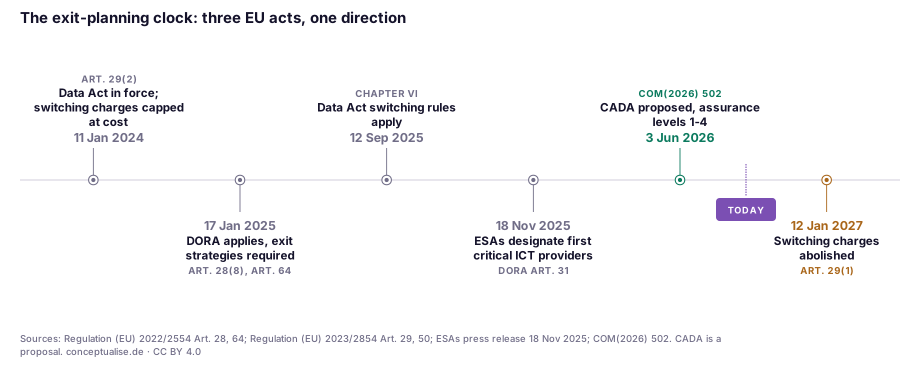
Three changes make a paper exit plan hard to defend.
- Supervisors now hold the data. Under Implementing Regulation (EU) 2024/2956, the register of information records for each critical ICT service whether an exit plan exists, how substitutable the provider is, how hard reintegration would be, and whether alternatives have been identified. "Exit plan: yes" next to "not substitutable, no alternative identified" is a supervisory finding you wrote yourself.
- The big clouds are under direct oversight. On 18 November 2025 the European Supervisory Authorities (ESAs) published the first list of designated critical ICT third-party providers. Law firm TLT counts 19, including AWS, Google Cloud and Microsoft. Oversight of the provider does not shift your duty: Article 28(1)(a) keeps the financial entity "at all times" fully responsible for compliance.
- Leaving got cheaper and more defined. The Data Act's switching chapter has applied since 12 September 2025, and Article 29 abolishes switching charges from 12 January 2027. The old excuse that egress fees make exit uneconomic is expiring.
For ECB-supervised banks the bar is higher. According to Jones Day's summary of the ECB cloud outsourcing guide of 16 July 2025, exit strategies should exist before go-live, be tested periodically, show realistic costs and be independently reviewed. For the wider DORA picture, our DORA implementation guide for Azure covers the other four pillars.
What the law actually requires
The texts are more concrete than most exit plans we review.
| Source | Requirement | What it means in practice |
|---|---|---|
| DORA Art. 28(7) | Contracts must be terminable for significant breach, risk-relevant changes, evidenced ICT risk weaknesses, or if supervision is impeded | Your trigger list. Each one needs a named decision owner |
| DORA Art. 28(8) | Exit without disruption or client detriment; plans comprehensive, documented, tested, reviewed; alternatives and transition plans identified | The runbook, plus evidence it works |
| DORA Art. 29 | Assess concentration risk, including providers that are "not easily substitutable" | Feeds workload tiering and the alternative-provider list |
| DORA Art. 30(3)(f) | Contracts must include a mandatory adequate transition period during which the provider keeps delivering | Time to run the runbook, written into the contract |
| RTS (EU) 2024/1773 Art. 10 | An exit plan per contract, reviewed and tested; covers interruptions, failed delivery, unexpected termination; "realistic, feasible, based on plausible scenarios and reasonable assumptions" | The quality test a supervisor will apply |
| Data Act Art. 25 | Provider must support your exit; statutory notice, transition, retrieval and erasure terms | Floor for contract and timeline (chart below) |
Two details are often missed. Article 10 of the RTS names three scenarios, and a friendly, planned migration is none of them: your plan must work when the provider is failing. And Article 28(8) accepts reincorporating the service in-house, so "alternative solution" need not mean a second hyperscaler. Our article on when cloud repatriation makes sense covers the in-house option.
The runbook: five workstreams, one plan
The numbers match the callouts in the figure. All five workstreams share the same phases, which is the point of the swimlane: data cannot cut over before identity and DNS are ready.
① Contracts
The contract sets your clock. Check for the Article 28(7) termination grounds, the Article 30(3)(f) transition period, provider exit assistance and the Data Act Article 25 terms: notice, transition, an exhaustive list of exportable data, retrieval window and erasure. At trigger, a named person with authority invokes termination or submits the switching request. At close-out, get written confirmation of the switch and, later, of erasure.
② Data
Exit-ready means an inventory of exportable data, open formats, and a current copy of critical data outside the provider, not in another region of the same one. At trigger, freeze schema changes and start the bulk export; during transition, keep the target in sync with change data capture. Cut-over is a final delta plus reconciled row counts and checksums. Until the charge ban applies, ask for an exit waiver: AWS (via support) and Google Cloud both publish one. Our ransomware-resilient backup design is a good starting point for that independent copy.
③ Identity and keys
Paper plans break here first. If identity, break-glass accounts and key management live with the provider you are leaving, the exit depends on the system you are exiting. Keep identity and emergency access independent, and prefer keys you can export or hold externally. During transition, re-issue secrets, certificates and workload identities in the target; federation makes this far easier, see workload identity federation without secrets. At close-out, revoke old trust relationships and destroy provider-held keys.
④ Network and DNS
Own your DNS zones, registrar account and IP plan outside the provider. Otherwise cut-over depends on the departing provider's control plane on the worst possible day. Build the target landing zone at trigger, sync over a private interconnect, then cut over DNS with low TTLs and an open rollback window.
⑤ Applications
Tier workloads by exit effort (see the chart below) and choose a path per tier: rehost, replatform, replace or retire. Keep infrastructure as code that can target the alternative platform; "we could rewrite it" is not a transition plan. Rebuild, run in parallel, then shift traffic tier by tier while watching SLOs. Close-out means decommissioning the source and updating the register.
⑥ The exit test
Article 28(8) says "sufficiently tested", and Article 10 of the RTS asks for periodic testing of each plan. We test at three levels:
- Tabletop, yearly: walk the full runbook with the real owners, legal and procurement included, using an RTS scenario such as unexpected termination.
- Data restore, at least yearly: restore critical data from the independent copy into a second environment and reconcile it.
- Live exit of one representative workload: move it end to end to the alternative platform and time every step.
Only the live exit proves feasibility. Pick a workload that shares the identity, network and data patterns of the critical ones, not the easiest one.
What the numbers say
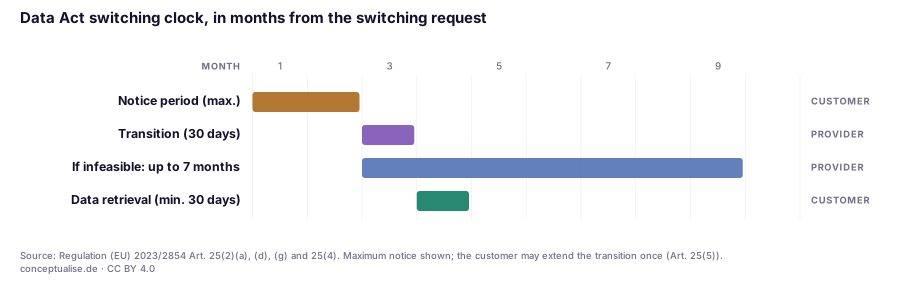
The Data Act sets a statutory floor: notice of at most two months, then up to 30 days of transition with the contract in force and the provider obliged to assist. If that is technically unfeasible, the provider must say so within 14 working days and may extend to seven months at most. Retrieval gets at least 30 days. These are rights, not migration estimates; a complex critical function may need a longer DORA transition period. Negotiate it.
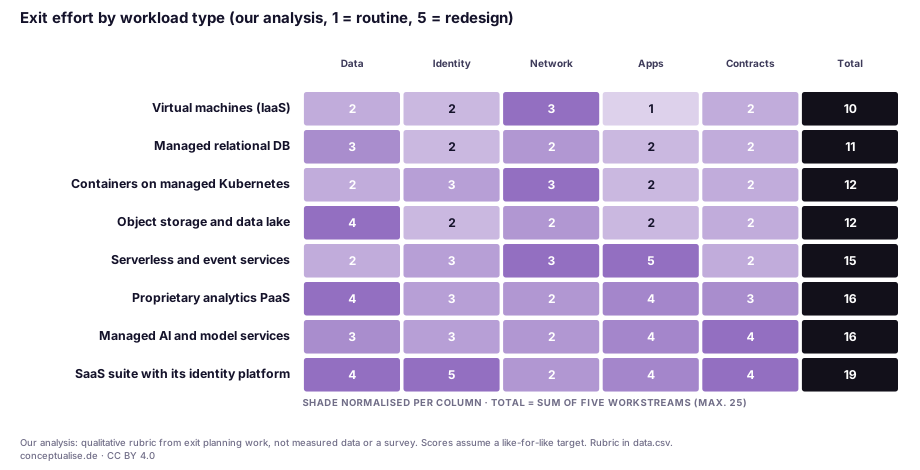
The heat grid is our analysis, not measured data: eight workload types scored from 1 (routine) to 5 (redesign) per workstream, assuming a like-for-like target. The rubric is in the CSV.
- IaaS is the easy part. Virtual machines and standard-engine databases score lowest, and the Data Act obliges infrastructure providers to help you reach "functional equivalence" (Art. 30(1)).
- Serverless and proprietary analytics are application rewrites. The data moves; code bound to provider-specific triggers and query engines does not.
- SaaS suites with their own identity platform are the hardest exit. The identity workstream becomes a redesign, yet most plans we see give it one line.
In a recent engagement
In a recent engagement with a DACH financial services firm, we reviewed the exit plan for a critical customer platform on a hyperscaler. It was tidy: alternative provider, migration estimate, sign-off. The register said "exit plan: yes".
A half-day tabletop with the real owners found four blockers. The public DNS zones were hosted by the provider being exited. The break-glass accounts lived in its identity service. The "independent" backup sat in a second region of the same tenant. And the contract had no explicit transition period, so the timeline rested on goodwill. None of it was expensive to fix; nobody who would do the work had ever walked through it.
Exit readiness checklist
| # | Check | Evidence a supervisor can see |
|---|---|---|
| 1 | Every critical ICT service has its own exit plan | Plan per contract, linked from the register |
| 2 | Termination rights and a transition period in the contract | Clause references (Art. 28(7), 30(3)(f)) |
| 3 | Data Act switching terms present | Notice, transition, retrieval, erasure clauses |
| 4 | Critical data copy held outside the provider | Last restore test report |
| 5 | Identity and break-glass independent of the provider | Architecture record, access test |
| 6 | DNS, registrar and IP plan owned outside the provider | Zone and registrar ownership |
| 7 | Workloads tiered by exit effort, path per tier | Scored inventory |
| 8 | Alternative or in-house option identified per service | Register field B_07.01.0110 |
| 9 | Exit tested: tabletop, restore, live workload | Test reports with timings |
| 10 | Results reported to the management body | Minutes, remediation backlog |
Governance for European enterprises
DORA binds financial entities, supervised by the national competent authority (BaFin in Germany), with the ECB's cloud guide on top for significant euro-area banks. Exit plans must match what the register of information says.
The Data Act binds providers serving EU customers, regulated or not, and gives you leverage when renegotiating. The Commission's "Digital Omnibus" proposal of November 2025 would relax switching duties for contracts concluded before 12 September 2025, for services largely adapted to one customer and for smaller non-IaaS providers. According to law-firm summaries, the Article 29 charge rules still apply. It is still in the legislative process.
The Cloud and AI Development Act (CADA), proposed on 3 June 2026 as COM(2026) 502, would introduce four Union assurance levels for cloud services. It is still a proposal aimed mainly at public procurement, but the levels will likely shape how you choose an alternative provider. Our CADA explainer covers the levels in detail.
Pragmatic adoption path
- Weeks 1–2: scope. List services supporting critical or important functions and reconcile them with the register, including substitutability and reintegration.
- Weeks 3–4: contracts. Gap-check against DORA Articles 28(7) and 30(3)(f) and Data Act Article 25; renegotiate missing clauses.
- Weeks 5–8: exit-ready architecture. Fix identity, DNS and the independent data copy first. They block every workload.
- Weeks 9–10: tier and plan. Score workloads and write one runbook per tier, not per application.
- Quarter 2 onwards: test. Tabletop, restore, then a live exit of one representative workload. Report to the management body; repeat yearly.
The verdict
A DORA exit plan is not hard to write. It is hard to make true. The paper version names an alternative and a timeline. The working version knows where DNS, identity and keys live, has a contract that buys time, and has moved at least one real workload. With switching charges gone from January 2027 and supervisors holding substitutability data for every critical service, "we have a plan" will soon be followed by "show us the last test".
If you want a senior second pair of eyes on your exit plans, from contract gaps to a live exit test, our cloud architecture practice designs and pressure-tests exactly this with European financial institutions.
FAQ
Does DORA require an exit plan for every cloud service?
Article 28(8) requires exit strategies for ICT services supporting critical or important functions. Delegated Regulation (EU) 2024/1773 then requires the policy for those services to demand a documented exit plan for each contractual arrangement, with periodic review and testing. Other services still need termination rights under Article 30(2).
What does a DORA exit plan have to contain?
It must be comprehensive, documented, sufficiently tested and reviewed periodically (Art. 28(8)). It must identify alternative solutions and transition plans to move services and data to another provider or back in-house. Under Article 10 of Delegated Regulation 2024/1773 it must also be realistic, feasible, based on plausible scenarios and have a schedule compatible with the contract's exit terms.
How do you test a cloud exit plan without actually leaving?
Combine three levels: a yearly tabletop of the whole runbook with the real owners, a technical restore of critical data into a second environment, and a live exit of one representative workload. Record what broke and how long each step took, and update the plan.
What does the EU Data Act change for cloud exit?
Since 12 September 2025, cloud contracts must allow switching with a notice period of at most two months, a transition of up to 30 days (extendable to seven months where technically unfeasible) and at least 30 days for data retrieval. From 12 January 2027, providers may not charge switching fees at all; until then charges are capped at cost.
If our cloud provider is a designated critical ICT third-party provider, do we still need an exit plan?
Yes. The ESAs designated the first critical ICT third-party providers on 18 November 2025, which brings those providers under EU oversight. Article 28(1)(a) of DORA still keeps each financial entity fully responsible for its own compliance, including exit strategies.
How does the proposed Cloud and AI Development Act affect exit planning?
The CADA, proposed by the Commission on 3 June 2026 as COM(2026) 502, would introduce four Union assurance levels for cloud services, used mainly by public sector bodies. It is still a proposal, but a target provider's assurance level may become a criterion when choosing your alternative.
Sources
Checked on 15 November 2026. This article is not legal advice.
Tier A: primary and regulatory
- Regulation (EU) 2022/2554 (DORA), EUR-Lex: Art. 4, 28(1), 28(7), 28(8), 29, 30(2)–(3), 31, 64
- Commission Delegated Regulation (EU) 2024/1773 (RTS on the policy for ICT services supporting critical or important functions), Art. 10
- Commission Implementing Regulation (EU) 2024/2956 (ITS on the register of information), template B_07.01
- Regulation (EU) 2023/2854 (Data Act), EUR-Lex: Art. 23, 25, 29, 30, 31, 50
- ESMA: European Supervisory Authorities designate critical ICT third-party providers (18 November 2025)
- European Commission: Cloud and AI Development Act policy page and proposal COM(2026) 502
Tier B: analysis and reporting
- Jones Day: New ECB Guide on Outsourcing Cloud Services to Cloud Service Providers (November 2025)
- TLT: EU regulators designate critical ICT third-party providers under DORA
- Bird & Bird: Digital Omnibus, what's new on switching under the EU Data Act (2026)
- Greenberg Traurig: EU Digital Omnibus package proposes amendments to Data Act (July 2026)
Tier C: vendor and directional
- AWS: Free data transfer out to internet when moving out of AWS (5 March 2024, updated)
- Google Cloud: Eliminating data transfer fees when migrating off Google Cloud (12 January 2024)
- Exit effort scores (chart 3): our analysis, qualitative rubric, not measured data
Topics