Cloud and AI Development Act (CADA): An Architect's Guide
The EU Cloud and AI Development Act proposal explained: four Union assurance levels, who must buy what, and where Council and Parliament stand now.
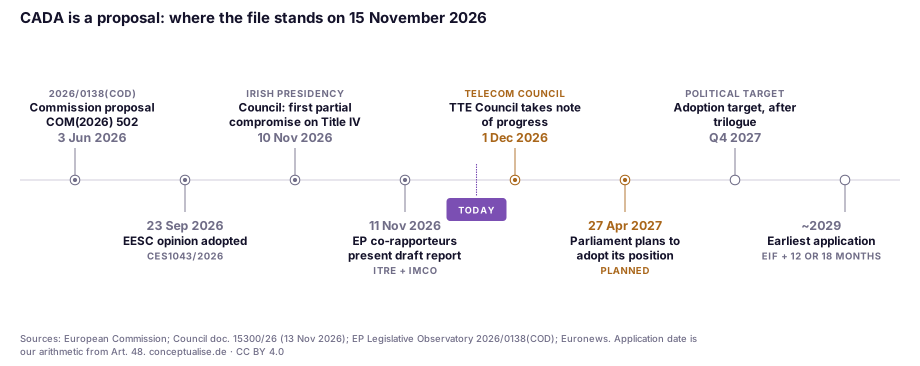
On 3 June 2026 the European Commission proposed the Cloud and AI Development Act (CADA), COM(2026) 502. Most headlines covered the data-centre ambition: triple EU capacity within five to seven years. For architects, the part that matters is Title IV. It defines four "Union assurance levels" for cloud services and tells public buyers which level they may use for which activity. Last week both co-legislators moved: the Council's Irish Presidency tabled a first compromise on that title on 10 November, and Parliament's two co-rapporteurs presented their joint draft report on 11 November.
This explainer is for the people who will turn those levels into landing zones, contracts and exit plans: CTOs, enterprise and cloud architects, public-sector IT leaders and the providers who sell to them, with a DACH lens. It is not legal advice. And it describes a proposal. Contrary to some coverage, CADA is not in trilogue yet. Every criterion below can still change, and the Council text already changes several.
TL;DR / Key takeaways
- Four cumulative levels: Level 1 is self-assessed EU residency, including metadata and telemetry. Levels 2–4 need an independent audit and national recognition, and add EU personnel, certification, SBOMs and, from Level 3, a ban on third-country control.
- Public buyers are bound, private firms mostly are not: Level 1 becomes the floor for public-sector cloud; activities that protect public order in NIS2 sectors, justice, law enforcement and similar areas need Level 2, 3 or 4, decided by a risk assessment.
- Keys are not a criterion of their own: cryptographic material counts as an "asset" that must sit in the EU, and encrypted data is still customer data. Key custody becomes evidence, not a level.
- US-controlled clouds top out at Level 2, unless the Commission names the US an "associated third country". Level 4 has no exception.
- Timeline: Parliament plans its position for 27 April 2027, the adoption target is Q4 2027, and the rules would apply 12 months later (18 in the Council text). Realistically, around 2029.

Download: Editable draw.io file · Open in diagrams.net · Chart data (CSV)
Why this matters now
The Commission's explanatory memorandum is blunt about the starting point. The market share of EU cloud providers in Europe fell from 29% in 2017 to 15% in 2022 and has stayed there since, and "three non-EU hyperscalers control over 70% of the European cloud market". Both figures come from Synergy Research Group, whose July 2025 update put the European market at EUR 61 billion in 2024.
Three developments turned that concern into an architecture problem for 2027 budgets.
- The Commission already buys this way. In April 2026 it awarded its own sovereign cloud tender, worth up to EUR 180 million over six years, using its Cloud Sovereignty Framework. Bidders needed at least SEAL-2. STACKIT, Scaleway and a Post Telecom consortium with OVHcloud and Clever Cloud reached SEAL-3; a Proximus consortium with S3NS, Clarence and Mistral reached SEAL-2.
- The legislative text exists and is moving. The Council's progress report of 13 November 2026 (doc. 15300/26) shows the Irish Presidency has finished a first read-through, rewritten the recognition procedure and is due to table compromise text on the data-centre pillars on 24 November.
- Hyperscalers have already built for it. AWS opened its European Sovereign Cloud in Brandenburg in January 2026, operated, AWS says, exclusively by EU residents. CADA is the first EU law that would test such claims against audited criteria.
What CADA contains, in one paragraph
Title II creates Cloud and AI Leadership Initiatives, national strategies and frontier-AI projects. Title III speeds up data centres through "acceleration zones" with an aggregated baseline permit and a 12-month permit limit (Art. 13(5)). Title IV, "Autonomy", holds the sovereignty framework (Art. 16–28), procurement rules (Art. 29–33), a voluntary EuroCloud Federation (Art. 34) and an "open source first" push (Art. 41–44). Your architecture decisions sit in Title IV, so that is what the rest of this article covers.
The four Union assurance levels, domain by domain
Article 16 sets four levels that providers "shall meet in order to provide their cloud computing services to Union entities and public sector bodies". "Cloud computing service" takes the NIS2 definition, so on our reading it covers IaaS, PaaS and SaaS, including model APIs. The levels are cumulative: under Article 20(1), failing any lower-level criterion rules out the higher ones. Hardware is explicitly out of scope; software is in.
The numbers below match the callouts in the figure.
① Jurisdiction and control
- Level 1: the provider is established in the EU. Third-country control is allowed, but such a provider must guarantee that its home country has no law requiring it to report software vulnerabilities to the state before they are known to be exploited (Annex II 1.1(g)). We read that as aimed at mandatory pre-disclosure regimes such as China's 2021 vulnerability rules.
- Level 2: provider and subcontractors are EU-established. Third-country control is still possible if the provider proves the foreign controller cannot restrict the service, access customer data, disrupt it or impose foreign sanctions (2.1(g)), and that any non-EU subsidiary is effectively separated (2.1(k)).
- Level 3: no third-country control, with one exception. Under Article 18 the Commission can name "associated third countries" whose providers may be audited for Level 3. The six conditions include a GDPR adequacy decision, no powers to compel data access that conflict with Article 32 of the Data Act, no powers to force service disruption or sanctions compliance, an open market and reciprocal access to public cloud procurement.
- Level 4: no third-country control at all, for provider and subcontractors.
Annex III makes the auditor walk the whole cap table: every holder of 5% of capital or votes, veto and appointment rights, and commercial or financial links that confer comparable influence. So the claim of a partnership model, such as a European operator running a hyperscaler's technology, is decided by the operator's ownership documents, not the region's marketing name.
One drafting detail shows how early this text is: Annex II 3.1(g) refers to an implementing act "under Article 19", but associated third countries are in Article 18. Expect the cross-references to move.
② Data, assets and keys
From Level 1, customer data including metadata and telemetry must remain exclusively in the EU "at any time, including before, during or after the configuration or use of the service". At Levels 1 to 3 the public buyer can explicitly waive this. Infrastructure and "assets" of the provider and its relevant subcontractors must also be in the EU (1.1(b), 2.1(b)).
Levels 2 to 4 add that data generated by using the service must not be used to train or fine-tune any AI system operated by a third country or third-country entity, and must not leave the EU "in any case" (2.1(f)). Annex III wants contract clauses, data-flow diagrams showing where MLOps pipelines touch customer data, model cards and per-record data lineage.
Level 4 is, oddly, narrower on residency: criterion 4.1(c) applies to customer data "which, following a risk assessment, is identified as sensitive". It also drops the buyer's opt-out. We expect the co-legislators to tidy this up.
What about keys? Annex II has no key-management criterion. Keys enter through Annex III. First, "assets" is defined to include "cryptographic materials that enables the provision of the cloud computing service", so keys must be located in the EU. Second, the data-localisation evidence requires that no customer data, "including encrypted data", is transferred outside the Union without the public body's approval. And a third-country-controlled provider must show it is "unable to comply, legally, technically and operationally, with any request to access customer data, including encrypted data". So encryption with keys outside the provider's reach is not a way around residency, but it is the strongest evidence a Level 2 provider can offer for the "no access" safeguard. The patterns in our Azure sovereign cloud guide (customer-managed keys in an EU-hosted HSM, confidential computing for data in use) are exactly what an auditor will ask to see.
③ Operations and personnel
This domain will hurt most, because follow-the-sun operations are the industry default.
- Level 1: non-EU support is allowed if it is traceable, secure and governed, and does not "in any way" compromise the provider's operational autonomy (1.1(d)).
- Level 2: personnel are located in the EU, and technical and operational support is "initiated and performed exclusively within the Union" (2.1(b), (h)). The buyer can additionally require personnel screening and Union citizenship (2.1(d)).
- Level 3 and 4: personnel, including subcontractors' personnel, are Union citizens with national security clearance where they handle classified information, and support is performed by Union residents and by third parties not under third-country control.
Annex III is specific about what "support" means: help desk, infrastructure administration, SOC and NOC operations, privileged access, backup handling and disaster recovery, "including the access path to operate the service". Admin access must run through EU-located paths, shown with geo-restricted network controls and privileged access management. If your managed-service provider runs a 24/7 desk from outside the EU, Level 2 rules it out for that service, whatever the region label says.
④ Certification
Level 1 asks the provider to demonstrate "state-of-the-art cybersecurity standards". Levels 2 and 3 require a European cybersecurity certificate of at least assurance level "substantial", and Level 4 at least "high", under a cloud scheme adopted under the Cybersecurity Act (Regulation (EU) 2019/881). That scheme is EUCS, which, as far as we could verify, has still not been adopted. CADA therefore falls back to national schemes "where they exist", and otherwise to "the highest cybersecurity standards under applicable Union law". Annex III also names CEN/TS 18026:2024 certificates as acceptable evidence in the interim.
For German buyers the obvious national reference is the BSI C5 catalogue, covered in our BSI C5 guide. Whether a C5 attestation counts as a "national cybersecurity certification scheme" in CADA's sense is not settled. The Council lists alignment with the forthcoming Cybersecurity Act revision as an open issue.
⑤ Software supply chain
Level 1 only asks for full transparency and due diligence on subcontractors. From Level 2 the provider must show:
- a complete, current SBOM (using the CRA definition) and a list of dependencies relevant to the service, available to the auditor;
- for software owned or licensed by a third-country entity, controls that block remote features able to "materially tamper with or disrupt" a system, including during updates, plus source-code audits of security-relevant components and a documented migration plan if the vendor fails or a third country imposes restrictions;
- the same remote-feature controls for open-source components (2.1(j)).
Annex III goes further. It asks for alternative software, or at least a "minimal viable functionality" fallback, tested, with a switchover plan, and grants the auditor the right to inspect source code. Level 4 replaces the safeguards with a hard test: no third country holds "effective control over the design, development, maintenance, and evolution" of the components. Taken literally, that touches every proprietary non-EU database, hypervisor and operating system in the stack. It is the criterion we expect to be argued over most.
How a service gets a level
Recognition is per service, not per provider, and it runs through the national competent authority of the provider's main establishment (Art. 25(4)).
Some details matter for buyers and providers:
- SME shortcut: a Level 1 statement of conformity from an SME provider is recognised automatically in all Member States (Art. 17(3)).
- Auditor independence is strict: read literally, Article 20(4) bars an auditor that audited the same provider in the preceding 10 years, while the annual review (every two years in the Council text) may go to "the same or a different" auditor. That needs clarifying.
- Transparency and remedies: providers must report material changes, such as new owners, "as soon as possible" (Art. 23); revocations stay public for five years (Art. 22(3)); customers can claim compensation for a provider's breach (Art. 24(3)).
- The criteria can move: the Commission may amend Annexes II and III by delegated act and must review them every 18 months (Art. 16(2)–(3)). The Council wants to narrow that power for certain criteria.
Who must buy what
Article 29 obliges Member States and Union entities, within a year of entry into force and every two years after, to run risk assessments. They identify cloud-using activities that "contribute to the preservation of public order" in NIS2 Annex I or II sectors and in national or internal security, border management, defence, justice or law enforcement, and pick Level 2, 3 or 4. The Commission's methodology must say how the highest level is used for "the most critical public sectors activities including, but not limited to, defence".
Article 30 then sets the procurement rule. Activities not identified as public-order relevant must use services recognised at Level 1. Identified activities may only procure Level 2, 3 or 4. Exceptions exist where no recognised service fits, a tender in the previous year failed, or costs would be disproportionate. If the risk assessment requires a move to another service, the migration window is 12 months (18 in the Council text). Article 29(9) also asks assessors to consider multi-vendor or multi-cloud strategies.
The private sector is mostly a bystander. NIS2 Annex I entities that are not public bodies "may carry out similar assessments" (Art. 31(1)); the Commission could make that mandatory for highly critical sectors by delegated act (Art. 31(3)). The Council compromise deletes that power but extends the procurement provisions to contracting entities under the utilities Directive 2014/25/EU, such as electricity and water companies.
For innovative cloud and AI tenders, Article 32 adds "Union added value" as a mandatory non-price criterion, "ancillary and not decisive", and Article 33(4) sets Member States the objective of awarding at least 25% of all their cloud and AI procurement to innovative SMEs (the Council removes the percentage).
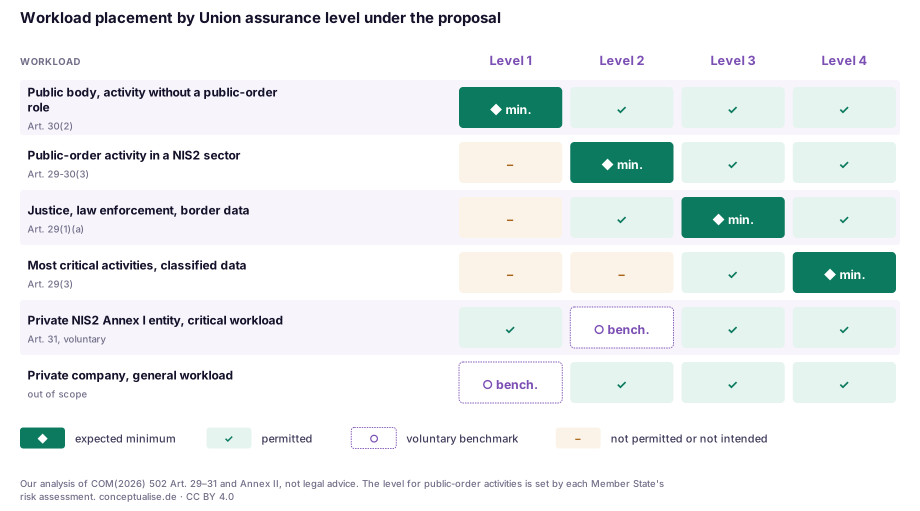
The matrix is our reading, not a legal determination. Where the minimum lands within Levels 2 to 4 is a Member State decision; we mark where we expect it. For private companies, CADA is a benchmark: the Level 1 criteria make a good baseline checklist for any cloud tender, and Level 2 is a sensible target for critical workloads at regulated firms.
What the numbers say
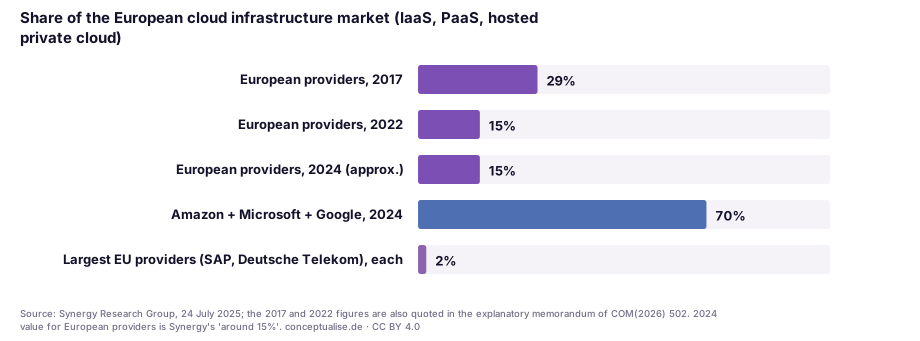
Three readings matter for planning.
First, the market is not short of growth, only of share. Synergy reports that European providers more than tripled their revenue between 2017 and 2024 while their share halved, because the market grew about six-fold. A Level 1 floor does not by itself reverse that, because Level 1 is designed to be reachable by third-country-controlled providers too.
Second, the supply at higher levels is thin, and Europe's largest providers are small. SAP and Deutsche Telekom lead the European providers with about 2% each, according to Synergy. Of the four winners in the Commission's April 2026 tender, three reached SEAL-3 and one SEAL-2. SEAL and CADA levels are different scales, so do not map one onto the other. But the result shows a short list for anything above the floor.
Third, the cost of being wrong is a forced migration. If a risk assessment moves a workload up a level, the proposal gives 12 months to migrate. Combined with the Data Act's switching rules, which remove switching charges from 12 January 2027, exit planning becomes a design-time property, not a contract appendix. Our DORA-grade cloud exit runbook walks through the mechanics.
Where Council and Parliament are taking it
On the Council side, the Presidency's first compromise on Title IV (presented 10 November 2026) reworks the text in ways architects should note:
| Topic | Commission proposal | Council compromise (first draft, Nov 2026) |
|---|---|---|
| Audit review cycle | Annual (Art. 20(8)) | Every two years |
| Migration after a risk assessment | ≤ 12 months | ≤ 18 months, extendable exceptionally |
| Commission override of national levels | Implementing act | Recommendation, Member State must respond within 3 months |
| National security and defence | In the risk-assessment scope | Removed from it |
| Private sector | Delegated act could mandate assessments | Power deleted; utilities under Directive 2014/25/EU added to procurement scope |
| Public-order criterion | Not stated for Level 1 | Clarified to apply to Level 1 too |
| Fines | Left to Member States | Maximum ceilings added |
| Date of application | Entry into force + 12 months | + 18 months |
Open issues on the Presidency's list include a simpler recognition architecture, national-security exemptions modelled on Article 2 of the AI Act, and alignment with the coming Cybersecurity Act revision.
In Parliament, ITRE (rapporteur Diego Solier, ECR) and IMCO (Reinier van Lanschot, Greens/EFA) share the file under the joint committee procedure. Their draft report, presented on 11 November 2026, emphasises common standards, stronger protection for critical sectors such as healthcare, energy and transport, and more public purchasing from European providers, according to press coverage. We have not seen the amendment text, so we do not speculate on the levels. Committee discussion is set for 1 December 2026; the committee vote is provisionally mid-March 2027.
In a recent engagement
In a recent engagement with a DACH organisation that runs IT for public-sector clients, we used the draft Annex II as a dry run before any tender required it. We mapped their application portfolio against the Article 29 test, then against Levels 1 and 2. The classification was the easy part. The evidence was not.
Three gaps came up in almost every service. Telemetry and support diagnostics left the EU by default in several SaaS products, even where the primary data stayed in a German region. Privileged access for at least one managed service ran through a global support organisation, which would fail the Level 2 support criterion however the contract was worded. And nobody could produce an SBOM, let alone a tested alternative, for the managed services the organisation depended on most. None of this required a new cloud. It required data-flow diagrams that include the control plane, an inventory of who can log in from where, and contract language that will survive an audit.
The provider checklist: what to ask for now
You cannot buy a "CADA Level 2" service today, because no service has been recognised. You can ask for the evidence Annex III will require. That turns the next renewal into preparation rather than guesswork.
| Annex II criterion | Evidence to request (Annex III) | Typical gap we see |
|---|---|---|
| (a) EU establishment | Company register extracts, EU staff and banking, BRIS/VIES entries | EU entity is a sales shell; operations elsewhere |
| (b) Location of infrastructure, assets, personnel | Precise addresses for primary, backup, DR and log storage; asset register incl. key material | Logs and backups in a "global" service |
| (c) Data localisation incl. metadata and telemetry | Data-flow diagram incl. control plane; access logs; data boundary terms | Telemetry and support bundles exported by default |
| (d) Citizenship and screening (L2 on request, L3/L4) | Access control policies, verification procedure | No mechanism to restrict an admin role by nationality |
| (e) Certification | EUCS once available; meanwhile national scheme or CEN/TS 18026 | Certificate scope excludes the service you buy |
| (f) No third-country AI training | Contract clauses, model cards, data-lineage records | "Service improvement" clauses allow reuse |
| (g) Third-country control | Cap table to ultimate owners, governance rights, refusal records | Parent can appoint the board |
| (h) EU-only support | Subcontractor register, admin access paths inside the EU | Follow-the-sun desk; break-glass from abroad |
| (i)/(j) Supply chain | SBOM, dependency origin, remote-feature controls, tested exit plan | No SBOM for managed services; no switchover test |
Governance for European enterprises
These regimes genuinely interact with CADA:
- NIS2 (Directive (EU) 2022/2555): CADA borrows its cloud definitions and uses its Annex I and II sectors to scope the risk assessment. For a NIS2 entity, Article 21 supply-chain measures and a CADA-style provider assessment are the same work.
- DORA (Regulation (EU) 2022/2554): financial entities are not CADA buyers, but DORA Article 28(8) already requires exit strategies for critical ICT services. CADA's Annex III exit evidence is a good template.
- Data Act (Regulation (EU) 2023/2854): CADA's Article 18 uses Data Act Article 32 on governmental access as a test for associated third countries, and the switching chapter makes forced migrations cheaper.
- Cyber Resilience Act (Regulation (EU) 2024/2847): CADA reuses the CRA definitions of software, component and SBOM. Vendors with CRA-grade SBOMs are ahead on criterion (i).
- GDPR: an adequacy decision is the first condition for an associated third country, but CADA's localisation rules go further than GDPR transfer rules, because they also cover non-personal data, metadata and telemetry.
- EU AI Act: CADA uses the AI Act's definition of an AI system and gives the AI Board an advisory role on national strategies. It does not change any AI Act obligation.
Before you compare providers in detail, read our sovereign cloud showdown and our earlier, still relevant view on Gaia-X and sovereign cloud.
Pragmatic adoption path
- Classify workloads now. Run the Article 29 test yourself: which applications support public-order activities in NIS2 sectors, justice, law enforcement or security? Record the data sensitivity, third-country access risk and disruption impact the article asks for.
- Set a target level per workload class. Use the placement matrix as a starting point, and treat Level 2 as the realistic target for critical workloads unless your sector or Member State signals higher.
- Collect Annex III evidence at the next renewal. Ask for data-flow diagrams including control plane and telemetry, the support and admin access model, ownership structure and SBOMs. Put the answers in your vendor risk register.
- Engineer for the gaps. Customer-managed keys in an EU-hosted HSM, EU-only admin paths, log and backup residency, and a tested exit route for the two or three services you depend on most.
- Track the texts quarterly. Watch the Council's second compromise (from December 2026), Parliament's committee vote (provisionally March 2027) and the Commission's implementing acts on risk-assessment methodology. Adjust targets when the levels firm up.
The verdict
CADA is the first serious attempt to turn "sovereign cloud" from a marketing adjective into audited criteria, and for that alone architects should welcome it. The proposal is clear where it matters most: residency includes metadata and telemetry, support location counts as much as data location, and control is judged on the cap table. It is weakest where engineers will feel it first: keys and encryption are handled only by implication, Level 4's supply-chain test is close to unmeetable for a mainstream stack, and the text still has cross-reference errors.
Do not wait for 2029. The evidence CADA will demand (data flows, admin paths, ownership, SBOMs, a tested exit) is the evidence good cloud governance should already have. Gather it now, and the eventual level will be a paperwork exercise rather than a migration.
If you want help classifying your estate against the CADA levels, or building the landing zone, key custody and exit plan behind a Level 2 claim, our cloud architecture practice does exactly this with European public-sector and regulated clients.
FAQ
Is the Cloud and AI Development Act already law?
No. The Commission proposed it on 3 June 2026 as COM(2026) 502. As of 15 November 2026 the Council is working on a first compromise text and the European Parliament's co-rapporteurs presented their draft report on 11 November 2026. Trilogues have not started. The political target is adoption in Q4 2027, and the proposal would apply 12 months after entry into force (the Council compromise says 18).
What are the four CADA Union assurance levels?
They are cumulative tiers in Annex II of the proposal. Level 1 requires an EU-established provider, EU data residency including metadata and telemetry, and is self-assessed. Level 2 adds EU personnel and support, an EU certificate of at least "substantial", SBOMs and safeguards against third-country control. Level 3 bars third-country control unless the home country is an associated third country and requires EU-citizen staff. Level 4 bars third-country control outright and requires a "high" certificate and effective control over software components.
Does CADA apply to private companies?
Not directly as a buyer. The procurement duties bind Union entities and public contracting authorities. Private NIS2 Annex I entities may carry out similar assessments under Article 31, and the Commission could require it for highly critical sectors by delegated act, a power the Council compromise deletes. The Council text would extend the procurement rules to utilities that buy under Directive 2014/25/EU. Cloud providers that want public-sector business are affected directly.
Can a US hyperscaler's sovereign cloud reach a CADA assurance level?
Under the proposal, a provider controlled from a third country can reach Level 1, and Level 2 if it proves that the foreign parent cannot access customer data, disrupt the service or impose foreign sanctions. Level 3 requires a Commission implementing act naming the home country as an associated third country under Article 18. Level 4 excludes third-country control entirely. Partnership models with an EU-controlled operator are assessed on their own ownership and control.
How does CADA relate to EUCS and the Commission's Cloud Sovereignty Framework?
CADA requires an EU cybersecurity certificate of at least "substantial" for Levels 2 and 3 and "high" for Level 4 under a cloud scheme adopted under the Cybersecurity Act, which is EUCS once it exists. Until then national schemes apply. The Commission's own Cloud Sovereignty Framework, with SEAL-0 to SEAL-4, is a procurement tool it used for its April 2026 tender; it is not part of the CADA legal text.
What should architects do about CADA before it is adopted?
Classify workloads by the Article 29 public-order test, map current providers against the Annex II criteria for the level you expect, and collect the Annex III evidence: data-flow diagrams covering metadata and telemetry, support and admin access locations, ownership and control, SBOMs and an exit plan. Build contract clauses and key custody so that changing provider later is possible, and track the Council and Parliament texts.
Sources
Checked on 15 November 2026. This article describes a legislative proposal and is not legal advice.
Tier A: primary and regulatory
- European Commission: Proposal for the Cloud and AI Development Act (CADA), COM(2026) 502, regulation text, annexes and impact assessment, 3 June 2026: Art. 1–2, 10–13, 16–34, 41–48; Annexes II and III; explanatory memorandum; legislative financial statement
- EUR-Lex: 52026PC0502
- Council of the EU: Presidency progress report on the Cloud and AI Development Act, doc. 15300/26, 13 November 2026
- Council of the EU: Commission proposal as transmitted, doc. 10104/26, 4 June 2026
- European Parliament Legislative Observatory: procedure 2026/0138(COD)
- European Commission: Commission advances cloud sovereignty through strategic procurement, 17 April 2026
- Directive (EU) 2022/2555 (NIS2); Regulation (EU) 2022/2554 (DORA), Art. 28(8); Regulation (EU) 2023/2854 (Data Act), Art. 29 and 32; Regulation (EU) 2024/2847 (CRA), Art. 3; Regulation (EU) 2019/881 (Cybersecurity Act)
Tier B: research, analysis and reporting
- Synergy Research Group: European Cloud Providers' Local Market Share Now Holds Steady at 15%, 24 July 2025
- Euronews: EU lawmakers push to reduce Europe's dependence on foreign cloud providers, 11 November 2026
- activeMind.legal: Cloud and AI Development Act (CADA) guide
Tier C: vendor and directional
Topics