Sovereign Cloud Comparison 2027: Five Offers Scored
Microsoft, AWS European Sovereign Cloud, S3NS, STACKIT and IONOS compared on control plane, operations, keys and jurisdiction, scored on EU SEAL levels.
On 14 January 2026 AWS switched on eusc-de-east-1 in Brandenburg, the first region of the AWS European Sovereign Cloud. Three months later the European Commission awarded its first sovereign cloud contracts, worth up to €180 million over six years. None of the winners was a US hyperscaler.
Every vendor now sells "sovereign cloud", and the label alone means little. This comparison is for the people who have to sign the contract and defend it to a regulator: CTOs, CISOs, architects and procurement leads. We compare five offers on the four layers that decide sovereignty, score them against the Commission's own framework, and say which workloads belong where.
TL;DR / Key takeaways
- Residency is not sovereignty. Every offer here keeps data in the EU. They differ on who runs the control plane, who operates it, who holds the keys and which law can reach the provider.
- AWS built the strongest separation of the US options. A separate partition, its own IAM and billing, and EU-resident operators. The US parent, and with it the CLOUD Act question, remains.
- Microsoft offers the broadest range, not the deepest separation. Its Sovereign Public Cloud is controls on global Azure. The real sovereignty options are Azure Local and the partner clouds, and Delos only targets launch in early 2027.
- S3NS is the middle path. It is Google technology under Thales control, SecNumCloud 3.2 qualified since December 2025. It is legally strong, but you still depend on Google's technology.
- STACKIT and IONOS win on ownership, not on breadth. On our indicative reading of the EU framework they score 83–86%, against 34% for the US offers. Expect to give up services in exchange.

Download: Editable draw.io file · Open in diagrams.net · Chart data (CSV)
Why this decision got urgent in 2026
Three things changed. First, the legal exposure became explicit. In June 2025 Microsoft France's director of public and legal affairs, Anton Carniaux, was asked by a French Senate inquiry whether he could guarantee that French citizens' data would never reach US authorities without French approval. "No, I cannot guarantee that," he answered, adding that it had never happened. It was an honest answer about the US CLOUD Act, which reaches data held by US providers wherever it sits, and it ended the assumption that an EU region equals EU control.
Second, sovereignty became measurable. In October 2025 the Commission published its Cloud Sovereignty Framework, version 1.2.1, for a €180 million tender. It defines eight sovereignty objectives and five assurance levels, from SEAL-0 to SEAL-4, with official weights. In April 2026 the Commission awarded contracts to four bidders: a Post Telecom group with OVHcloud and Clever Cloud, STACKIT, Scaleway, and a Proximus group that includes S3NS. Three reached SEAL-3. The Proximus/S3NS bid reached SEAL-2. Other public buyers will copy this scoring.
Third, regulation is moving from guidance to obligation. The Commission proposed the Cloud and AI Development Act (CADA) on 3 June 2026 as COM(2026) 502. It sets out four "Union assurance levels" and would oblige public buyers to procure at least level 1, and levels 2 to 4 where a risk assessment finds public-order relevance. The proposal is still with Parliament and Council. We explain the levels in our CADA explainer.
Meanwhile AWS has committed €7.8 billion to its sovereign cloud in Germany, and Microsoft shipped new sovereignty controls in April and October 2026. Vendors do not spend like that on a niche.
The four layers, offer by offer
The numbers below match the callouts in the hero diagram. Border colours are our verdict: green means EU or customer control, blue means separated but dependent on non-EU technology, amber means non-EU control or legal reach. We compare Microsoft Sovereign Public Cloud (with Sovereign Private Cloud and the partner clouds as variants), the AWS European Sovereign Cloud (ESC, one region in Brandenburg, with sovereign Local Zones planned in Belgium, the Netherlands and Portugal), S3NS PREMI3NS, STACKIT from the Schwarz Group's Schwarz Digits, and IONOS Cloud.
① Control plane
Microsoft is explicit that Sovereign Public Cloud is "built on Microsoft's global Azure infrastructure with enhanced sovereignty controls". Data stays inside the EU Data Boundary, which Microsoft completed on 26 February 2025 for Microsoft 365, Dynamics 365, Power Platform and most of Azure. The Sovereign Landing Zone adds policy-as-code guardrails. It is still one global platform.
AWS ESC is the opposite design. It runs in its own partition, aws-eusc, with its own IAM, its own billing system and dedicated Route 53 name servers on European top-level domains. AWS calls it "a physically and logically separate cloud infrastructure, with all components located entirely within the EU". The trade-off is a smaller service catalogue, so check the ESC capabilities list before you design.
S3NS runs a dedicated platform in French data centres. The software is Google Cloud technology, but S3NS operates it.
STACKIT and IONOS run their own platforms in their own data centres. STACKIT lists seven data centres in Germany and Austria. There is no foreign platform underneath.
② Operations personnel
Who can log in when something breaks at 03:00 matters more than any certificate.
Microsoft uses Data Guardian, which ensures "that only Microsoft personnel residing in Europe control remote access", with approval and real-time monitoring. In October 2026 Microsoft added oversight by a trusted EU partner, now rolling out in the EU and EFTA. It also launched a tamper-evident Production Touch Ledger, rolling out in phases. Customer Lockbox and just-in-time access sit on top. The engineers who build the platform are still global.
AWS ESC is operated "exclusively by EU residents located in the EU", and AWS says it is moving to operation by EU citizens. The managing directors are EU citizens, and an advisory board of EU citizens includes two independent members. Of the two US offers, AWS has the stronger operational separation.
S3NS says PREMI3NS is "operated and administered exclusively by S3NS employees in data centres located in France". SecNumCloud 3.2, which ANSSI granted in December 2025 across IaaS, CaaS and PaaS, audits exactly this.
STACKIT and IONOS operate with their own staff. No non-EU parent sits in the operating chain.
③ Key custody
This is the layer where the US offers are strongest. Microsoft made External Key Management with Azure Managed HSM generally available in October 2026. The root key stays in an HSM you own and operate, on premises or with a trusted third party. AWS offers the KMS External Key Store (XKS), where key material is created and used in a key manager you run outside AWS, reached through a proxy you supply. The KMS guide lists XKS in every KMS Region except China, and the ESC differences page names only two gaps: no CloudHSM key stores and no ML-KEM post-quantum key exchange. Confirm XKS for your ESC account before you design around it.
For S3NS, STACKIT and IONOS we could not confirm the same depth of external-key support across services from public documentation. Their default is provider-managed encryption. If your threat model includes the operator, ask which services support customer-held keys before you sign. This is the one layer where the EU-native offers can look worse than the hyperscalers.
④ Jurisdiction
Microsoft and AWS both contract with you under EU law, through EU entities, but their parents are US companies. AWS ESC uses "dedicated European legal entities established under German law". That does not settle whether a US court can compel the parent, and Carniaux's answer applies to every US provider.
S3NS is "a company incorporated under French law, headquartered in France, majority-owned and fully controlled by Thales". Google Cloud holds what S3NS calls an "extremely minority stake", and its representative sits on the board "as an observer, with no voting rights or veto rights". SecNumCloud 3.2 adds requirements on protection from non-European law, which S3NS says "aim to reduce the risks", not remove them.
STACKIT and IONOS have EU owners, which removes the question at the root.
What the scorecard says
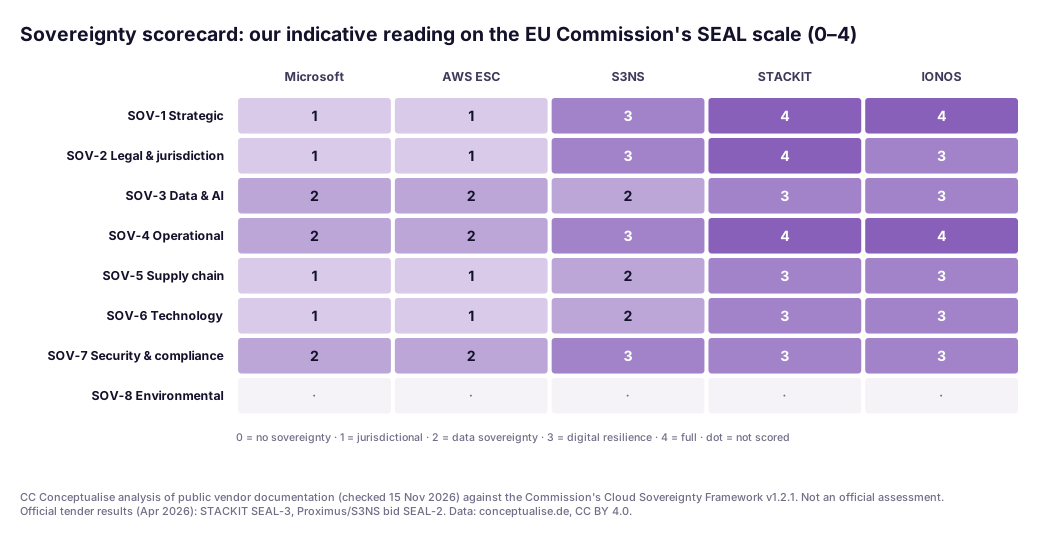
We scored each offer against the framework's eight objectives using the official SEAL definitions and public documentation only. These are our indicative scores, not official assessments. The only official results, STACKIT at SEAL-3 and the Proximus/S3NS bid at SEAL-2 from the April 2026 tender, are consistent with them. SOV-8 (environment) is not scored for lack of comparable data. The CSV gives a rationale per cell.
First, the US offers score low for structural reasons, not weak engineering: strategic, legal, supply-chain and technology objectives all ask who ultimately controls the stack. Microsoft and AWS score the same overall, even though AWS has the stronger separation, because the framework weights ownership and supply chain more than partitioning.
Second, S3NS shows what a joint venture can do: legal and operational scores near the EU-native offers, supply chain and technology lower because the stack is Google's.
Third, nobody reaches SEAL-4 throughout; that needs an EU-controlled supply chain from chips to software.
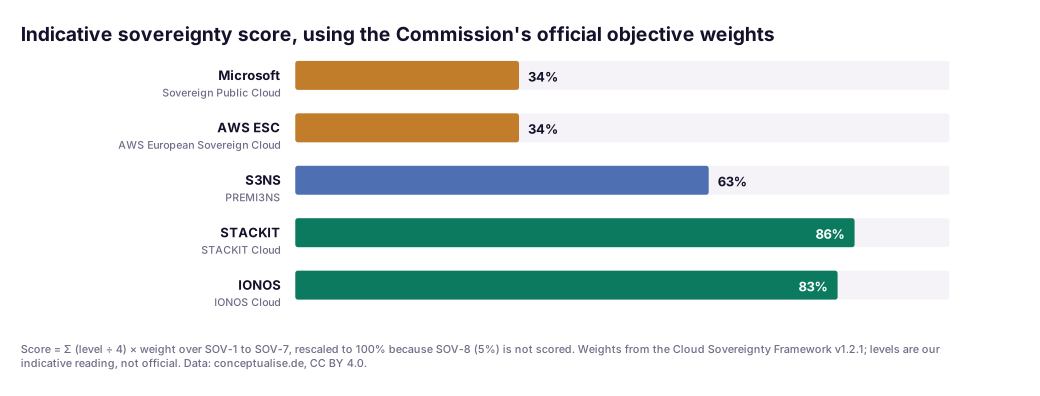
The weighted score applies the Commission's official weights (supply chain 20%; strategic, operational and technology 15% each; legal, data and security 10% each), rescaled to 100% because the 5% environment objective is left out, to our levels: STACKIT 86%, IONOS 83%, S3NS 63%, both US offers 34%. It is a sovereignty score, not a quality score. On service breadth, AI capability and maturity the ranking reverses.
In a recent engagement…
A regulated DACH organisation asked us to "pick the sovereign cloud" for an estate that had run on Azure for four years. The first draft of the brief assumed everything would move. We started with a workload inventory instead. Most of the estate, including collaboration, analytics and the new AI assistants, had no public-order relevance and sat comfortably inside the EU Data Boundary with customer-managed keys. A small set of systems handled data that a supervisor would treat as critical. For those, the answer was not "a more sovereign Azure". It was an EU-owned provider with customer-held keys, plus a documented and tested exit path for the rest.
The hard part was not technical. It was the identity design. Moving a few workloads to a second provider meant a second identity plane, a second logging pipeline and a second set of runbooks. The sovereignty decision took two workshops. The operating model took two months.
The decision table
It combines the verified facts with our verdict.
| Microsoft Sovereign Public Cloud | AWS European Sovereign Cloud | S3NS PREMI3NS | STACKIT | IONOS Cloud | |
|---|---|---|---|---|---|
| Status (Nov 2026) | Available in EU regions; new controls rolling out | GA since 14 Jan 2026, one region (Brandenburg) | GA; SecNumCloud 3.2 since Dec 2025 | GA | GA |
| ① Control plane | Global Azure, EU Data Boundary | Separate partition aws-eusc, own IAM and billing | Dedicated platform in France, Google technology | Own stack, DE/AT data centres | Own stack, own data centres |
| ② Operators | Data Guardian: EU-resident control of remote access | EU residents only, moving to EU citizens | S3NS employees only | Own staff | Own staff |
| ③ Customer-held keys | Yes: External Key Management with Managed HSM | Yes: External Key Store (XKS); no CloudHSM key stores | Check per service | Check per service | Check per service |
| ④ Parent jurisdiction | US | US | France (Thales) | Germany (Schwarz Group) | Germany |
| Key attestation | BSI C5, ISO 27001 | BSI C5, ISO 27001, SOC 1/2/3 | SecNumCloud 3.2 | BSI C5 Type 2 (21 products) | BSI C5 Type 1 (2023, compute and S3 storage) |
| Indicative score | 34% | 34% | 63% | 86% | 83% |
| Best fit | M365-centric estates, AI-heavy workloads, regulated but not public-order | AWS-native estates that need operational separation in the EU | French public sector and critical operators that need SecNumCloud with Google services | German public sector, public-order workloads, Kubernetes-first platforms | Infrastructure-centric workloads, German public sector and SMEs |
Two warnings. First, "check per service" is not a polite way of saying no. It means public documentation did not let us confirm it, so ask for it in writing. Second, attestation scope matters as much as the attestation. The IONOS C5 attestation announced in November 2023 is Type 1 and covers Compute Engine, Cloud Cubes and S3 Object Storage only; ask whether a newer Type 2 report exists. STACKIT's Type 2 covers 21 products. BSI has since published a revised catalogue, C5:2026, so ask every provider which version their next report will use. Our BSI C5 guide explains how to read a C5 report.
Governance for European enterprises
GDPR, Chapter V. Article 48 says that a third-country court or authority order to transfer personal data is only recognised if it rests on an international agreement. That is the legal core of the CLOUD Act debate, and your transfer impact assessment should say how you handle the conflict.
DORA. Since 17 January 2025, Regulation (EU) 2022/2554 requires financial entities to have exit strategies for ICT services that support critical or important functions (Article 28). A sovereign cloud choice that you cannot leave is still a concentration risk. Our DORA exit-plan runbook shows how to test one.
EU Data Act. Since 12 September 2025, Regulation (EU) 2023/2854 has given customers switching rights against cloud providers. Until 12 January 2027 switching charges may only cover cost; after that they are banned.
NIS2. Article 21(2)(d) of Directive (EU) 2022/2555 makes supply-chain security part of risk management for essential and important entities. Document why you chose your cloud provider.
CADA (proposed). If adopted as proposed, public-sector bodies will have to buy cloud services at a Union assurance level set by risk assessment (Article 30). Track it, but do not design to a draft.
National qualifications. In France, SecNumCloud is the bar for sensitive public workloads. In Germany, BSI C5 is the common baseline, and for the federal administration the BSI's cloud platform requirements apply too. Delos, designed to meet them, still targets launch in early 2027. Our Azure sovereignty guide covers the Microsoft-side controls in depth.
A pragmatic adoption path
- Classify workloads, not the company. Sort each workload into four classes: public-order or classified, regulated-critical, regulated, and general. The top two are usually smaller than the first workshop assumes.
- Set a minimum SEAL per class. Use the Commission's eight objectives as your questionnaire, even if you are a private company. It turns a feeling into a testable requirement.
- Close the cheap gaps on your current cloud first. Customer-held keys, EU Data Boundary or ESC placement, Customer Lockbox or the AWS equivalents, and logging into your own SIEM. No migration needed.
- Place the top classes deliberately. Choose an EU-owned provider or a disconnected private cloud for the workloads that need it, and design the second identity, logging and network plane before the first workload moves.
- Test the exit path every year. Restore a representative workload onto the other provider, time it and record it. Our vendor lock-in assessment helps you choose the first candidate.
The verdict
There is no single winner, but there is a clear ranking per layer.
If your hard requirement is legal sovereignty, only an EU-owned provider fully meets it. STACKIT and IONOS are the German choices, and S3NS comes close in France. If your hard requirement is operational separation while staying on a hyperscaler, AWS ESC is the most separate option today. If you can run hardware yourself, Microsoft's Sovereign Private Cloud on Azure Local goes further. If your hard requirement is breadth, meaning frontier AI, the full PaaS catalogue and Microsoft 365, the hyperscalers' sovereignty controls with your own keys are a defensible, documented compromise for most regulated, non-public-order workloads.
Most European enterprises will end up with two providers, a hyperscaler for breadth and an EU-owned cloud for the workloads that must answer only to EU law. The winners will design the identity, logging and exit plumbing for that split on purpose.
If you want an independent view of which of your workloads belong where, our cloud architecture team runs this assessment as a short, fixed-scope engagement, scored against the same framework.
FAQ
What is the difference between data residency and cloud sovereignty?
Data residency only says where data is stored and processed. Sovereignty asks who runs the control plane, who operates the service, who holds the encryption keys and which law can compel the provider. The Commission's Cloud Sovereignty Framework scores this across eight objectives on SEAL levels 0 to 4. A US hyperscaler region in Frankfurt gives you residency, not sovereignty on its own.
Does the AWS European Sovereign Cloud protect against the US CLOUD Act?
Not fully. Generally available since 14 January 2026, it is a separate partition with its own IAM, billing and DNS, run by German-law entities and operated only by EU residents. That is real operational separation, but the entities belong to a US parent, so compelled disclosure remains a legal question. External Key Store, which keeps key material outside AWS, is the strongest technical mitigation.
Is Microsoft's Sovereign Public Cloud sovereign?
It is a set of sovereignty controls on global Azure and Microsoft 365, not a separate cloud: EU Data Boundary, Data Guardian for EU-resident control of remote access, Customer Lockbox, tamper-evident access logs and External Key Management with Managed HSM, generally available since October 2026. For stricter needs Microsoft offers Sovereign Private Cloud on Azure Local and the partner clouds Delos and Bleu.
What are SEAL levels in the EU Cloud Sovereignty Framework?
SEAL means Sovereignty Effective Assurance Level. Framework version 1.2.1 (October 2025) defines SEAL-0 no sovereignty, SEAL-1 jurisdictional, SEAL-2 data sovereignty, SEAL-3 digital resilience and SEAL-4 full digital sovereignty. Tenders set a minimum per objective and rank passing bids by a weighted score. In April 2026 STACKIT reached SEAL-3 and the Proximus-led bid using S3NS reached SEAL-2.
Is S3NS independent from Google?
Legally and operationally largely yes, technologically no. S3NS is a French company controlled by Thales; Google holds a minority stake and is a board observer without voting or veto rights. PREMI3NS is run only by S3NS employees in France and has held SecNumCloud 3.2 since December 2025. The software is Google Cloud technology, so the roadmap dependency remains.
Should German enterprises move to STACKIT or IONOS instead of a hyperscaler?
For workloads where sovereignty is the hard requirement, often yes: both are EU-owned, which removes the jurisdiction question. Their catalogues are narrower, so most enterprises end up with a split, keeping innovation-heavy workloads on a hyperscaler with sovereignty controls and placing regulated or public-order workloads on an EU-owned provider. Decide per workload class and test the exit path.
Sources
All sources checked on 15 November 2026. Vendor capability claims are taken from the vendors' own pages and attributed as such. Scores are our analysis.
Tier A: primary, regulatory and official
- European Commission, Cloud Sovereignty Framework v1.2.1 (Oct 2025): https://commission.europa.eu/document/download/09579818-64a6-4dd5-9577-446ab6219113_en?filename=Cloud-Sovereignty-Framework.pdf
- European Commission, "Commission advances cloud sovereignty through strategic procurement" (17 Apr 2026): https://commission.europa.eu/news-and-media/news/commission-advances-cloud-sovereignty-through-strategic-procurement-2026-04-17_en
- European Commission, Proposal for the Cloud and AI Development Act, COM(2026) 502 (3 Jun 2026): https://eur-lex.europa.eu/legal-content/EN/TXT/HTML/?uri=CELEX%3A52026PC0502
- European Commission, CADA proposal page: https://digital-strategy.ec.europa.eu/en/library/proposal-cloud-and-ai-development-act-cada
- Regulation (EU) 2016/679 (GDPR), Article 48: https://eur-lex.europa.eu/eli/reg/2016/679/oj/eng
- Regulation (EU) 2022/2554 (DORA), Article 28: https://eur-lex.europa.eu/eli/reg/2022/2554/oj/eng
- Regulation (EU) 2023/2854 (Data Act), Chapter VI: https://eur-lex.europa.eu/eli/reg/2023/2854/oj/eng
- Directive (EU) 2022/2555 (NIS2), Article 21: https://eur-lex.europa.eu/eli/dir/2022/2555/oj/eng
- BSI, Cloud Computing Compliance Criteria Catalogue (C5): https://www.bsi.bund.de/EN/Themen/Unternehmen-und-Organisationen/Informationen-und-Empfehlungen/Empfehlungen-nach-Angriffszielen/Cloud-Computing/Kriterienkatalog-C5/kriterienkatalog-c5_node.html
- ANSSI, SecNumCloud providers in qualification: https://cyber.gouv.fr/offre-de-service/solutions-certifiees-et-qualifiees/services-de-securite-evalue/solutions-en-cours-de-qualification/prestataires-secnumcloud/
Tier B: analysis and reporting
- The Register, "Microsoft admits it 'cannot guarantee' data sovereignty" (25 Jul 2025): https://www.theregister.com/2025/07/25/microsoft_admits_it_cannot_guarantee/
- heise, "Controversial government cloud: Delos targets early 2027 launch" (10 Nov 2026): https://www.heise.de/en/news/Controversial-government-cloud-Delos-targets-early-2027-launch-11519537.html
- The Register, "Europe picks 4 sovereign cloud providers, but one has Google" (20 Apr 2026): https://www.theregister.com/2026/04/20/europe_picks_4_sovereign_cloud/
- Next, "SecNumCloud : Bleu vise désormais une qualification pour la fin d'année": https://next.ink/260765/secnumcloud-bleu-vise-desormais-une-qualification-pour-la-fin-dannee/
Tier C: vendor documentation, directional
- AWS News Blog, "Opening the AWS European Sovereign Cloud" (14 Jan 2026): https://aws.amazon.com/blogs/aws/opening-the-aws-european-sovereign-cloud
- AWS, European digital sovereignty FAQ: https://aws.amazon.com/compliance/europe-digital-sovereignty/faq/
- AWS, How AWS KMS differs in the AWS European Sovereign Cloud: https://docs.aws.eu/esc/latest/userguide/kms.html
- AWS, KMS external key stores (ESC documentation): https://docs.aws.eu/kms/latest/developerguide/keystore-external.html
- Microsoft, "Announcing comprehensive sovereign solutions empowering European organizations" (16 Jun 2025): https://blogs.microsoft.com/blog/2025/06/16/announcing-comprehensive-sovereign-solutions-empowering-european-organizations/
- Microsoft, "Advancing digital sovereignty with greater control and choice" (20 Oct 2026): https://blogs.microsoft.com/blog/2026/10/20/advancing-digital-sovereignty-with-greater-control-and-choice/
- Microsoft, "Microsoft Sovereign Private Cloud scales to thousands of nodes with Azure Local" (27 Apr 2026): https://blogs.microsoft.com/blog/2026/04/27/microsoft-sovereign-private-cloud-scales-to-thousands-of-nodes-with-azure-local/
- Microsoft Learn, What is Microsoft Sovereign Cloud?: https://learn.microsoft.com/en-gb/azure/azure-sovereign-clouds/microsoft-sovereign-cloud
- Microsoft, EU Data Boundary completion (26 Feb 2025): https://blogs.microsoft.com/on-the-issues/2025/02/26/microsoft-completes-landmark-eu-data-boundary-offering-enhanced-data-residency-and-transparency/
- S3NS, PREMI3NS SecNumCloud qualification: https://www.s3ns.io/en/news/en-PREMI3NS-SecNumCloud
- STACKIT, Facts: https://stackit.com/en/facts
- IONOS, C5 attestation for Compute Engine, Cloud Cubes and S3 Object Storage (7 Nov 2023): https://ionos-group.com/investor-relations/publications/announcements/ionos-receives-c5-certification-for-compute-engine-cloud-cubes-and-s3-object-storage.html
Topics