npm Supply-Chain Attacks 2026: axios, SAP, TeamPCP
We dissect the 2026 npm supply-chain attacks, from axios and SAP to TeamPCP, and map which of eight controls would have stopped each one before install.
At 00:21 UTC on 31 March 2026, axios@1.14.1 appeared on npm. Axios is the HTTP client a large share of JavaScript projects import without a second thought. Datadog put its reach at over 100 million weekly downloads. The new version added a single dependency, plain-crypto-js@4.2.1, whose postinstall script downloaded a remote-access trojan for whichever operating system it landed on. The maintainers' own post-mortem records the malicious versions as removed at 03:15 UTC. That gave the attack a three-hour window, opened at night in Europe, on a package your build almost certainly resolves.
Axios was not the worst incident of 2026. It was one of more than a dozen. In the same year a cluster called TeamPCP worked its way through Trivy, Checkmarx GitHub Actions and LiteLLM. A worm family dubbed "Mini Shai-Hulud" stole credentials from SAP's developer packages and hundreds of AntV versions. An npm token stolen through a GitHub Actions workflow turned jscrambler's CLI against its own users. This teardown is for the people who have to decide what changes on Monday: CTOs, CISOs, platform leads and architects. We dissect each incident and map one composite kill chain. Then we show, incident by incident, which control would actually have stopped it.
TL;DR / Key takeaways
- One kill chain, many actors. Every 2026 npm incident we examined followed the same seven stages: takeover, malicious publish, resolution, script execution, credential harvest, exfiltration and reuse. Different attackers, same physics.
- Cooldowns are the cheapest high-impact control. Every malicious version with a public removal time was gone within 41 hours, and most within three. A seven-day minimum release age would have skipped all of them.
- npm 12 closed the install-hook door, so attackers moved. Since 8 July 2026, npm no longer runs dependency lifecycle scripts by default. Three days later the jscrambler payload shipped inside the CLI code itself.
- Provenance is not innocence. TanStack and Red Hat packages were published with valid build provenance from hijacked pipelines. Provenance tells you where a package was built, not whether it is safe to install.
- CRA makes this a compliance question. Since 11 September 2026, Cyber Resilience Act Article 14 reporting applies, so a compromised dependency in your product can start a 24-hour reporting clock.

Download: Editable draw.io file · Open in diagrams.net · Chart data (CSV)
Why 2026 was different
npm compromises are not new. What changed between September 2025 and October 2026 was the pace and the target. The packages were no longer abandoned typosquats. They were maintained, popular packages with real maintainers. And the payloads stopped looking for crypto wallets and started looking for the credentials that run your delivery pipeline.
The turn came in September 2025. On 8 September, the maintainer of chalk and debug was phished through a look-alike domain, npmjs.help, which captured a live TOTP code. Aikido reported 18 packages with more than two billion combined weekly downloads, and a browser-side crypto clipper that was live for about two hours. A week later, on 15 September, Shai-Hulud became the first self-propagating npm worm. It used stolen npm tokens to republish every package its victims maintained. CISA's alert of 23 September counted more than 500 compromised packages. On 24 November 2025, "Sha1-Hulud: The Second Coming" moved execution to preinstall, pulled in the Bun runtime to dodge Node-focused monitoring, and tried to wipe the user's home directory when it found nothing to steal. Datadog counted 796 packages and 1,092 versions.
The registry responded quickly. Trusted publishing over OIDC had been generally available since 31 July 2025. GitHub then cut write-token lifetimes and permanently revoked all classic npm tokens on 9 December 2025. In 2026 it shipped staged publishing with human 2FA approval (GA 22 May) and, on 8 July, npm 12 with dependency install scripts off by default. These are real improvements. The 2026 incidents show what attackers do once those doors start to close: they go after the publishing pipeline instead of the token, and they move the payload out of the install hook.
The dissection: six incidents, one pattern
We picked the incidents with the best primary documentation. Where sources disagree on counts, and in the worm waves they always do, we name the source we used and leave the range out.
TeamPCP: the CI-tooling campaign (March–June 2026)
The Cloud Security Alliance describes TeamPCP as a threat cluster that ran a multi-phase campaign from March to June 2026. It is the one actor in this set that went after the security tooling inside pipelines rather than the application dependencies.
- Entry vector. The GitHub advisory for Trivy (GHSA-69fq-xp46-6x23, CVE-2026-33634) describes access gained in late February. It adds that credential rotation after a 1 March disclosure was "not atomic", which may have let the attacker keep a foothold.
- Payload. On 19 March the attacker published a malicious Trivy v0.69.4 and force-pushed 76 of 77
trivy-actiontags. The infostealer read the GitHub Actions runner's process memory for secrets. If exfiltration failed and a token was available, it created a publictpcp-docsrepository in the victim's organisation to hold the loot. Datadog then traced CanisterWorm on npm (20–22 March), compromised Checkmarx GitHub Actions and OpenVSX extensions (23 March), and malicious LiteLLM 1.82.7 and 1.82.8 on PyPI (24 March). LiteLLM 1.82.8 dropped a.pthfile so the stealer ran on every Python start. - What it stole. npm and PyPI tokens, CI secrets, OIDC tokens, cloud credentials, SSH keys and kubeconfigs.
- Detection and removal. The advisory puts the malicious Trivy binary's exposure at about three hours and the poisoned action tags at about twelve. CSA puts LiteLLM's window at about three hours.
The lesson is uncomfortable. The scanner you added to secure the pipeline ran with the pipeline's secrets, so a compromised security tool became the most privileged thing in the build.
axios: a maintainer's PC, not a token (31 March 2026)
- Entry vector. The post-mortem is unusually candid. The attacker "gained access to the lead maintainer's PC through a targeted social engineering campaign and RAT malware", which began about two weeks earlier. 2FA was enabled. It did not matter, because the attacker was on the machine.
- Payload.
axios@1.14.1andaxios@0.30.4addedplain-crypto-js@4.2.1. A clean decoy, 4.2.0, had been published the day before so the name had history. Itspostinstallfetched a per-OS RAT, then deleted itself and restored a cleanpackage.jsonto hide the evidence. - What it stole. Datadog reports no confirmed data theft, but the RAT beaconed system data and directory listings every 60 seconds. Treat any machine that installed it as fully compromised.
- Detection and removal. Community issues appeared around 01:00 UTC, and the attacker deleted them. A collaborator opened a deprecation PR at 01:38 and contacted npm. The versions were removed at 03:15 UTC. The post-mortem admits there was "no automated way to detect an unauthorized publish".
- Attribution. Google's threat intelligence team names UNC1069, a North Korea-nexus actor. That makes it a separate actor from TeamPCP with a different technique, so don't let anyone tell you 2026 was one gang.
SAP cap-js and mbt: Mini Shai-Hulud appears (29 April 2026)
- Entry vector. Not confirmed by SAP, and researchers disagree. Aikido's strongest lead for
mbtis a CI pull-request build that exposed an npm publishing token. For the@cap-jspackages, SafeDep and StepSecurity point to an OIDC trusted-publisher configuration that trusted any workflow in the repository, combined with a modified workflow on a non-main branch. - Payload.
@cap-js/sqlite2.2.2,@cap-js/postgres2.2.2,@cap-js/db-service2.10.1 andmbt1.2.48 each rannode setup.mjsas apreinstallhook. That fetched Bun and executed what Aikido calls an "11.7 MB credential stealer and propagation framework". - What it stole. GitHub and npm tokens, Actions secrets including runner memory, AWS, Azure, GCP and Kubernetes credentials, and browser passwords. It also took AI-assistant and MCP configuration. It persisted by planting editor task files and AI coding-agent session hooks in repositories it could write to.
- Detection. Aikido and Wiz published the same day. Wiz attributes the wave to TeamPCP with high confidence.
The detail to remember is the OIDC angle. Trusted publishing removes long-lived tokens, but an over-broad trust policy simply moves the target from the token to the workflow.
TanStack and AntV: provenance stops meaning "safe" (11–19 May 2026)
- Entry vector. CSA describes the TanStack chain as abuse of
pull_request_target, then Actions cache poisoning, then an OIDC token pulled from runner memory. It produced 84 malicious artifacts across 42 packages in about six minutes. On 19 May the AntV maintainer account published what Socket counts as 639 compromised versions across 323 packages, including collateral such asecharts-for-react. - Payload. The same Mini Shai-Hulud pattern: a
preinstallhook running an obfuscated script under Bun, credential theft and republishing with stolen tokens. - The new part. CSA calls TanStack the first documented case of malicious npm packages carrying valid SLSA Build Level 3 provenance. The packages were built by the real pipeline, so the attestation was true. The attacker controlled the pipeline. Red Hat's
@redhat-cloud-servicespackages followed on 1 June the same way: an employee's GitHub account pushed commits, and workflows withid-token: writepublished them with valid provenance. - Detection. Socket reports a median detection time of about 6.7 minutes for the AntV wave.
jscrambler: the payload leaves the install hook (11 July 2026)
- Entry vector. A developer's machine was compromised. The attacker took a GitHub SSH key, gained write access to the repository and "used a GitHub Actions workflow to exfiltrate the npm token", according to the vendor's post-mortem.
- Payload. Malicious
jscramblerversions 8.14.0, 8.16.0, 8.17.0, 8.18.0 and 8.20.0, plus four helper plugins pinned to 8.18.0. Early versions used apreinstallhook. Later ones moved the code into the CLI itself, which matters because npm 12 had shipped three days earlier with install scripts off. Third-party analyses describe a native infostealer per operating system. - Detection and removal. The vendor detected the first publish "within seconds" through automated notifications. It revoked the token and shipped a clean 8.22.0 about three hours later. npm removed the malicious versions about 41 hours after the first publish. The post-mortem counts 1,614 downloads across all affected packages.
keyv/cacheable and Tensorlake: the worm adapts (August–October 2026)
On 4 August 2026, keyv@6.0.0 opened a wave across the keyv and cacheable ecosystems. Datadog documents a preinstall plus Bun stealer that resolved its command-and-control address through an Ethereum contract. Singapore's CSA advisory AD-2026-009 reports more than 1,300 malicious versions. On 8 October, tensorlake@0.5.144 went out through the project's own release workflow after a malicious push to main. StepSecurity found it installed a "hostage" service: revoke the stolen GitHub token before removing that service, and it deletes your home directory. Incident response now has an order of operations.
The kill chain, stage by stage
Put the incidents side by side and the attacker's route through your estate is always the same. The numbers below match the warm callouts in the hero diagram. The letters match the green controls.
① Takeover
The attacker gets the ability to publish. In 2026 that meant a phished TOTP code (chalk/debug), a RAT on the maintainer's machine (axios), a stolen SSH key (jscrambler), or a token or OIDC grant pulled out of CI (SAP, TanStack, Red Hat). Phishing-resistant MFA (A) stops only the first of these. That is why it is necessary but nowhere near sufficient.
② Malicious publish
The attacker ships a patch or minor version, so every caret range picks it up. Trusted publishing with no tokens allowed (B) defeats stolen-token publishes, but not a hijacked workflow. Staged publishing, where a human must approve each release with 2FA, defeats both. As a consumer you cannot enforce either upstream, so you check for them instead.
③ Resolution
Your developer runs npm install, or your update bot opens a pull request, and the newest matching version arrives minutes after publication. This is the stage where consumers hold the strongest card. A committed lockfile with npm ci (C) means nothing changes silently, and a cooldown means nothing new arrives until the security community has had a week to look at it.
④ Script execution
The preinstall or postinstall hook runs with the full privileges of the developer or the CI job. Turning scripts off and allow-listing the few packages that genuinely need them (D) removes this stage for most 2026 payloads. npm 12 does it by default; older npm needs --ignore-scripts or ignore-scripts=true in .npmrc.
⑤ Credential harvest
The payload reads environment variables, ~/.npmrc, git credentials, cloud CLI caches and, on CI runners, process memory. Short-lived, narrowly scoped credentials issued by OIDC (E) don't prevent the theft. They make the stolen token expire before it is useful and keep it from reaching production.
⑥ Exfiltration
Data leaves over HTTPS to attacker domains, through webhook services, or into public GitHub repositories created with the victim's own token. An egress allow-list on build agents (F) breaks this stage in CI. On developer laptops it is much harder, which is why stages ③ and ④ matter more there.
⑦ Reuse and propagation
Stolen npm tokens republish the victim's own packages, and the worm moves to the next maintainer. Fast token revocation and registry takedown (G) are the only brakes. As the Tensorlake case shows, revocation has to come after you clean up persistence, not before.
What the numbers say
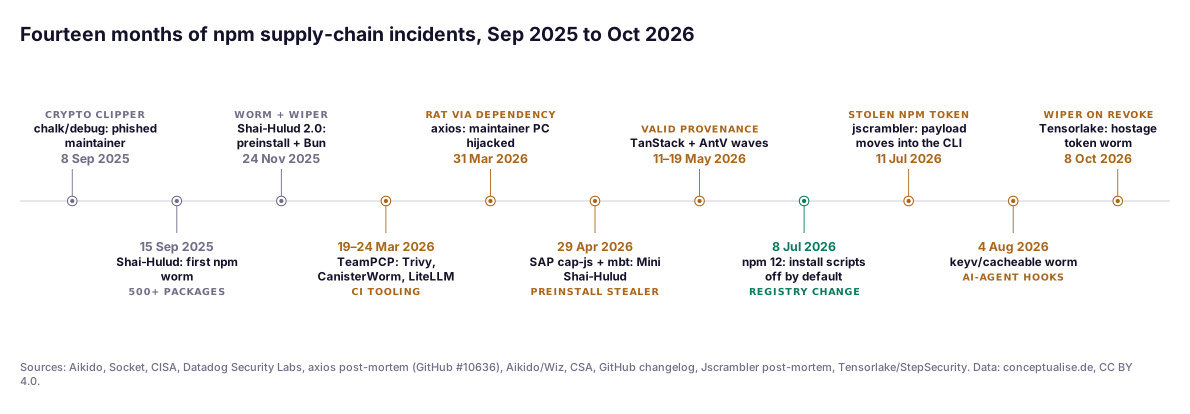
The timeline shows the shift. In 2025 there were three big events. In 2026 the gaps closed to weeks, and the attackers kept moving: from CI tooling in March to developer packages in April and May, to payloads outside the install hook in July.
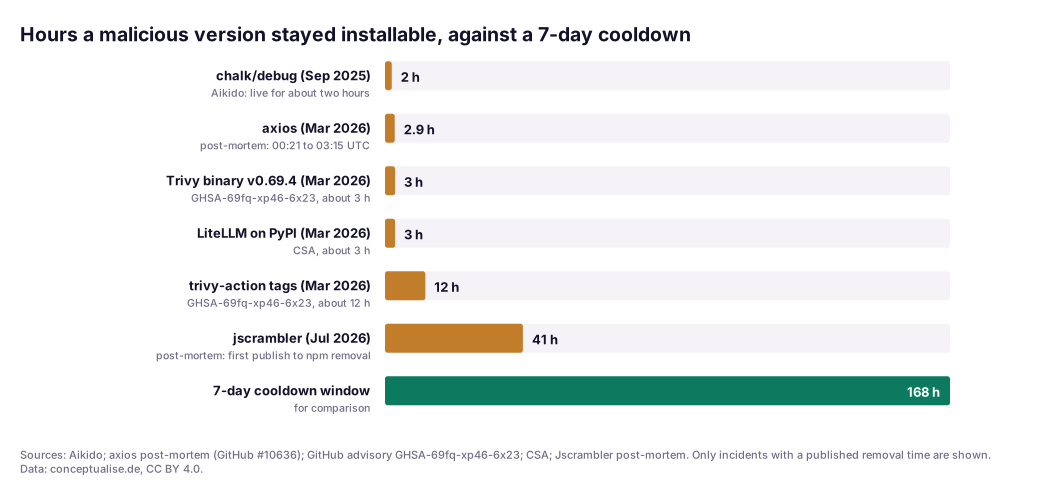
This is the chart we would put in front of a board. Every incident with a published removal time was cleaned up in hours, not days. The longest, jscrambler at about 41 hours, is a quarter of a seven-day window. The ecosystem's detection is now fast: Socket's median for the AntV wave was under seven minutes. The problem is that your npm install is faster still. A cooldown turns the community's detection speed into your protection.
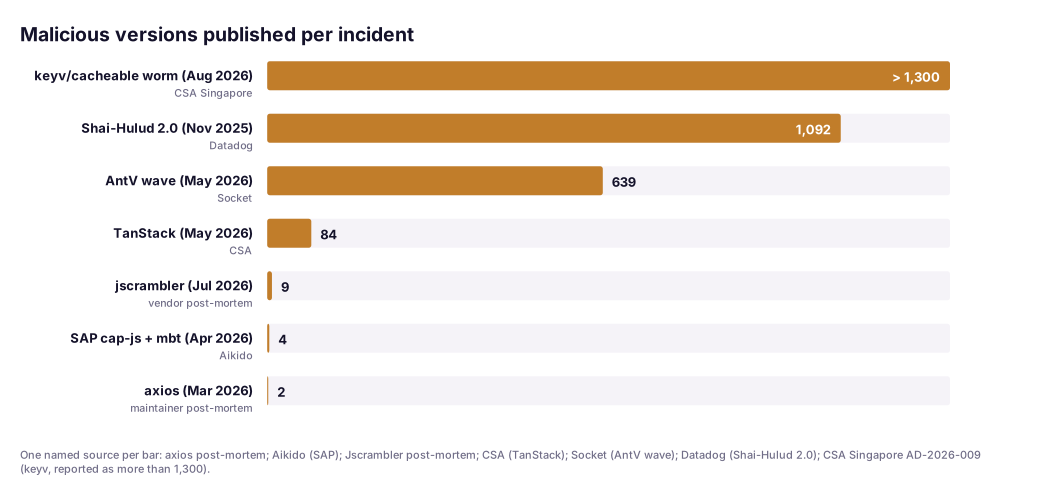
Blast radius splits cleanly in two. Targeted takeovers like axios, SAP and jscrambler publish a handful of versions of a high-value package. Worms publish hundreds or thousands of versions of whatever their victims maintain. For worms, your exposure depends on how many of your transitive dependencies sit downstream of a single compromised maintainer, and for most organisations nobody knows that number.
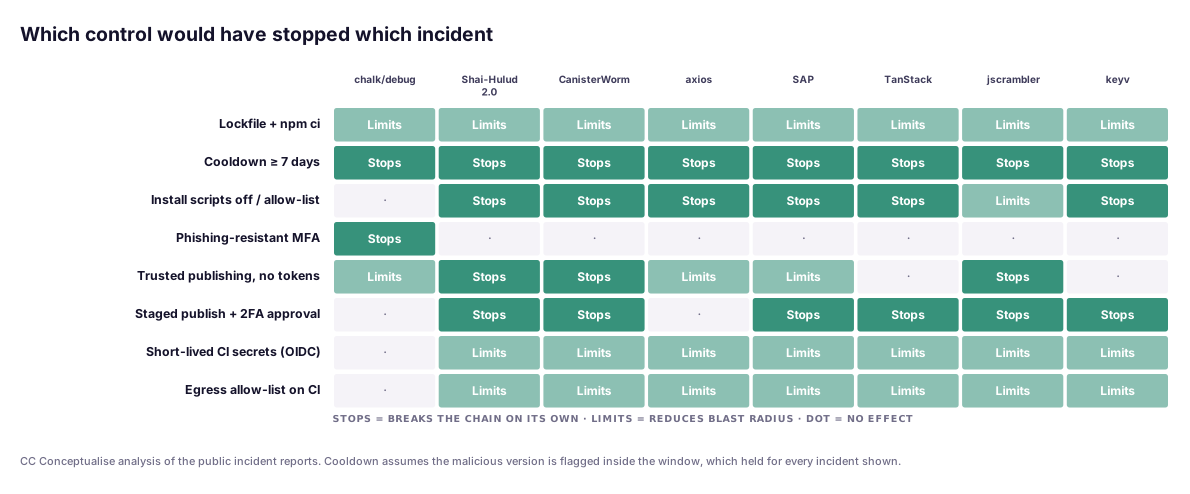
The heat grid is our analysis of the public reports, not external data. Three readings stand out. First, the cooldown row is solid green. That is not because cooldowns are magic: every incident here was detected and pulled within the window. Second, phishing-resistant MFA, the control most security programmes start with, would have stopped exactly one of eight. Third, no consumer-side control stops all eight, so you need at least two layers at stages ③ and ④.
In a recent engagement…
During a supply-chain readiness review this year for a European software vendor, we walked one of their main product pipelines with the kill chain above in hand. Nothing in it was negligent. Every individual choice had a reason. Together they lined up stages ③ to ⑥ for an attacker.
The update bot auto-merged patch releases as soon as tests passed, which is good hygiene for CVEs but means a malicious patch arrived within the hour. The CI images used whatever npm version shipped with their Node base image, so scripts still ran by default. Build agents held a long-lived cloud deployment credential as a pipeline variable, because "the OIDC migration was on the roadmap". And the agents could reach any host on the internet, because a firewall allow-list had been tried once and broke a build.
The fixes were boring, which is the point. We added a seven-day cooldown on the bot, with an explicit fast lane for security advisories. We set ignore-scripts=true and allow-listed the two packages that really needed a native build. We moved deployment to federated OIDC credentials scoped to one environment, and put an egress allow-list on the build pool that started in log-only mode for two weeks. The team's main worry, that cooldowns would slow down security patching, went away once the fast lane existed. The change that took longest was not technical: agreeing who owns the allow-list.
The controls checklist
This is the screenshot-able part. The Breaks stage column refers to the kill-chain numbers above, and Would have stopped is from the heat grid.
| # | Control | How to implement (2026 tooling) | Breaks stage | Would have stopped |
|---|---|---|---|---|
| 1 | Lockfile + npm ci | Commit package-lock.json; CI uses npm ci, never npm install | ③ (limits) | Nothing alone; it stops silent drift so the other controls have a fixed point |
| 2 | Cooldown / minimum release age | npm min-release-age (days); pnpm minimumReleaseAge (minutes, default 1 day in pnpm 11); Yarn 4 npmMinimalAgeGate; Bun install.minimumReleaseAge (seconds); Dependabot cooldown, Renovate minimumReleaseAge | ③ | All eight in our grid |
| 3 | Install scripts off + allow-list | npm 12 default; on npm 11 ignore-scripts=true; pnpm allowBuilds; Bun trustedDependencies | ④ | Every preinstall/postinstall payload; not chalk/debug, only partly jscrambler |
| 4 | Private registry proxy with quarantine | Proxy npmjs through Azure Artifacts, Artifactory or Nexus with malware scanning and a hold on new versions | ③ | Same as cooldown, enforced centrally |
| 5 | Trusted publishing + provenance (as publisher) | OIDC trusted publishing scoped to one workflow and branch; disallow tokens; staged publishing with 2FA approval | ①② | Token-based waves; staged approval also stops hijacked workflows |
| 6 | Provenance checks (as consumer) | npm audit signatures in CI; alert when a package that used to have provenance suddenly has none | ② (detects) | Unusual publishes; not TanStack or Red Hat, which had valid provenance |
| 7 | CI secret scoping + OIDC | Federated credentials per environment; no long-lived cloud keys or npm tokens in pipeline variables | ⑤ (limits) | Reduces blast radius of every stealer |
| 8 | Egress control on build agents | Default-deny outbound from runners; allow registries, source control and your cloud endpoints | ⑥ | Exfiltration from CI in every stealer wave |
| 9 | SBOM and fast lookup | CycloneDX SBOM per build, indexed so you can answer "do we ship version X?" in minutes | Response | Shortens response, and supports CRA reporting |
Two warnings. A cooldown needs a documented bypass for security fixes, otherwise teams will switch it off the first time a critical CVE lands. And an allow-list for install scripts is a list of packages whose compromise still runs code on install, so keep it short and review it like a firewall rule.
Governance for European enterprises
For EU organisations, 2026 turned supply-chain hygiene into a regulatory obligation in two places.
Cyber Resilience Act. Regulation (EU) 2024/2847 applies in full from 11 December 2027, but Article 14 reporting has applied since 11 September 2026. Manufacturers of products with digital elements must report actively exploited vulnerabilities and severe incidents affecting the security of their products through ENISA's Single Reporting Platform. That means an early warning within 24 hours, a notification within 72 hours, and a final report within 14 days of a fix for vulnerabilities, or within one month for incidents. Consider a compromised dependency that ships inside your product, or stolen CI credentials used to tamper with your releases. Either can fall into scope. Your incident runbook needs a step that asks "is this CRA-reportable?" within the first hours, not after the clean-up. The CRA also expects due diligence on third-party components and an SBOM, which is control 9 above. Our CRA 24/72-hour reporting runbook walks through that decision and the submission step by step.
NIS2. Article 21(2)(d) of Directive (EU) 2022/2555 requires essential and important entities to address supply-chain security. Article 21(3) asks them to consider each direct supplier's vulnerabilities and secure development practices. An npm dependency is not a supplier contract, but auditors increasingly treat open-source intake as part of this obligation. Cooldowns, script allow-lists and a quarantining proxy are the kind of documented, proportionate measures that answer the question. We covered the wider obligation in our NIS2 supply-chain security guide.
For DORA-regulated financial entities, the same controls feed ICT third-party risk and incident classification. The useful habit is the same everywhere: write the control down, measure it, and keep the evidence.
A pragmatic adoption path
- Week 1: inventory and freeze drift. Find every pipeline that runs
npm installinstead ofnpm ci, every CI image's npm version, and every long-lived npm or cloud token in pipeline variables. Fix thenpm cicases immediately. - Week 2: cooldown with a fast lane. Set a seven-day minimum release age in your package manager and update bots, with an explicit bypass for security advisories. If you run a registry proxy, enforce it there so laptops get it too.
- Weeks 3–4: scripts off. Move CI to npm 12, or set
ignore-scripts=true, and build the allow-list from the packages that actually break. Most organisations end up with a handful. - Month 2: secrets and egress. Replace long-lived CI credentials with OIDC federation scoped per environment. Put egress control on build agents in log-only mode, then enforce. Our DevSecOps pipeline design guide covers the runner architecture.
- Month 3: publish like you consume. For your own packages, switch to trusted publishing scoped to one workflow and branch, disallow tokens, and enable staged publishing. Add provenance checks and SBOM generation to the pipeline, as in our Azure DevOps supply-chain guide. Then rehearse the incident runbook, in the right order: isolate, remove persistence, rotate, report.
The verdict
The 2026 npm attacks were not sophisticated in the way that matters. Their entry vectors varied, from social engineering to cache poisoning, but once a malicious version reached the registry they all depended on two habits most organisations still have. We install versions minutes after they are published, and we let install-time code run next to our most valuable credentials.
Our view is blunt. If you do only one thing this quarter, set a seven-day cooldown with a security fast lane. If you do two, turn install scripts off. Everything else, from egress control and OIDC to provenance and SBOMs, is about making the next incident small. Rely on provenance or MFA alone and you are protected against the 2025 attacks. Attackers have since moved on.
If you want a second pair of eyes on your pipelines, our DevSecOps team runs exactly this kill-chain walkthrough as a short, fixed-scope review. You leave with the controls table filled in for your own estate.
FAQ
What happened in the axios npm compromise of March 2026?
On 31 March 2026 an attacker published axios@1.14.1 and axios@0.30.4 from the lead maintainer's account after compromising his PC through a targeted social-engineering campaign. Both versions added a new dependency, plain-crypto-js, whose postinstall script downloaded a remote-access trojan for macOS, Windows or Linux. The maintainers' post-mortem says the malicious versions were removed at 03:15 UTC, roughly three hours after the first publish. Google's threat intelligence team attributes the campaign to UNC1069, a North Korea-nexus actor.
What is Mini Shai-Hulud and how does it relate to TeamPCP?
Mini Shai-Hulud is the name researchers gave to a 2026 family of self-propagating npm stealers. They run a preinstall script, download the Bun runtime and harvest developer and CI credentials. The family hit SAP's cap-js and mbt packages on 29 April 2026 and the AntV ecosystem on 19 May 2026. Wiz attributes the SAP wave to the TeamPCP cluster with high confidence. The Cloud Security Alliance describes TeamPCP as running a multi-phase campaign from March to June 2026 that also touched Trivy, Checkmarx GitHub Actions and LiteLLM on PyPI.
Does npm 12 stop these attacks?
Partly. npm 12, generally available since 8 July 2026, no longer runs dependency preinstall, install or postinstall scripts unless you approve them. That removes the execution step most 2026 worms relied on. It does not help if your pipeline still uses an older npm, if a package you have allow-listed is the one compromised, or if the payload lives in the package code itself, as in the jscrambler incident three days later. Treat it as one layer, not the fix.
What is a dependency cooldown and which package managers support it?
A cooldown, or minimum release age, tells the package manager to ignore versions younger than a set period. npm has min-release-age (in days). pnpm has minimumReleaseAge (in minutes, defaulting to one day since pnpm 11). Yarn 4 has npmMinimalAgeGate, and Bun has install.minimumReleaseAge (in seconds). Dependabot and Renovate offer the same idea for update pull requests. Every malicious version we looked at with a published removal time was pulled within 41 hours, so a seven-day window would have skipped all of them.
Do these incidents trigger reporting under the EU Cyber Resilience Act?
They can. Since 11 September 2026, Article 14 of the CRA requires manufacturers of products with digital elements to report actively exploited vulnerabilities and severe incidents affecting the security of their products. That means an early warning within 24 hours, a notification within 72 hours and a final report later. If a compromised dependency ships in your product, or a stolen credential lets an attacker tamper with your releases, assess it against Article 14 straight away. NIS2 entities must separately cover supply-chain security under Article 21(2)(d).
What should we do first if we installed a compromised npm version?
Isolate the affected machine or runner before rotating anything. Several 2026 payloads punish revocation. Shai-Hulud 2.0 attempted to wipe the home directory when it found no credentials. The October 2026 Tensorlake worm installed a service that deleted the home directory if its stolen GitHub token was revoked. Remove persistence, including AI-agent and editor hooks. Then rotate npm, GitHub, cloud and CI credentials from a clean machine, and search your organisation for exfiltration repositories. Our incident response playbook covers the wider process.
Sources
All sources checked on 15 November 2026. Where sources disagree on package or version counts, we cite one named source and say so.
Tier A: primary, advisory and regulatory
- axios maintainers, post-mortem (GitHub issue #10636): https://github.com/axios/axios/issues/10636
- GitHub Security Advisory GHSA-69fq-xp46-6x23 (Trivy, CVE-2026-33634): https://github.com/advisories/GHSA-69fq-xp46-6x23
- Jscrambler, security incident post-mortem (July 2026): https://jscrambler.com/blog/security-incident-postmortem-jscrambler/
- CISA, "Widespread Supply Chain Compromise Impacting npm Ecosystem" (23 Sep 2025): https://www.cisa.gov/news-events/alerts/2025/09/23/widespread-supply-chain-compromise-impacting-npm-ecosystem
- GitHub, "Our plan for a more secure npm supply chain" (22 Sep 2025): https://github.blog/security/supply-chain-security/our-plan-for-a-more-secure-npm-supply-chain/
- GitHub changelog, npm install-time security and npm 12 (8 Jul 2026): https://github.blog/changelog/2026-07-08-npm-install-time-security-and-gat-bypass2fa-deprecation
- Cyber Security Agency of Singapore, advisory AD-2026-009 (keyv/cacheable): https://www.csa.gov.sg/alerts-and-advisories/advisories/ad-2026-009/
- Regulation (EU) 2024/2847 (Cyber Resilience Act), Articles 14 and 71: https://eur-lex.europa.eu/eli/reg/2024/2847/oj/eng
- European Commission, CRA reporting obligations: https://digital-strategy.ec.europa.eu/en/policies/cra-reporting
- Directive (EU) 2022/2555 (NIS2), Article 21: https://eur-lex.europa.eu/eli/dir/2022/2555/oj/eng
- pnpm v11.0.0 release notes: https://github.com/pnpm/pnpm/releases/tag/v11.0.0
Tier B: research
- Google Threat Intelligence Group, North Korea-nexus actor targets axios: https://cloud.google.com/blog/topics/threat-intelligence/north-korea-threat-actor-targets-axios-npm-package/
- Datadog Security Labs, axios compromise: https://securitylabs.datadoghq.com/articles/axios-npm-supply-chain-compromise/
- Datadog Security Labs, TeamPCP and LiteLLM: https://securitylabs.datadoghq.com/articles/litellm-compromised-pypi-teampcp-supply-chain-campaign/
- Datadog Security Labs, Shai-Hulud 2.0: https://securitylabs.datadoghq.com/articles/shai-hulud-2.0-npm-worm/
- Datadog Security Labs, keyv/cacheable worm: https://securitylabs.datadoghq.com/articles/npm-worm-compromises-popular-npm-packages
- Cloud Security Alliance, npm and AI toolchain supply-chain whitepaper: https://labs.cloudsecurityalliance.org/research/csa-whitepaper-npm-ai-toolchain-supply-chain-security-v1-0-c/
- Aikido, chalk/debug compromise: https://www.aikido.dev/blog/npm-debug-and-chalk-packages-compromised
- Aikido, "Mini Shai-Hulud has appeared" (SAP): https://aikido.dev/blog/mini-shai-hulud-has-appeared
- Wiz, Mini Shai-Hulud and SAP npm packages: https://www.wiz.io/blog/mini-shai-hulud-supply-chain-sap-npm
- Socket, AntV packages compromised: https://socket.dev/blog/antv-packages-compromised
- Socket, tinycolor and the first Shai-Hulud wave: https://socket.dev/blog/tinycolor-supply-chain-attack-affects-40-packages
- StepSecurity, Tensorlake hostage-token worm: https://stepsecurity.io/blog/tensorlake-npm-compromised-hostage-token-worm
Tier C: vendor and news, directional
- Infinum, axios npm supply-chain attack: https://infinum.com/blog/axios-npm-supply-chain-attack/
- Snyk, TanStack packages compromised: https://snyk.io/blog/tanstack-npm-packages-compromised
- The Hacker News, SAP npm packages compromised: https://thehackernews.com/2026/04/sap-npm-packages-compromised-by-mini.html
- BleepingComputer, Red Hat npm packages compromised: https://bleepingcomputer.com/news/security/red-hat-npm-packages-compromised-to-steal-developer-credentials
Topics