CRA Vulnerability Reporting: The 24/72-Hour Runbook
Practitioner runbook for CRA Article 14: what triggers a report, the 24h/72h/14-day clock, the ENISA platform, BSI specifics and how it differs from NIS2.
Since 11 September 2026, every manufacturer selling a product with digital elements in the EU has had a new legal clock to watch. Article 14 of the Cyber Resilience Act (CRA) now requires you to notify any actively exploited vulnerability and any severe incident affecting your product's security within 24 hours of becoming aware of it. On the same day, ENISA switched on the Single Reporting Platform that those notifications must go through. The rest of the CRA does not apply until 11 December 2027. Reporting is the one obligation that is already live.
This runbook is for the people who will be woken up when it fires: CTOs, CISOs and product security (PSIRT) leads at software and hardware vendors, with a DACH lens. A NIS2 incident process does not cover this: different trigger, different recipient, and the subject is your product, not your organisation. This is not legal advice; it is how we set the process up with clients, checked against the regulation text as of 15 November 2026.
TL;DR / Key takeaways
- Two triggers only: an actively exploited vulnerability (reliable evidence that a malicious actor exploited it) or a severe incident affecting the security of your product. A bug-bounty finding with no evidence of exploitation is not a mandatory report.
- Four deadlines: early warning ≤ 24 h, notification ≤ 72 h, final report ≤ 14 days after a fix is available (vulnerability) or ≤ 1 month after the notification (incident). All run from awareness.
- One channel: ENISA's Single Reporting Platform, routed to the CSIRT coordinator of your main establishment (the BSI for German manufacturers) and visible to ENISA at the same time.
- Legacy is in scope: reporting applies to products placed on the market before 11 December 2027, and continues after support ends.
- CRA ≠ NIS2 ≠ GDPR: a compromised build pipeline can trigger all three, with three recipients and overlapping clocks. Pre-wire the hand-offs.

Download: Editable draw.io file · Open in diagrams.net · Chart data (CSV)
Why this matters now
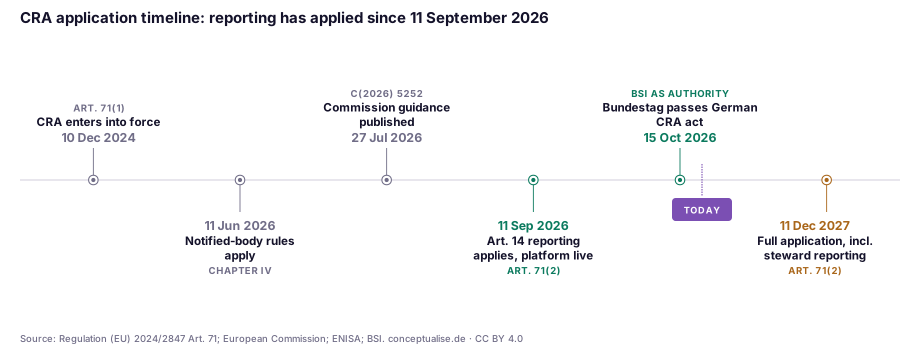
Regulation (EU) 2024/2847 entered into force on 10 December 2024. Article 71(2) staggers its application: the notified-body chapter from 11 June 2026, Article 14 reporting from 11 September 2026, and everything else from 11 December 2027. Three developments turned the reporting date into operations.
- The Commission published guidance. On 27 July 2026 it issued its (non-binding) guidance on applying the CRA, C(2026) 5252. Section 9.1 defines when a manufacturer counts as "aware"; the CRA FAQ (updated 4 September 2026) adds examples on zero-days, bug bounties and components.
- The platform went live on time. ENISA deployed the "initial operating capability" of the Single Reporting Platform (SRP) on 11 September 2026. It is English-only, has no API yet, and requires EU Login with MFA.
- Germany named its authority. The Bundestag passed the CRA implementation act (CRA-Durchführungsgesetz) on 15 October 2026. It makes the BSI market surveillance authority, notifying authority and CSIRT; the BSI says it has coordinated CRA reports since 11 September 2026. As of 15 November 2026 we could not confirm that the act has been promulgated in the Bundesgesetzblatt, so check before relying on its national penalty and support provisions.
The stakes are set in Article 64(2): breaches of Article 13 or 14 can draw fines of up to EUR 15 million or 2.5% of worldwide annual turnover, whichever is higher. Article 64(10) exempts micro and small enterprises from fines for missing the 24-hour early-warning deadline. The other deadlines still apply to them.
What triggers a CRA report, and what does not
Article 14 has exactly two mandatory triggers.
Actively exploited vulnerability. Article 3(42) defines it as "a vulnerability for which there is reliable evidence that a malicious actor has exploited it in a system without permission of the system owner". The key words are reliable evidence and malicious actor. Recital 68 excludes vulnerabilities found in good faith for testing, investigation, correction or disclosure.
Severe incident having an impact on the security of the product. Under Article 14(5), an incident is severe where it (a) negatively affects, or is capable of affecting, the product's ability to protect the availability, authenticity, integrity or confidentiality of sensitive or important data or functions, or (b) has led, or is capable of leading, to malicious code being introduced or executed in the product or in a user's systems. Recital 68 gives the textbook example: malicious code slipped into a security update release channel. In practice this is a compromise of your development, build or update infrastructure.
When does the clock start?
The regulation says "becoming aware". The Commission's guidance (paragraph 213) aligns this with NIS2 and GDPR practice. You are aware when, after a prompt initial assessment, you have a reasonable degree of certainty that a vulnerability in your product is being actively exploited, or that a severe incident has compromised its security. The guidance stresses "prompt action": a triage ticket left in a queue over the weekend does not delay T0 in your favour.
Worked examples
| Situation | Reportable under Art. 14? | Why |
|---|---|---|
| Researcher submits an RCE via your bug bounty, no sign of exploitation | No (voluntary under Art. 15) | No reliable evidence of malicious exploitation (Commission FAQ) |
| Customer's SOC sends logs showing your appliance's auth bypass used by an intruder | Yes, vulnerability | Reliable evidence, malicious actor, your product |
| Exploited flaw in an open-source library, reachable and exploited in your product | Yes, you notify too | Integrators notify; the component maker does too if it placed the component on the market |
| Same library flaw, but the vulnerable code is unreachable in your product | No | Not exploited in your product; report upstream under Art. 13(6) |
| Attacker pushes a trojanised firmware update through your signing pipeline | Yes, severe incident | Art. 14(5)(b): malicious code in the product |
| Exploitation you already knew about before 11 September 2026 | No | No retroactive reporting (guidance para. 217) |
| Exploited vulnerability in a product whose support ended in 2025 | Yes | Reporting survives end of support (guidance para. 210) |
The clock: four deadlines, one case file
Each deadline is a progressively richer version of the same case. Article 14 says each later stage is due "unless the relevant information has already been provided", so you are building one file over time, not writing three separate documents.
| Stage | Deadline | Must contain (minimum) |
|---|---|---|
| Early warning (vulnerability) | Without undue delay, ≤ 24 h after awareness | Member States where you know the product has been made available |
| Early warning (incident) | Without undue delay, ≤ 24 h after awareness | Whether unlawful or malicious acts are suspected; Member States where the product is available |
| Notification (vulnerability or incident) | ≤ 72 h after awareness | General product information; nature of the exploit and vulnerability, or nature and initial assessment of the incident; corrective or mitigating measures taken and those users can take; how sensitive you consider the information |
| Intermediate report | On request of the CSIRT (Art. 14(6)) | Relevant status updates |
| Final report (vulnerability) | ≤ 14 days after a corrective or mitigating measure is available | Description, severity and impact; information on the malicious actor where available; details of the security update or corrective measures |
| Final report (incident) | ≤ 1 month after the 72 h notification | Detailed description, severity and impact; type of threat or root cause; applied and ongoing mitigations |
Two details catch teams out. The vulnerability final report runs from fix availability, not awareness. And the sensitivity flag matters: under Article 16(2) and Delegated Regulation (EU) 2026/881, the CSIRT may delay passing your notification on to other CSIRTs on defined grounds, for example a fix expected within 72 hours.
Roles: who does what at 02:00
A 24-hour duty needs named people and deputies, not a mailbox. Our starting RACI:
| Activity | PSIRT lead | Product owner / engineering | Legal / regulatory | Comms / customer success | CISO / management |
|---|---|---|---|---|---|
| Intake and first triage | A/R | C | I | I | I |
| Reportability decision, T0 timestamp | A/R | C | C | I | I |
| Early warning submission (SRP) | A/R | C | C | I | I |
| 72 h notification | A/R | R | C | I | I |
| User information (Art. 14(8)) | C | C | C | A/R | I |
| Fix, advisory, VEX | C | A/R | I | C | I |
| Final report | A/R | R | C | I | C |
| NIS2 / GDPR hand-off | R | I | A | I | C |
On the platform side, ENISA's model has one Primary Assigned Representative per manufacturer and up to 20 Secondary ones. Each needs a personal EU Login account with MFA, and the association is verified by the designated CSIRT. Do not let an incident be the first time anyone logs in.
The runbook: seven steps
The numbers match the callouts in the figure above.
① Intake: catch the signal
Annex I Part II requires a coordinated vulnerability disclosure (CVD) policy (point 5) and a contact address for vulnerability reports (point 6). In practice that means a security.txt file, a monitored security mailbox, your bug bounty, partner and customer escalation paths, threat-intelligence feeds and your own telemetry. The most common failure we see: the channels exist but feed queues nobody reads at weekends. Merge them into one PSIRT queue with on-call cover and a receipt timestamp.
② Triage: is it reportable?
Apply the two-trigger test, fast. Record three timestamps: signal received, assessment started, reasonable certainty reached (T0). T0 is the one the regulator will ask about. If you conclude "not reportable", record why.
③ The 24-hour early warning
This is deliberately thin. Product, the Member States where you know it is available, and for incidents whether malicious or unlawful acts are suspected. Pre-fill a template with your product catalogue and distribution countries so that this step takes minutes. One practical warning: ENISA's FAQ notes that the platform's 72-hour counter currently runs from the early-warning submission, not from your awareness time. A future release will add an awareness timestamp field. Until then, your case file is the authoritative clock.
④ The 72-hour notification
By now engineering owes a first technical picture: affected versions, nature of the exploit, what you have done and what users can do. Set the sensitivity level here. If the CSIRT later requests an intermediate report under Article 14(6), answer it from the same case file.
⑤ Inform impacted users
Article 14(8) requires you to inform impacted users, and where appropriate all users, about the vulnerability or incident and the mitigations they can deploy. Where appropriate, do it in a structured, machine-readable format. This duty is triggered by awareness, not by the fix. The Commission's guidance (paragraphs 220–221) says it is risk-based and proportionate: for products used in sensitive environments, targeted notices to affected customers can be the right call before any public disclosure. If you stay silent, the CSIRT may inform your users itself.
⑥ Fix, advisory and VEX
Annex I Part II requires security updates without delay, separate from feature updates where technically feasible, free of charge and accompanied by advisory messages (point 8). Once the update is available, you must publicly disclose information about the fixed vulnerability (point 4). Here the SBOM pays off: with a machine-readable SBOM covering at least top-level dependencies (point 1), you answer "which products and versions are affected?" in hours, and can publish a CSAF advisory with VEX statements for products that are not affected. If the root cause is in a third-party component, Article 13(6) requires you to report it to the maintainer and share your fix. Our supply chain security guide for Azure DevOps covers generating and signing those SBOMs in the pipeline, and our teardown of the 2026 npm supply-chain attacks shows what a compromised dependency looks like in practice.
⑦ The final report
For a vulnerability, the final report is due no later than 14 days after the corrective or mitigating measure is available. For a severe incident, it is due within one month after the 72-hour notification. Write it from the case file, then run a retrospective: did T0 hold up, and did the SBOM answer the blast-radius question?
CRA vs NIS2 vs GDPR: one event, three clocks
If you have read our NIS2 24/72-hour incident reporting runbook, the numbers will look familiar. The legal logic is not the same.
| CRA Art. 14 | NIS2 Art. 23 (DE: NIS2UmsG) | GDPR Art. 33/34 | |
|---|---|---|---|
| Who reports | Manufacturer of the product | Essential or important entity | Controller |
| About what | Actively exploited vulnerability or severe incident in a product | Significant incident affecting the entity's services | Personal data breach |
| Trigger | Awareness (reasonable certainty after prompt assessment) | Awareness of a significant incident | Awareness of a breach |
| Recipient | CSIRT coordinator of main establishment via ENISA SRP, simultaneously ENISA | CSIRT or competent authority (DE: BSI) | Data protection supervisory authority |
| Deadlines | 24 h / 72 h / 14 d after fix or 1 month | 24 h / 72 h / 1 month | 72 h where feasible; data subjects without undue delay if high risk |
| Users / customers | Inform impacted users (Art. 14(8)) | Inform recipients of services where appropriate | Inform data subjects if high risk |
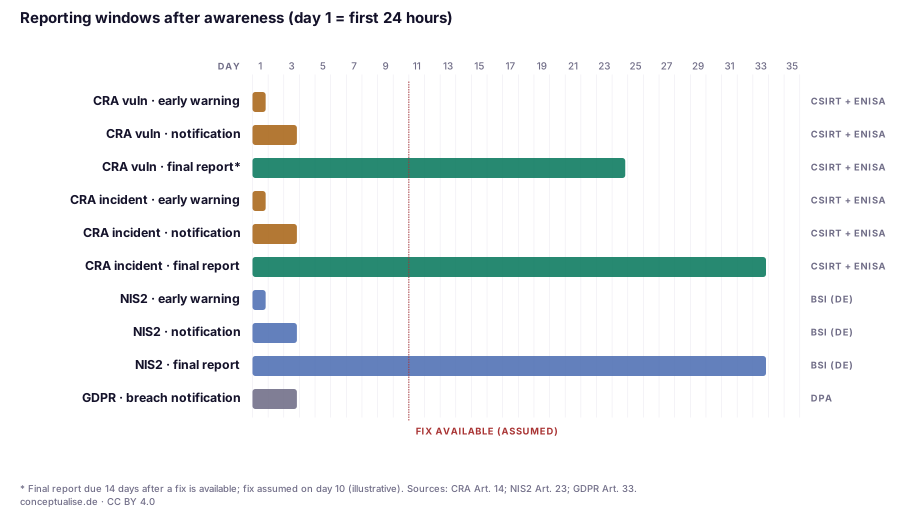
Take a realistic case: an attacker compromises a German vendor's build server and ships a trojanised update. That is a CRA severe incident. If the vendor is itself a NIS2 entity (see our NIS2 Germany scope test), it is very likely a significant incident too, and if personal data leaked, GDPR applies. Three recipients, overlapping clocks, one case file. Your customers' NIS2 supply chain obligations will also make them ask you for exactly this evidence.
In a recent engagement
In a recent engagement with a DACH manufacturer of connected industrial equipment, we ran a tabletop in early autumn 2026. The scenario: a customer reports that an intruder used a known-but-unpatched flaw in a field gateway. The technical response was good; the reporting chain was not. The security.txt address forwarded to a mailbox checked on weekdays. Nobody held an EU Login account linked to the company. The team debated whether the German subsidiary or the Austrian parent was the "main establishment", which Article 14(7) answers: where cybersecurity decisions for the products are predominantly taken. And because SBOMs existed only for the newest line, no one could quickly say which products shipped the affected firmware.
None of these gaps was exotic or expensive to fix. Walking the clock end to end with the real on-call people is what exposed them.
Readiness checklist
- A published
security.txtand CVD policy, with a monitored contact address (Annex I Part II, points 5–6). - One PSIRT queue fed by every intake channel, with 24/7 on-call and a named deputy.
- A written two-trigger test and T0 definition ("reasonable certainty").
- Main establishment determined and documented under Article 14(7), including the non-EU fallback order if relevant.
- Primary and secondary Assigned Representatives registered on the SRP with EU Login and MFA.
- Early-warning, notification and final-report templates pre-filled with product and distribution-country data.
- User-notification templates and distribution lists per product, plus CSAF.
- SBOMs for every product still on the market, legacy included.
- A documented hand-off to NIS2 and GDPR owners, with a shared case file.
- A tabletop exercise at least twice a year.
Pragmatic adoption path
- Week 1: scope and ownership. List in-scope products on the EU market, including out-of-support ones; fix the main establishment; name the PSIRT lead and deputies.
- Week 2: channels and accounts. Publish
security.txt, consolidate intake, and register Assigned Representatives on the SRP. - Weeks 3–4: templates and decision rule. Write the two-trigger test, T0 procedure and report templates; agree the RACI.
- Weeks 5–6: SBOM and advisory plumbing. Generate SBOMs in CI for every shipping line and set up CSAF/VEX publication.
- Week 7 onwards: drill. Run a tabletop with a CRA, NIS2 and GDPR overlap; fix what breaks; repeat every six months.
The verdict
CRA reporting is not hard because the forms are long; they are short by design. It is hard because it moves the regulatory trigger from the SOC to product security, which most vendors have never run on a 24-hour legal clock. The calm manufacturers know which signals count, can timestamp T0 defensibly, and can tell from an SBOM which products are affected. Everything else is templates.
If you want a second pair of senior eyes on your PSIRT runbook, from intake routing and SRP registration to SBOM-driven advisories, our DevSecOps practice builds and pressure-tests exactly this with European manufacturers. Where the same event also triggers NIS2, our Zero Trust and cybersecurity practice connects the two processes.
FAQ
When does the CRA 24-hour clock start?
At awareness. The Commission's July 2026 guidance treats a manufacturer as aware once a prompt initial assessment gives it a reasonable degree of certainty that a vulnerability in its product is being actively exploited, or that a severe incident has compromised the product's security. The assessment must start immediately.
Do we have to report every vulnerability a researcher sends us?
No. Article 14 covers actively exploited vulnerabilities: there must be reliable evidence that a malicious actor exploited it. According to the Commission's CRA FAQ, a bug-bounty zero-day with no evidence of exploitation is not a mandatory report. Handle it through your CVD process and, if useful, report it voluntarily under Article 15.
Who receives a CRA notification in Germany?
Notifications go through ENISA's Single Reporting Platform to the CSIRT coordinator of the Member State of your main establishment, and ENISA sees them at the same time. For a German main establishment that is the BSI, which says it has coordinated CRA reports since 11 September 2026.
Does CRA reporting apply to products sold before 11 December 2027 or no longer supported?
Yes. Article 69(3) applies Article 14 to in-scope products placed on the market before 11 December 2027, and the Commission's guidance says reporting continues after the support period ends. Annex I Part II vulnerability handling does not apply to those products, but notifying and informing users does.
How does CRA reporting relate to NIS2 and GDPR?
They are separate duties. The CRA concerns your product and goes to the CSIRT coordinator and ENISA via the Single Reporting Platform. NIS2 concerns your own services and goes to the national authority (the BSI in Germany). GDPR Article 33 concerns personal data breaches and goes to the data protection authority. A compromised build pipeline can trigger all three.
What are the penalties for missing a CRA reporting deadline?
Article 64(2) allows fines of up to EUR 15 million or 2.5 percent of worldwide annual turnover, whichever is higher, for breaching Articles 13 or 14. Article 64(10) spares micro and small enterprises fines for missing the 24-hour early warning. Member States set the detailed rules; Germany's implementation act passed the Bundestag on 15 October 2026.
Sources
Checked on 15 November 2026. This article is not legal advice.
Tier A: primary and regulatory
- Regulation (EU) 2024/2847 (Cyber Resilience Act), EUR-Lex: Art. 3(42), 13(6), 14, 15, 16, 24(3), 64, 69(3), 71; Annex I Part II
- Commission Delegated Regulation (EU) 2026/881 on delaying dissemination of notifications
- European Commission: Commission guidance on the application of the CRA, C(2026) 5252, 27 July 2026
- European Commission: CRA implementation FAQs (updated 4 September 2026)
- European Commission: CRA reporting obligations
- ENISA: The CRA Single Reporting Platform is launched (11 September 2026)
- ENISA: Single Reporting Platform FAQ
- BSI press release: CRA-Durchführungsgesetz passed by the Bundestag (16 October 2026)
- Directive (EU) 2022/2555 (NIS2), Art. 23; Regulation (EU) 2016/679 (GDPR), Art. 33–34
Tier B: analysis and reporting
- Security-Insider: CRA-Meldepflicht läuft – wo ENISA-Plattform und Fristen in der Praxis haken (30 October 2026)
- Help Net Security: ENISA launched the CRA Single Reporting Platform (14 September 2026)
Tier C: vendor and directional
- None relied on for facts in this article.
Topics