Dependency Firewalls: Cooldowns, Curation and Quarantine
A dependency firewall puts a proxy registry between your builds and npm or PyPI. We show how cooldowns, curation and quarantine stop malicious releases.
On 11 July 2026 an attacker published malicious versions of the jscrambler CLI with a stolen npm token. The vendor spotted the first publish within seconds and shipped a clean release about two hours later. npm removed the bad versions roughly 41 hours after the first one appeared. That was the longest exposure window of any incident since September 2025 that we could time from primary sources. Most of the others were measured in single-digit hours.
The registry and the security community now spot and pull malicious releases quickly. Most enterprise builds are quicker still: they resolve a caret range minutes after publication. A dependency firewall closes that gap. It is a proxy registry that decides which versions your estate may see, how old they must be and what happens to suspicious ones. This article is for the people who have to put it in place: CTOs, CISOs, platform leads and architects.
TL;DR / Key takeaways
- A dependency firewall is a proxy registry with opinions. One entry point for every client, an allow-list, a cooldown on metadata, malware scanning, quarantine and an audit trail. Egress rules stop anyone going around it.
- The cooldown does most of the work. In the six tracked incidents with a public removal time, a one-day cooldown would have skipped five malicious releases. Three days or more would have skipped all six.
- Defaults changed in 2026. pnpm 11 holds new versions for a day by default; Yarn 4.15 does the same for new projects. npm 11.10 added
min-release-age, but it is off unless you set it. - Filter metadata, do not just block tarballs. A proxy that refuses the newest version without hiding it from the version list breaks installs. Then someone adds a bypass.
- Design the fast lane first. A cooldown without a dated exception path for security fixes gets switched off at the first critical CVE.

Download: Editable draw.io file · Open in diagrams.net · Chart data (CSV)
Why this matters now
Our teardown of the 2026 npm supply-chain attacks found one consistent pattern. The attackers varied, from a North Korea-nexus actor against axios to the TeamPCP cluster against CI tooling. What did not vary was the moment of exposure: a malicious version reaches the registry, and a build somewhere resolves it before anyone has had time to look. Socket reported a median detection time of about 6.7 minutes for the May 2026 AntV wave. Detection is fast. Installation is faster.
The ecosystem has responded by changing defaults. pnpm 11 (28 April 2026) resolves nothing younger than 1,440 minutes unless you opt out. Yarn 4.15 made a one-day npmMinimalAgeGate the default in May, but only for new projects: upgrades pin the old value. npm 11.10.0 added min-release-age in February, and Dependabot now applies a three-day cooldown to version updates even when you configure none. Each helps. None is a control you can evidence across an estate, because each lives in a different client and config file.
The six stages of a dependency firewall
The numbers below match the callouts in the hero diagram. Stages 1–3 sit on the serve path, where a client asks for a package. Stages 4–6 sit on the ingest path, where a new upstream version arrives.
1. Single entry point
Every client resolves through one registry URL: laptops, CI runners, container builds and update bots. In .npmrc that is one registry= line; pip and uv use an index URL, Maven and NuGet a mirror. The part teams skip is the egress rule. If a runner can still reach registry.npmjs.org, one --registry flag walks around everything else. Block public registries at the network layer for build agents, and treat a direct connection from a laptop as a finding.
2. Allow-list and curation
A curated registry decides which packages may enter at all: approved packages or scopes for production, a block on look-alikes of your top dependencies, and dependency-confusion protection for internal names. Azure Artifacts, for example, blocks new public versions of a name you also publish internally. Start in report-only mode. A hard allow-list on day one produces a week of broken builds and a political problem.
3. Cooldown on metadata
This stage would have absorbed every incident in our charts. The proxy hides versions younger than N days, so a caret range resolves to the newest aged version. If it only blocks the tarball, the client still sees the new version as latest, fetches it and fails. Sonatype's Policy Compliant Component Selection works the right way: it filters requests so the client gets the most recent compliant version, not an error.
Client cooldowns are the backstop, with one trap. pnpm 11 skips the age check by default when metadata has no time field (minimumReleaseAgeIgnoreMissingTime: true), so a proxy that strips timestamps quietly disables it. Renovate, by contrast, holds updates that lack a release timestamp.
4. Malware and integrity scan
New versions are analysed before they enter the cache: new install scripts, obfuscated payloads, install-time network calls, a drop in provenance, and matches against feeds such as the OpenSSF malicious-packages data in OSV format. pnpm's trustPolicy: no-downgrade brings the provenance check to the client, failing an install when trust evidence is weaker than in earlier releases. Remember TanStack, though: valid provenance from a hijacked pipeline is still valid provenance.
5. Quarantine and release
Anything the scanner flags, or policy cannot decide, goes into quarantine: held, visible to security, invisible to clients, until someone releases or rejects it. The same mechanism carries the security fast lane. When an advisory names a fixed version still inside the cooldown, a reviewed exception releases exactly that version, with an expiry date and an owner.
6. Cache, purge and evidence
Proxies cache, and caches remember. Microsoft documents that saved package versions are immutable and remain in an Azure Artifacts feed even if the upstream is disabled. Good for availability; bad when npm pulls a malicious version your proxy already saved. Your runbook needs a purge step: find every cached version named in an advisory, block it and record that you did. The same audit log shows which builds pulled which versions, which is the evidence a responder or auditor will ask for.
What the numbers say
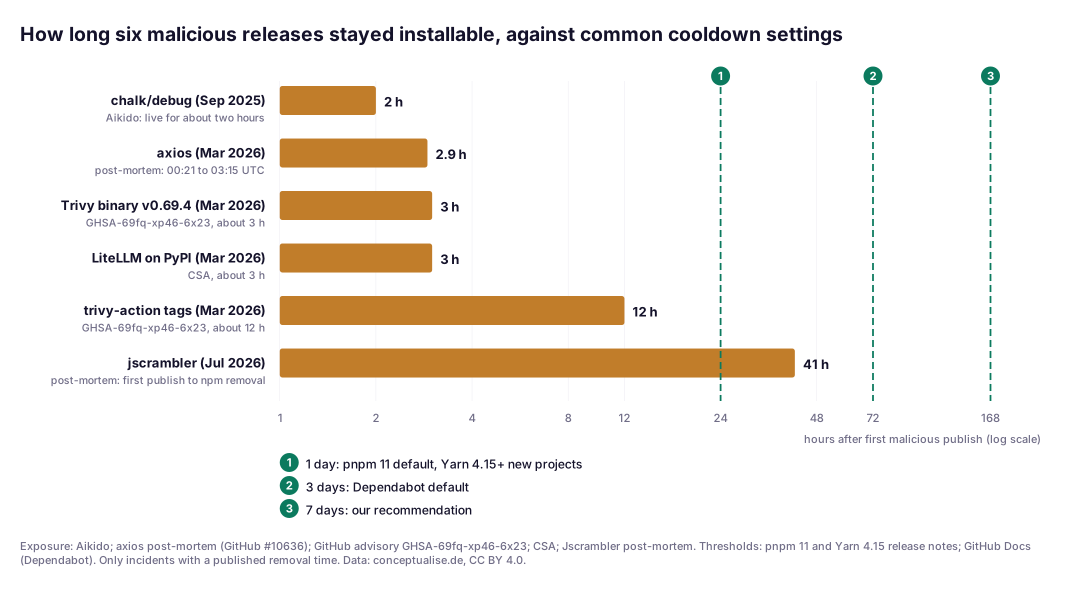
We reused the exposure windows from our npm teardown, each tied to one primary source, and plotted them on a log scale against three common cooldown lengths. Five of six close before the one-day line. Only jscrambler, at about 41 hours, crosses it.
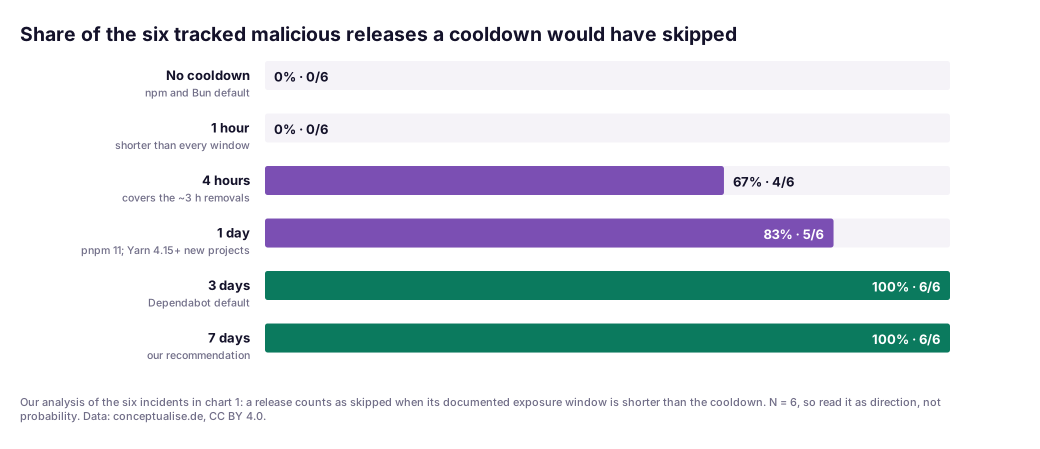
One hour skips none of the six, because even the fastest takedowns took about two hours. Four hours skips four, a day five, three days all six. Be honest about what this is: six incidents, and survivor-biased, since these are the attacks that were detected and documented. A patient attacker could stay live longer. That is why we recommend seven days, not three, and why stage 4 still matters.
In a recent engagement…
During a supply-chain review this year, a European software company told us they "already had a dependency firewall". They had a commercial proxy registry, scanning switched on and pipelines pointed at it. What it enforced was another matter. The scanner ran in report-only mode after a false positive once blocked a release. There was no cooldown, so the proxy served new versions as fast as npm did. Build agents could still reach the public registry, and a few older pipelines did. The cache kept every version ever requested, with no purge process.
None of the fixes needed new tooling. We added a seven-day cooldown on proxy metadata with an advisory-driven fast lane, and blocked public registries for build agents, which surfaced the forgotten pipelines within two days. Scanning moved to quarantine for new install scripts only, where false positives are rare, and purge became a runbook step. The slowest part was agreeing that the platform team owns the exception list.
The decision table: cooldown settings, checked
Settings checked against documentation and release notes on 15 November 2026. Defaults change, so re-check before you copy.
| Tool | Setting | Unit / format | Default today | Exemptions |
|---|---|---|---|---|
| npm (11.10.0+) | min-release-age | days | off | none documented; use proxy or bot fast lane |
| pnpm (10.16+, default in 11) | minimumReleaseAge in pnpm-workspace.yaml | minutes | 1,440 in pnpm 11 | minimumReleaseAgeExclude; pnpm audit --fix adds fixes |
| Yarn (4.10+, default in 4.15) | npmMinimalAgeGate | duration, e.g. 3d, 1w | one day for new projects since 4.15 | npmPreapprovedPackages |
| Bun | install.minimumReleaseAge in bunfig.toml | seconds | off | install.minimumReleaseAgeExcludes |
| uv | exclude-newer | date, or duration such as 7 days / P7D | off | per-package cut-off via exclude-newer-package |
| pip | --uploaded-prior-to | datetime, or P<n>D | off | none documented; needs upload-time metadata from the index |
| Dependabot | cooldown | days, per semver level | three days for version updates | security updates are never delayed |
| Renovate | minimumReleaseAge | duration, e.g. 3 days | off | per packageRules; needs a release timestamp |
| Proxy registry | product-specific hold or immaturity policy | varies | varies | quarantine release, dated exceptions |
Proxy capabilities differ, so map each of the six stages to your product. JFrog markets a Curation "immaturity policy" that holds new versions for 14 days. Sonatype Repository Firewall quarantines components before they reach the repository. The Azure Artifacts pages we checked document caching and dependency-confusion protection, but neither a release-age hold nor malware scanning, so pair Artifacts with client cooldowns and a separate scanner. For laptops without a corporate proxy, Socket's free sfw wrapper runs an ephemeral proxy per install for npm, Yarn, pnpm, pip, uv and cargo.
Checklist before you call it a firewall: one registry URL everywhere · egress blocked for build agents · cooldown on metadata, not just tarballs · timestamps preserved for clients · client cooldown as a backstop · quarantine with a named owner · dated security fast lane · purge step in the incident runbook · audit log retained.
Governance for European enterprises
Cyber Resilience Act. Article 13(5) of Regulation (EU) 2024/2847 requires manufacturers to exercise due diligence when integrating third-party components, including free and open-source software. The main obligations apply from 11 December 2027; Article 14 reporting has applied since 11 September 2026. A dependency firewall makes that due diligence visible: written rules, quarantine decisions and a log of what entered which build. The same log decides how fast you can answer the 24-hour question, which our CRA reporting runbook walks through.
NIS2. Article 21(2)(d) of Directive (EU) 2022/2555 requires essential and important entities to address supply-chain security. Open-source intake is not a supplier contract, but auditors increasingly ask how it is governed, and a documented cooldown and exception process is a proportionate answer. We cover the wider obligation in our NIS2 supply-chain guide.
A pragmatic adoption path
- Week 1: measure. List every client that resolves packages and where from: proxy logs, CI package-manager versions, egress flows from build agents.
- Week 2: client backstops. Seven-day cooldown in Renovate or Dependabot and in pnpm, Yarn or Bun;
min-release-age=7for npm 11.10+. Check that your proxy keeps thetimefield. - Weeks 3–4: one door. Point every client at the proxy, block public registries for build agents, run the allow-list in report-only mode.
- Month 2: cooldown and fast lane at the proxy. Hide versions younger than seven days. Turn advisories into dated, owned exceptions, and rehearse one.
- Month 3: quarantine and purge. Quarantine new install scripts and provenance drops, add purge to the incident runbook and keep the audit log. Our Azure DevOps supply-chain guide covers the pipeline side.
The verdict
A dependency firewall is less a product than a set of decisions your existing proxy can enforce. The most valuable one is also the cheapest: do not install anything younger than a week. The data is thin but consistent. Malicious releases are found and pulled in hours; the question is whether your builds wait that long.
Our view: put the cooldown on the proxy, keep a client cooldown as a backstop, close the egress path and build the fast lane before anyone needs it. Scanning and quarantine then handle the attackers patient enough to outlast a week. With AI coding agents adding dependencies faster than humans review them, as we argue in our guide to securing AI coding agents, the case only gets stronger.
If you want to know what your proxy actually enforces today, our DevSecOps team runs a short, fixed-scope review against the six stages above and leaves you with the gaps ranked.
FAQ
What is a dependency firewall?
A proxy registry between your developers, CI runners and update bots and public registries such as npmjs.com or PyPI. Every install resolves through it. It enforces an allow-list, hides versions that are too new, scans new versions and quarantines suspicious ones. Egress rules stop anyone installing straight from the internet.
How long should a dependency cooldown be?
We recommend seven days, with a dated exception path for security fixes. In the six incidents from September 2025 to July 2026 with a published removal time, every malicious release was gone within 41 hours. One day would have skipped five of them, three days all six. Six is not a sample, so seven days buys margin.
Which package managers support a minimum release age?
As of November 2026: npm min-release-age (days, since 11.10.0, off by default); pnpm minimumReleaseAge (minutes, 1,440 by default since pnpm 11); Yarn npmMinimalAgeGate (one day by default for new projects since 4.15); Bun install.minimumReleaseAge (seconds, off); uv exclude-newer and pip --uploaded-prior-to. Dependabot defaults to a three-day cooldown; Renovate has minimumReleaseAge.
Does a cooldown delay security patches?
Only if you let it. Dependabot never applies its cooldown to security updates, and pnpm audit --fix adds the patched version to minimumReleaseAgeExclude. For npm and proxy registries you need an explicit fast lane: a reviewed, dated exception for the fixed version. Without one, teams switch the cooldown off at the first critical CVE.
Is a client-side cooldown enough without a proxy registry?
It is a good start but hard to evidence. Client settings differ by package manager and live in files anyone can change. A proxy enforces one policy for every client, adds scanning and quarantine, keeps an audit log and can purge versions pulled upstream. We run both: the proxy as the control, the client setting as a backstop.
Does a dependency firewall help with Cyber Resilience Act compliance?
It supports it. CRA Article 13(5) requires due diligence when integrating third-party components, including open source, and Article 14 reporting has applied since 11 September 2026. A firewall gives you documented intake rules, quarantine decisions and a log of which versions entered which build, which also speeds up incident triage.
Sources
All sources checked on 15 November 2026. Exposure windows are reused from our npm teardown, where each is tied to one primary source.
Tier A: primary, documentation and regulatory
- npm CLI v11.10.0 release (adds
min-release-age): https://github.com/npm/cli/releases/tag/v11.10.0 - npm docs, config (
min-release-age,before): https://docs.npmjs.com/cli/v11/using-npm/config - pnpm v10.16.0 release notes (introduces
minimumReleaseAge): https://github.com/pnpm/pnpm/releases/tag/v10.16.0 - pnpm v11.0.0 release notes (1,440-minute default,
minimumReleaseAgeIgnoreMissingTime,audit --fix): https://github.com/pnpm/pnpm/releases/tag/v11.0.0 - pnpm docs, dependency resolution settings (
trustPolicy,minimumReleaseAgeStrict): https://pnpm.io/settings/dependency-resolution - Yarn 4.10.0 and 4.15.0 release notes (
npmMinimalAgeGate, one-day default): https://github.com/yarnpkg/berry/releases - Yarn PR #7135 (one-day default for new projects, existing projects pinned on upgrade): https://github.com/yarnpkg/berry/pull/7135
- Bun docs, bunfig.toml (
install.minimumReleaseAge): https://bun.com/docs/runtime/bunfig - uv settings reference (
exclude-newer): https://docs.astral.sh/uv/reference/settings/ - pip install reference (
--uploaded-prior-to): https://pip.pypa.io/en/stable/cli/pip_install/ - GitHub Docs, Dependabot options reference (
cooldown): https://docs.github.com/en/code-security/dependabot/working-with-dependabot/dependabot-options-reference - Renovate docs, configuration options (
minimumReleaseAge,minimumReleaseAgeBehaviour): https://docs.renovatebot.com/configuration-options/ - Microsoft Learn, Azure Artifacts upstream sources: https://learn.microsoft.com/en-us/azure/devops/artifacts/concepts/upstream-sources
- Microsoft Learn, safeguard against malicious public packages (upstream behaviour): https://learn.microsoft.com/en-us/azure/devops/artifacts/concepts/upstream-behavior
- axios maintainers, post-mortem: https://github.com/axios/axios/issues/10636
- GitHub Security Advisory GHSA-69fq-xp46-6x23 (Trivy): https://github.com/advisories/GHSA-69fq-xp46-6x23
- Jscrambler, security incident post-mortem: https://jscrambler.com/blog/security-incident-postmortem-jscrambler/
- Regulation (EU) 2024/2847 (Cyber Resilience Act), Articles 13 and 14: https://eur-lex.europa.eu/eli/reg/2024/2847/oj/eng
- Directive (EU) 2022/2555 (NIS2), Article 21: https://eur-lex.europa.eu/eli/dir/2022/2555/oj/eng
Tier B: research
- OpenSSF Malicious Packages (OSV-format reports): https://github.com/ossf/malicious-packages
- Cloud Security Alliance, npm and AI toolchain supply-chain whitepaper: https://labs.cloudsecurityalliance.org/research/csa-whitepaper-npm-ai-toolchain-supply-chain-security-v1-0-c/
- Aikido, chalk/debug compromise: https://www.aikido.dev/blog/npm-debug-and-chalk-packages-compromised
- Socket, AntV packages compromised: https://socket.dev/blog/antv-packages-compromised
Tier C: vendor, directional
- Sonatype, Repository Firewall: https://help.sonatype.com/en/repository-firewall.html
- Sonatype, Policy Compliant Component Selection: https://help.sonatype.com/en/policy-compliant-component-selection.html
- JFrog, Curation product page (immaturity policy): https://jfrog.com/curation/
- Socket, introducing Socket Firewall (30 Sep 2025): https://socket.dev/blog/introducing-socket-firewall
Topics