Securing AI Coding Agents: Sandboxes, Secrets, Guardrails
AI coding agents leak secrets at twice the baseline rate. Nine controls, from sandbox to CI, to run Claude Code, Copilot and Cursor safely in your SDLC.
On 17 March 2026, GitGuardian published the fifth edition of its State of Secrets Sprawl report. One line went round every AppSec channel we follow. Commits co-authored by Claude Code leaked secrets at about 3.2%, against a baseline of 1.5% across all public GitHub commits. That is roughly double. GitGuardian was careful to say this "should not be read as a simple tool failure", and it is right: a human still accepts and pushes every one of those commits. But the number captures something real. Coding agents now write a large share of the code reaching our repositories, and the controls around them were built for human-paced change.
The leak rate is only the most visible symptom. Since mid-2025, malware hijacked locally installed agent CLIs to hunt for credentials. A prompt injection flipped GitHub Copilot into auto-approve. A worm tried to plant files in .claude/ folders to persist. And researchers spent a week in July 2026 showing that agent sandboxes hold while the tools around them do not. This article is for the people who decide how agents run in the delivery pipeline: CTOs, CISOs, platform leads and architects. We follow code from the laptop through the agent sandbox and the repository into CI, mark nine control points, and say plainly which ones stop which failure.
TL;DR / Key takeaways
- Agents double the leak rate, and humans still press the button. GitGuardian measured about 3.2% for Claude Code co-authored commits against a 1.5% baseline. Push protection is now table stakes.
- The sandbox is necessary, not sufficient. Built-in sandboxes cover shell commands. Hooks, MCP servers and file tools often run outside them, and by default they can still read
~/.ssh. - The real escape is the trust handoff. The 2026 sandbox-escape wave did not break sandboxes. Agents wrote config, hook and task files that a trusted tool outside later ran. Protect those files like code.
- Agents bypass your network controls. CLI and IDE agents talk to model APIs and MCP servers straight from the workstation, usually around your web proxy. Route them through an AI gateway.
- Four controls carry most of the weight. In our matrix, managed policy, no ambient credentials, protected config files and approval-gated CI together stop or limit every scenario. Each alone leaves gaps.

Download: Editable draw.io file · Open in diagrams.net · Chart data (CSV)
Why this matters now
Two years ago an AI assistant completed lines in an editor. Today it is an agent. It reads the repository, runs the build, installs packages, calls tools over MCP, edits configuration and opens pull requests, all with the permissions of the developer's machine or the CI runner. It is less an IDE plug-in than a new colleague with shell access who believes whatever it reads.
Secrets. GitGuardian counts about 29 million secrets detected on public GitHub in 2025, with newly leaked secrets up 34% year on year. Secrets for AI services rose 81% to 1,275,105. It found 24,008 unique secrets in MCP configuration files, and notes that popular MCP setup guides tell users to paste keys straight into them.
Agents as a weapon. On 26–27 August 2025, eight malicious Nx versions reached npm. Snyk's analysis shows the payload ran any installed AI CLI with its safety switches off: Claude Code with --dangerously-skip-permissions, Gemini CLI with --yolo, Amazon Q with --trust-all-tools. It asked them to inventory keys, .env files and wallets. Semgrep found that Claude refused in the logs it reviewed, but warns that rewording often bypasses such refusals. An agent CLI with a bypass flag is a ready-made reconnaissance tool for any malware on the machine.
Agents as a target. In July 2025, malicious code committed to the Amazon Q Developer extension for VS Code smuggled in a prompt asking the agent to wipe the machine and cloud resources. It shipped in version 1.84.0 before being pulled; Amazon says no users were affected. CVE-2025-53773, published on 12 August 2025, showed a prompt injection telling Copilot to set "chat.tools.autoApprove": true in the workspace settings, after which it ran terminal commands without asking.
Sandboxes, and what sits around them. CVE-2026-25725, fixed in Claude Code v2.1.2, let code inside the bubblewrap sandbox create .claude/settings.json and plant a SessionStart hook that ran with host privileges on the next launch. In July 2026, Pillar Security published seven issues across Cursor, Codex CLI, Gemini CLI and Antigravity. The Cloud Security Alliance's note makes the point that matters: none broke the sandbox. Each had the agent write something that a trusted component outside later ran.
Persistence. The Mini Shai-Hulud worm that hit SAP's npm packages in April 2026 stole Claude and MCP configuration. Aikido reports it also tried to push .claude/settings.json, .vscode/tasks.json and .vscode/setup.mjs into repositories, in commits authored as "claude". We covered the campaign in our 2026 npm supply-chain teardown.
None of this argues for banning agents. It argues for treating the agent as a privileged workload with its own threat model. Our guide to prompt injection and tool abuse covers the general agent case; here we stay on the delivery path.
The nine control points, from laptop to CI
The hero diagram reads left to right. A developer prompts an agent client. The agent plans, calls a model, edits the workspace and runs commands in a sandbox. It pushes to a branch, a pull request triggers CI, and CI deploys. Underneath sit three things the agent does not control: untrusted content, the model API and MCP servers or extensions. Where they fit, we map to the OWASP Top 10 for Agentic Applications (9 December 2025), so your risk register can cite a recognised taxonomy.
① Managed agent policy: no YOLO modes on real machines
Every serious agent has a permission system: allow, ask and deny rules, a sandbox switch and a mode that skips all prompts. The question is who sets them. By default the developer does, and the repository can often suggest settings too. CVE-2025-53773 worked because a workspace file could flip auto-approve.
Set the security-relevant keys centrally, where users and repositories cannot override them. Claude Code's documentation puts managed settings at the top of its precedence order: "Nothing in your own settings files or --settings overrides a managed key." Bypass and auto modes cannot be enabled from project settings at all. Copilot, Cursor and Codex have their own enterprise policy surfaces. Use them to enforce the sandbox, keep bypass modes off on machines holding real credentials, deny reads of .env, ~/.ssh and cloud CLI caches, and restrict which MCP servers load. This maps to OWASP ASI02 and ASI03, and it is the cheapest control on the list.
② OS sandbox or dev container: isolate filesystem and network together
Claude Code uses Seatbelt on macOS and bubblewrap on Linux and WSL2; Codex CLI and Gemini CLI ship their own OS-level sandbox modes. Claude Code's sandbox has two independent layers, filesystem and network isolation, and network traffic goes through a local proxy that checks each host against an allow-list that starts empty. Keep both layers on: filesystem limits without egress limits still let a command send out whatever it can read, and egress limits without filesystem limits let it plant files that later commands run.
Read the limits as carefully as the features. The same page says the sandbox "covers shell commands only". File and web tools follow permission rules instead, and hooks and local MCP servers "run with your full access". The default read scope is "most of the machine, including credential files such as ~/.ssh and ~/.aws/credentials". So we use two tiers:
- Interactive work on a laptop: built-in sandbox enforced by policy, set to fail closed, unsandboxed retries off, read-deny rules for credential paths.
- Autonomous or long-running work: a disposable dev container, a cloud development environment or a cloud agent such as Copilot cloud agent. Mount the repository and a scoped token, nothing else.
The second tier is where bypass modes become acceptable, because there is nothing to steal and nothing to persist into.
③ No ambient credentials within the agent's reach
This control turns most other failures into non-events. The Nx malware asked agents for SSH keys and .env files. Mini Shai-Hulud harvested cloud token caches and MCP configs. GitGuardian's analysis of the Shai-Hulud 2 stealer found 33,185 unique secrets on 6,943 compromised machines. An agent, or malware posing as one, can only steal what is there.
Move cloud access to short-lived credentials issued through SSO, and CI to OIDC federation scoped per environment. Take API keys out of .env and MCP config files and fetch them at runtime from a secrets manager or credential helper. Give the agent its own repository-scoped token, never the developer's organisation-wide personal access token. The working rule: if a secret is readable from the agent's environment, assume it will eventually land in a prompt, a log or a commit.
④ Egress through an AI gateway: agents ignore your proxy
This is the gap most organisations have not noticed. Browser traffic to ChatGPT or Gemini usually crosses a secure web gateway with TLS inspection and DLP. A CLI agent or IDE extension usually does not. It opens its own connections to the model API, package registries and every remote MCP server configured on the machine. In most estates we review, the security team cannot list which model endpoints and MCP servers developers' agents talk to.
Route model traffic through an AI gateway that holds provider keys, enforces approved models and regions, logs prompts to your retention rules and applies DLP. Most agent clients accept a custom base URL; if yours does not, make that a procurement criterion. Let sandbox egress follow an allow-list of your registries and source control. And watch the routes an allow-list will not catch, above all pushes to github.com with a stolen token. The gateway is also your audit trail. Without it, "what did the agent send to the model?" has no answer.
⑤ MCP servers and extensions from an approved registry only
Every MCP server an agent loads is code running with the agent's permissions, often outside the sandbox. So is every IDE extension. In GitGuardian's sample of public MCP config files, Google API keys were the most common valid secret, and 14% of all secrets found were PostgreSQL connection strings. MCP is where agents reach production data.
Keep an internal registry of approved servers and extensions, each with an owner, a pinned version and a reviewed scope. Configure clients to load only those, and run discovery for what slips through. Be honest about the limit: the Amazon Q incident was a poisoned official extension, so an allow-list would not have stopped it. Version pinning with a short cooldown would have bought time. That is why our matrix marks this control "limits", not "stops". This is OWASP ASI04, and our piece on shadow MCP discovery and governance covers the discovery half.
⑥ Protect config, hook and task files: close the trust handoff
This is the 2026 lesson. The sandbox constrains what the agent does, not what other tools later do with the files it wrote. In the CSA's words, a sandbox "is only as strong as the assumptions made by everything downstream of it". The files that matter are those a trusted component will run or obey without asking: agent settings and hooks (.claude/settings.json, Cursor hooks, chat.tools.autoApprove), .vscode/tasks.json, Git hooks and config, project-local virtualenvs, and CI workflow files.
Three controls apply. The agent client should refuse sandboxed writes to these paths; Claude Code's fix for CVE-2026-25725 did exactly that. Developer tools should re-confirm any task, hook or interpreter that changed during an agent session. And the repository should require code-owner review for these paths. A CODEOWNERS entry for .github/workflows/, .claude/ and .vscode/ takes ten minutes.
⑦ Secret scanning with push protection, before and at the remote
Back to the 3.2%. Agents produce larger commits, touch configuration often and happily copy a working connection string from one file to another. Reviewers skim large agent diffs. So check every commit automatically, twice. First on the machine: a pre-commit hook running ggshield, gitleaks or TruffleHog, or a pre-tool hook that scans before every git commit the agent issues, so the agent fixes its own mistake. Then at the remote: push protection in GitHub Secret Protection, Azure DevOps Advanced Security or GitLab blocks the push whatever happened on the laptop.
A blocked push gets fixed in a minute. A secret found weeks later often never gets revoked: GitGuardian found 64% of valid secrets from 2022 still live in 2026.
⑧ A separate identity for the agent, and branch protection that assumes it
An agent should not commit as the developer, with the developer's token, to any branch it likes. GitHub's documentation for Copilot cloud agent is a good reference model. The agent can push to a single branch only. The person who asked for the pull request cannot approve it. Only users with write access can trigger it. Commits are authored by Copilot, with the developer as co-author.
Apply that to every agent, local ones included. Agent work lands on agent/* branches. Main requires review from someone other than the requester. Commits are signed, so an attacker cannot simply author commits as "claude", as Mini Shai-Hulud did. This is OWASP ASI03, and it turns "the agent did it" into a reviewable event.
⑨ Approval-gated CI with no secrets for agent-triggered runs
An agent-authored pull request can change code, tests, build scripts and workflows. If CI runs it automatically with deployment secrets in scope, the agent, or whoever injected it, gets those secrets. GitHub's default is the right one: for Copilot cloud agent, "workflows are not triggered until Copilot cloud agent's code is reviewed", and a user with write access approves the run.
Apply the same rule to every agent. Agent-branch pipelines run after human approval, without deployment credentials, as you would treat fork pull requests. They run the scans that catch what agents get wrong: secrets, SAST, dependencies and licences. Deployment uses OIDC scoped per environment. GitGuardian found that 59% of the machines hit by the Shai-Hulud 2 stealer were CI/CD runners, so treat the runner as the most exposed host in the path. Our DevSecOps pipeline design guide covers runner isolation.
What the numbers say
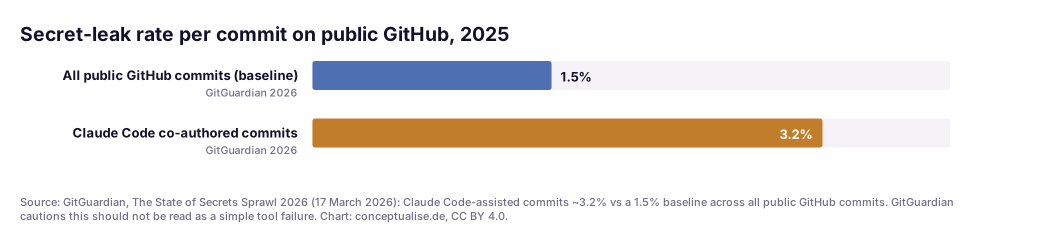
Read the headline chart carefully. GitGuardian's figure covers commits it could attribute to Claude Code as co-author. It does not measure every AI-assisted commit; tools that leave no trace are invisible here. The public summary does not publish the full method, and we could not verify it independently. We read the doubling as a workflow signal, not a model-quality score. Agents raise the volume and size of change per developer, and review habits built for human-sized commits do not keep up.
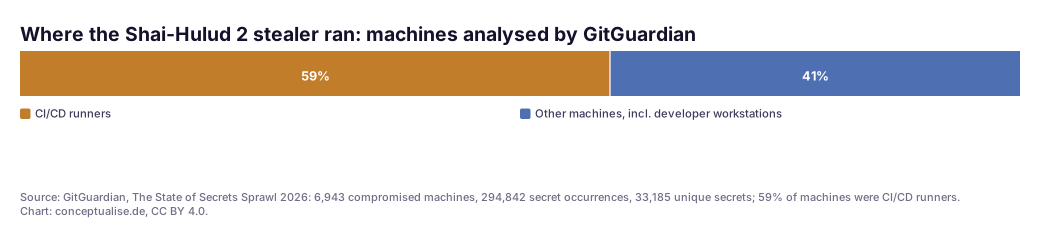
The second chart explains why controls ⑦ to ⑨ matter as much as ① to ⑥. Most machines the stealer reached were CI runners, not laptops. Workstation and pipeline are one blast radius, and an agent that triggers CI with secrets in scope effectively holds those secrets.
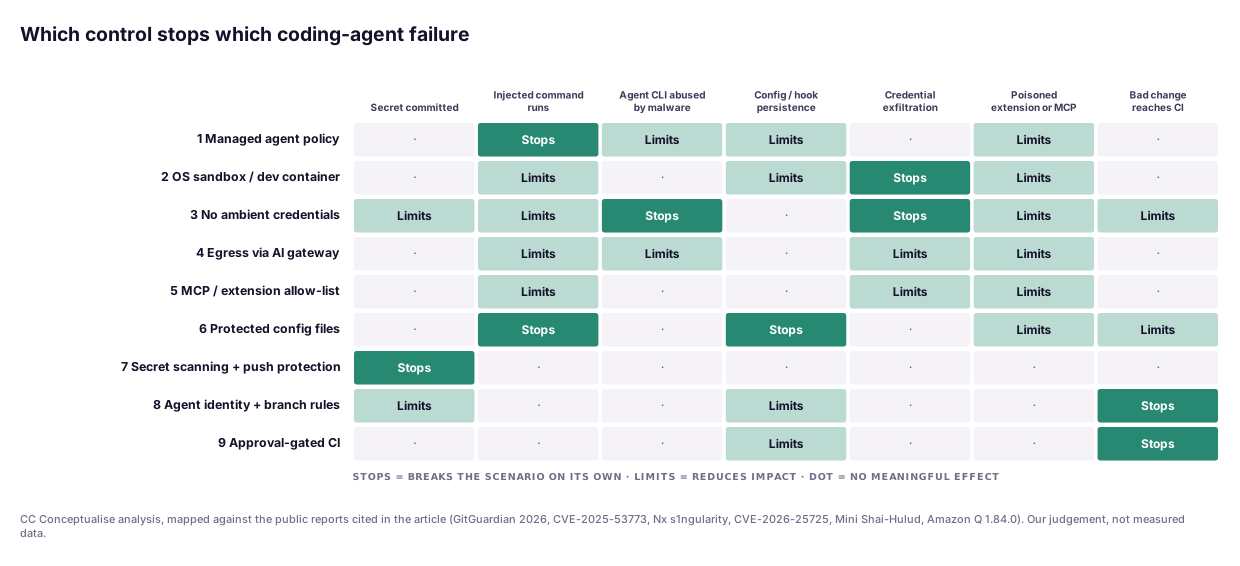
The matrix is our analysis, not external data: each control scored against seven scenarios drawn from the incidents above. Three readings stand out. No row is solid, so a single-control strategy is not a strategy. One column has no "Stops" at all: the poisoned extension or MCP server. When a trusted vendor ships bad code, allow-lists and sandboxes only limit the damage, and pinning, cooldowns and fast removal are what remain. And four controls carry most of the weight: managed policy ①, no ambient credentials ③, protected config files ⑥ and approval-gated CI ⑨ together stop or limit every scenario. If budget or patience is short, start there.
In a recent engagement…
Earlier this year we reviewed agent usage at a European software company that had rolled out a commercial coding agent to a few hundred engineers. The rollout was well run: a licence process, a training session, an acceptable-use policy. The security review came afterwards and found the usual gap between policy and machine.
Permission settings were left to each developer, and a noticeable share had switched on the skip-prompts mode because prompts "slowed them down". Cloud CLI sessions with long refresh windows sat in home directories. Several repositories had MCP config files committed with API keys inline, copied from a README. Agent traffic went straight from laptops to the model provider and to remote MCP servers nobody in security had heard of. Agent pull requests triggered the full pipeline, including a job with deployment credentials, before anyone looked.
None of it was malicious and most of it was invisible. The fix took about six weeks. Managed settings came first: sandbox on and fail-closed, bypass modes off on laptops, read-deny rules for credential paths. Long autonomous tasks moved into dev containers, where bypass mode was allowed. We rotated committed keys, enabled push protection and added CODEOWNERS for workflow and agent config paths. Then CI changed so agent branches waited for approval and ran without deployment secrets. The AI gateway came last, because it needed procurement. The hardest conversation was who owns the MCP allow-list.
The control checklist
This is the screenshot-able part. Stops refers to the matrix above.
| # | Control | How to implement (late-2026 tooling) | Evidence for an auditor | Stops |
|---|---|---|---|---|
| 1 | Managed agent policy | Claude Code managed settings; Copilot, Cursor and Codex enterprise policies via MDM | Policy in config management; client shows policy source | Auto-approve flips |
| 2 | OS sandbox or dev container | Built-in sandbox, enforced and fail-closed; containers or cloud agents for autonomous runs | Policy requires sandbox; container images in a registry | Exfiltration from sandboxed commands |
| 3 | No ambient credentials | Short-lived SSO credentials; secrets manager or credential helper; per-repo agent tokens | No long-lived keys on endpoints or in MCP configs | Agent CLI abuse; credential theft |
| 4 | Egress via AI gateway | Agent base URL set to the gateway; sandbox network allow-list | Gateway logs per user and model | Limits only |
| 5 | MCP and extension allow-list | Internal registry; client allow-lists; pinned versions with a cooldown | Registry with owners; discovery reports | Limits only |
| 6 | Protected config, hook and task files | Client write-protection; re-confirm changed tasks; CODEOWNERS on .github/workflows/, .claude/, .vscode/ | CODEOWNERS; branch rules; client at or above fixed release | Config/hook persistence |
| 7 | Secret scanning + push protection | Pre-commit or agent pre-tool scanner; server-side push protection | Push-protection metrics; bypasses reviewed | Secret committed |
| 8 | Agent identity + branch protection | Agent-only branches; requester cannot approve; signed commits | Branch rulesets; audit log attributing agent commits | Bad change reaching CI or main |
| 9 | Approval-gated CI | Approval for agent-branch runs; no deployment secrets; OIDC per environment | Workflow and environment protection settings | Agent runs reaching CI secrets |
Two warnings. Every control has a bypass, and developers will find it if the control costs more than a few seconds a day, so measure friction as well as coverage. And agent clients move fast: the 2026 sandbox fixes shipped as point releases. Treat agent CLIs and extensions as managed software with a minimum version.
Governance for European enterprises
No EU regime names coding agents. Several apply anyway, and auditors have started asking.
EU AI Act. Writing software with an agent is not an Annex III high-risk use, and those obligations now apply only from 2 December 2027 under Regulation (EU) 2026/1744. Article 4 does apply: since 2 February 2025, deployers must ensure sufficient AI literacy among staff using AI systems. For agents, that means training on what the agent can do with their credentials. Keep the record.
NIS2. Article 21(2)(d) of Directive (EU) 2022/2555 covers supply-chain security. Point (e) covers security in acquisition, development and maintenance, including vulnerability handling. Agents, extensions and MCP servers are both supply chain and development process. Controls ①, ⑤ and ⑦ to ⑨ are the documented, proportionate measures an auditor wants to see, and German entities under BSI supervision face the same logic.
Cyber Resilience Act. If you make products with digital elements, Regulation (EU) 2024/2847 does not care who wrote the code. Annex I and the Article 13 due-diligence duty apply to agent-written code exactly as to human code. Article 14 reporting has applied since 11 September 2026, so a leaked signing key or a planted backdoor can become reportable. Our CRA reporting runbook covers that decision.
DORA and GDPR. Financial entities cover agents within the ICT risk management framework of Regulation (EU) 2022/2554, and third-party agents or models belong in the ICT third-party register. Code, test data and logs often contain personal data, so whatever reaches a model provider needs a lawful basis and, outside the EU, a transfer mechanism. The AI gateway ④ is how you prove what was sent.
For DACH teams, the October 2024 joint paper by the BSI and France's ANSSI on AI coding assistants is a citable reference. It flags package hallucination, indirect prompt injection and poisoning, and stresses that assistants do not replace experienced developers. It predates agentic tools, but its core advice holds.
A pragmatic adoption path
- Week 1: inventory. Find which agent clients, versions, permission modes and MCP servers are in use. Endpoint management, IDE extension inventories and a search for committed MCP configs give you most of the picture.
- Week 2: managed policy and push protection. Push managed settings for every allowed client: sandbox enforced, bypass modes off on laptops, credential paths read-denied, a minimum version. Turn on server-side push protection everywhere. That covers ①, ② and ⑦ in days.
- Weeks 3–4: repository and CI guardrails. Add CODEOWNERS for workflow, agent-config and IDE-task paths. Restrict agents to agent branches. Require approval before CI runs on them and remove deployment secrets from those runs. That covers ⑥, ⑧ and ⑨.
- Month 2: credentials and containers. Move to short-lived SSO credentials, move keys out of
.envand MCP configs, and offer a dev-container or cloud-agent path for long autonomous tasks. That covers ② and ③. - Month 3: gateway and registry. Point agents at an AI gateway, enforce sandbox egress allow-lists and publish an approved MCP and extension registry. Then rehearse "an agent pushed a secret and a hook file to main", and make sure the runbook removes persistence before rotating.
The verdict
AI coding agents are less a new kind of risk than an old kind at a new speed. They hold the developer's privileges, read untrusted content all day and produce change faster than review habits absorb. The 2026 incidents needed nothing exotic: a credential within reach, a settings file a prompt could flip, a hook something trusted would later run, or a pipeline that ran first and asked later.
Our view is blunt. If you do one thing this quarter, push managed settings that enforce the sandbox and keep bypass modes off on machines with real credentials. If you do two, add push protection and approval-gated CI for agent branches. The rest of the nine turns the next incident from an estate-wide problem into one bad pull request. Banning agents is not on the list. It does not work, and the developers who most need guardrails are the first to route around a ban.
If you want an outside view, our DevSecOps team runs this nine-point walkthrough as a short, fixed-scope review across one or two representative teams. You leave with the control checklist filled in for your estate and managed policy files ready to deploy.
FAQ
Do AI coding agents really leak more secrets than developers?
On public GitHub, yes. GitGuardian's State of Secrets Sprawl 2026 found that commits co-authored by Claude Code leaked secrets at about 3.2%, against a 1.5% baseline across all public commits. GitGuardian warns against reading that as a simple tool failure, because a human still accepts and pushes each commit. Agents produce larger commits faster and reviewers skim them, so the checks must be automatic: push protection, pre-commit scanning and fewer secrets on the machine.
Is the built-in sandbox in Claude Code, Codex CLI or Cursor enough?
It is necessary, not sufficient. Claude Code's documentation says its sandbox covers shell commands only; hooks, local MCP servers and the built-in file tools run outside it, and by default it can still read most of the machine, including ~/.ssh. Enforce the sandbox through managed settings, add read-deny rules for credential paths, and protect config and hook files the agent could write.
What is the trust-handoff problem in coding-agent sandboxes?
The sandbox does its job, but the agent writes a file that a trusted tool outside the sandbox later runs: a Git hook, an IDE task, a virtualenv interpreter or the agent's own settings. The Cloud Security Alliance used the framing for Pillar Security's July 2026 disclosures across Cursor, Codex CLI, Gemini CLI and Antigravity. CVE-2026-25725 in Claude Code, fixed in v2.1.2, let sandboxed code plant a SessionStart hook in .claude/settings.json.
Should we allow YOLO, bypass-permissions or auto-approve modes?
Only in a disposable environment with no credentials and restricted egress, such as a dev container or a cloud agent. Not on a laptop with real credentials. The Nx s1ngularity malware of August 2025 ran locally installed AI CLIs with --dangerously-skip-permissions, --yolo and --trust-all-tools to hunt for secrets, and CVE-2025-53773 showed a prompt injection switching Copilot into auto-approve. Lock the permission mode with managed settings.
How do we stop prompt injection in coding agents?
You contain it rather than stop it. Treat issues, comments, READMEs, web pages, dependencies and MCP tool output as untrusted. Then make sure an injected instruction finds no credentials to steal, no open route to send them, no config or hook file to persist in, and no path to production without a second human reviewer and an approved CI run.
Which EU regulations apply to using AI coding agents?
Using a coding agent is not high-risk under the EU AI Act, but Article 4 AI literacy has applied since 2 February 2025. NIS2 Article 21(2)(d) and (e) cover supply-chain security and secure development, which now include agents and MCP servers. Manufacturers under the Cyber Resilience Act carry the same duties for agent-written code as for human code. DORA entities fold agents into ICT risk management, and GDPR covers personal data sent to model providers.
Sources
All sources checked on 15 November 2026. Agent products change quickly; where we describe a client's settings or sandbox, we cite the vendor documentation as it stood on that date.
Tier A: primary, advisory and regulatory
- Anthropic, Claude Code security advisory GHSA-ff64-7w26-62rf (CVE-2026-25725, fixed in v2.1.2): https://github.com/anthropics/claude-code/security/advisories/GHSA-ff64-7w26-62rf
- Anthropic, Claude Code documentation, Sandboxing: https://code.claude.com/docs/en/sandboxing
- Anthropic, Claude Code documentation, Settings files and precedence: https://code.claude.com/docs/en/settings
- GitHub Docs, Risks and mitigations for Copilot cloud agent: https://docs.github.com/en/copilot/concepts/security-governance-and-network-settings/risks-and-mitigations
- GitHub Docs, Customize the agent firewall: https://docs.github.com/en/copilot/how-tos/use-copilot-agents/coding-agent/customize-the-agent-firewall
- NVD, CVE-2025-53773: https://nvd.nist.gov/vuln/detail/CVE-2025-53773
- OWASP GenAI Security Project, Top 10 for Agentic Applications for 2026 (9 Dec 2025): https://genai.owasp.org/resource/owasp-top-10-for-agentic-applications-for-2026/
- ANSSI and BSI, AI Coding Assistants (4 Oct 2024): https://cyber.gouv.fr/en/publications/jointly-led-international-publications/ai-coding-assistants/
- Regulation (EU) 2024/1689 (AI Act), Article 4: https://eur-lex.europa.eu/eli/reg/2024/1689/oj/eng
- Directive (EU) 2022/2555 (NIS2), Article 21: https://eur-lex.europa.eu/eli/dir/2022/2555/oj/eng
- Regulation (EU) 2024/2847 (Cyber Resilience Act), Articles 13 and 14, Annex I: https://eur-lex.europa.eu/eli/reg/2024/2847/oj/eng
- Regulation (EU) 2022/2554 (DORA): https://eur-lex.europa.eu/eli/reg/2022/2554/oj/eng
Tier B: research and analysis
- GitGuardian, The State of Secrets Sprawl 2026 (report page): https://www.gitguardian.com/state-of-secrets-sprawl-report-2026
- GitGuardian, The State of Secrets Sprawl 2026 (blog summary: 3.2% vs 1.5%, MCP and workstation findings): https://blog.gitguardian.com/the-state-of-secrets-sprawl-2026/
- GitGuardian, press release, 17 March 2026: https://blog.gitguardian.com/the-state-of-secrets-sprawl-2026-pr/
- Cloud Security Alliance, "AI Coding Agent Sandbox Escapes: The Trust Handoff Flaw" (22 Jul 2026): https://labs.cloudsecurityalliance.org/research/csa-research-note-ai-coding-agent-sandbox-escapes-20260722-c/
- Snyk, Weaponizing AI coding agents for malware in the Nx malicious package: https://snyk.io/blog/weaponizing-ai-coding-agents-for-malware-in-the-nx-malicious-package
- Semgrep, Security alert: Nx compromised to steal wallets and credentials: https://semgrep.dev/blog/2025/security-alert-nx-compromised-to-steal-wallets-and-credentials
- Embrace The Red, GitHub Copilot: remote code execution via prompt injection (CVE-2025-53773): https://embracethered.com/blog/posts/2025/github-copilot-remote-code-execution-via-prompt-injection
- Aikido, Mini Shai-Hulud has appeared (SAP npm packages): https://aikido.dev/blog/mini-shai-hulud-has-appeared
- JFrog Security Research, Amazon Q VS Code extension compromised with malicious code (23 Jul 2025): https://research.jfrog.com/post/amazon-q-vs-code-extension-compromised-with-malicious-code/
Tier C: vendor and news, directional
- StepSecurity, Nx build system package compromised: https://stepsecurity.io/blog/supply-chain-security-alert-popular-nx-build-system-package-compromised-with-data-stealing-malware
- The Hacker News, Malicious Nx packages in s1ngularity attack: https://thehackernews.com/2025/08/malicious-nx-packages-in-s1ngularity.html
- TechRepublic, Amazon Q data-wiping prompt: https://www.techrepublic.com/article/news-amazon-q-data-wiping-prompt-security-hack/
Topics