Deepfake CEO Fraud: Payment Controls for Finance Teams
Deepfake CEO fraud beats eyes and ears, not process. Six payment controls for finance teams, from out-of-band callbacks to VoP, mapped to real cases.
In early 2024 a finance employee at Arup's Hong Kong office joined a video conference with people he believed were the company's chief financial officer and other colleagues. He then made 15 transfers totalling HK$200 million, about US$25.6 million, according to CNN. Every other person on the call was a deepfake. Arup later confirmed that "fake voices and images" were used.
The usual lesson drawn from the case is the wrong one. The problem was not that the fake was too good to spot. It was that one person could move US$25 million on the strength of a video call. This article is for the people who own that process: CFOs, treasury leads, CISOs and the architects who connect ERP to banks. We map six controls onto one approval flow and test them against documented cases.
TL;DR / Key takeaways
- Deepfakes change the delivery, not the fraud. It is still business email compromise: urgency, secrecy, authority, new account. The FBI recorded US$3.05 billion of BEC losses in 2025; complaints mentioning AI accounted for US$30.3 million.
- Don't make people judge faces. Even purpose-built detectors are unreliable, so design a process where nobody has to.
- The out-of-band callback breaks every documented case. Hang up and call back on a directory number. In our analysis it would have stopped all five cases with a loss or breach.
- Verification of Payee helps, within limits. Euro-area banks have offered it since 9 October 2025. It catches name mismatches, not mule accounts.
- "Skip the gate" is the alarm. An executive who asks you to bypass a control has failed it. Put that sentence in the policy.

Download: Editable draw.io file · Open in diagrams.net · Chart data (CSV)
Why this matters now
Two things have changed since 2019. The first is cost. That year, CNBC later summarised, the CEO of a UK energy firm wired €220,000 after scammers imitated the head of the parent company on the phone. Today cloning tools are a commodity, and listed companies publish hours of executive audio. Wiz's CEO said the attackers who targeted his staff in 2024 built his voice from a conference talk.
The second is volume. FinCEN issued alert FIN-2024-Alert004 in November 2024 after observing more suspicious activity reports describing deepfake media from 2023 onwards. The FBI's 2025 Internet Crime Report, published in April 2026, logged 22,364 complaints with an AI element and US$893 million in losses. Deloitte projects that generative AI could lift US fraud losses from US$12.3 billion in 2023 to US$40 billion by 2027. That is a forecast, not a measurement.
None of these numbers is European. We found no EU-wide statistic on deepfake payment fraud that we could verify. DACH companies have known the "Fake President" scam for a decade; the Austrian aerospace supplier FACC reported losing about €42 million to it in 2016, according to Reuters. Deepfakes just make the president more convincing.
The approval flow, gate by gate
The diagram applies one rule six times: every gate is passed in a channel the attacker does not control. The numbers match the callouts.
① Classify the request
Flag a request as high risk if it involves new or changed bank details, urgency or confidentiality, an executive asking directly instead of through the workflow, an amount above a threshold, or a channel switch ("let's move this to WhatsApp"). FinCEN lists a switch of communication method blamed on "technical glitches" as a red flag for identity checks; the same logic applies to payment requests.
Make these mandatory fields in the payment workflow. If staff must decide whether something "feels" risky, the attacker has already won the argument about urgency.
② Out-of-band callback
This is the control that matters most. The employee ends the conversation and calls the requester back on a number from the corporate directory or HR system. Never use a number, link or invitation that came with the request. Above a higher threshold, add a pre-agreed challenge that public footage cannot answer, and rotate it.
The callback must reach a person through a separate channel, not the same messaging thread. LastPass's employee spotted the 2024 WhatsApp deepfake precisely because it came "outside of normal business communication channels". Refusal must also be safe: a written rule, signed by the CEO, that nobody is criticised for delaying a payment to complete a callback.
③ Verify the beneficiary
Changes to vendor bank details need their own process: requested by one person, confirmed by callback to the vendor's known contact, approved by another. New beneficiaries get a cooling-off period.
Add the bank's Verification of Payee (VoP), which checks IBAN against payee name before you authorise a credit transfer. That catches an account in someone else's name. It does not catch a mule account opened in the name you typed, and it does not apply outside its scope: the Arup transfers were made from Hong Kong.
④ Dual approval
A second approver who is not the requester and was not on the call. Fake "colleagues" on a call can appear to agree, so approval must happen in the ERP or banking portal under the approver's own identity. Enforce segregation of duties in the system: whoever creates a beneficiary cannot release a payment to it.
Dual approval limits damage; it rarely stops the attack. If the second approver trusts the same call, two people are fooled instead of one.
⑤ Bank-side release
The last gate sits with the bank: signing with a hardware token or FIDO2 key, per-user limits, and a hold on first-time payees. Retool's 2023 breach began with a call from someone posing as IT staff, using a deepfake of a real employee's voice, to obtain one more MFA code. With a FIDO2 key there is no code to read out. Our guide to passwordless authentication with Entra ID and FIDO2 covers the rollout.
⑥ Stop, escalate, recall
Every gate shares one failure path: stop the payment, call the bank's fraud desk for a recall, tell security, keep the evidence. Recalls work best in the first hours. Our incident response playbook covers the security side.
What the numbers say
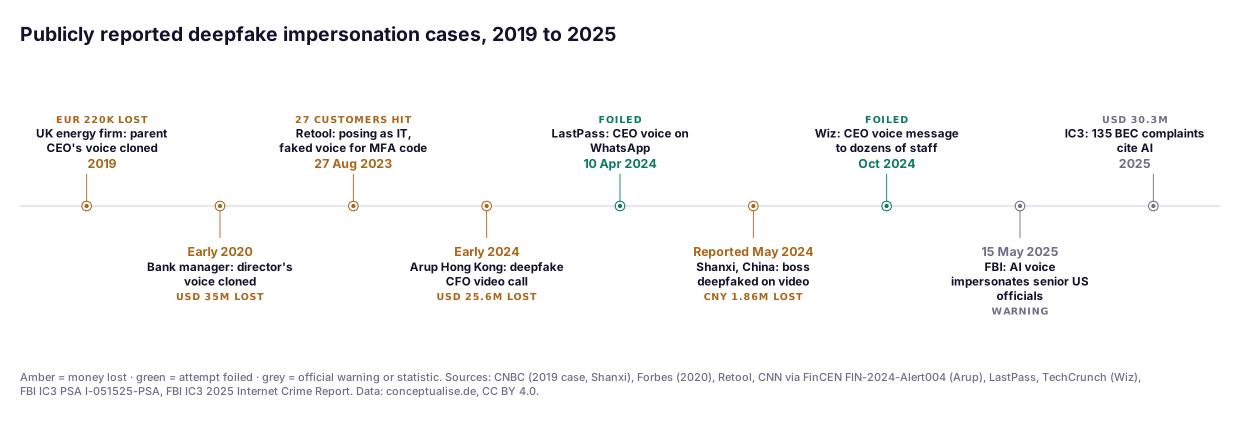
We included only cases with a named source. The attempts at LastPass and Wiz failed because staff noticed the channel or the voice was off, not because software flagged them. In every loss case, the reports describe a single employee acting on the call. We found no 2026 case documented well enough to include; that is a gap in public reporting, not a sign the attacks stopped.
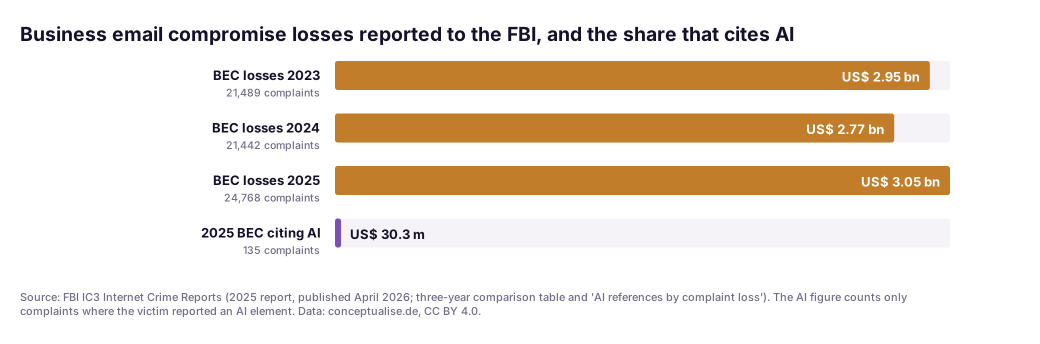
This is the chart for the board. BEC losses reported to the FBI held at about US$3 billion a year from 2023 to 2025; the slice citing AI is about one per cent. That undercounts, because many victims never learn the voice was synthetic. The conclusion holds anyway: deepfakes deliver an old fraud, so the controls for the old fraud are your first line.
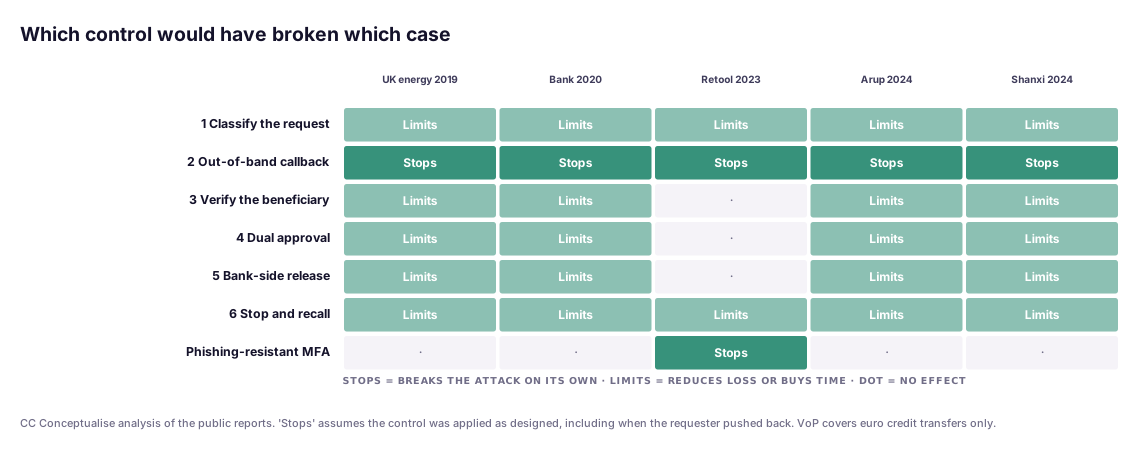
The heat grid is our analysis of the public reports, not external data. The callback row is solid dark green because every documented loss relied on the victim accepting the attacker's channel. The other gates limit damage. Phishing-resistant MFA stops only Retool, where the attacker wanted credentials, not a transfer.
In a recent engagement…
This year we walked through the payment process of a mid-sized European manufacturer with its treasury team. On paper it was solid: dual approval in the ERP, hardware tokens, annual phishing training.
Then we asked what happens when the CFO calls from an airport. Her assistant could raise an "urgent" payment and the deputy head of accounting would approve it, because that was how genuine urgent payments worked. Both approvers took their instruction from the same call. There was no callback rule, and the CFO's mobile number was on the company website.
The fixes were cheap: mandatory high-risk triggers, a callback to a directory number with a rotating challenge, and a short video from the CFO saying she would never ask anyone to skip it. The hardest part was persuading executives that they, too, would be called back.
The checklist: which gates for which request
| Request type | ① Classify | ② Callback | ③ Beneficiary | ④ Dual approval | ⑤ Bank release |
|---|---|---|---|---|---|
| Routine invoice, known payee | Automatic | No | VoP | Standard | Standard |
| Vendor changes bank details | High risk | Yes, vendor's known contact | Master-data process + VoP | Yes | Hold first payment |
| Executive asks for urgent or confidential payment | High risk | Yes, directory number + challenge | VoP + cooling-off | Yes, approver not on the call | Limit + first-payee hold |
| Request by video call, voice note or messenger | High risk | Always | As above | As above | As above |
| Bulk payment file | Rules on file contents | For new payees | No VoP opt-out without a compensating check | Yes | Signed release |
Governance for European enterprises
Verification of Payee. Regulation (EU) 2024/886 added Article 5c to the SEPA Regulation. Euro-area providers have had to offer the check for credit transfers since 9 October 2025; providers in non-euro Member States must follow by 9 July 2027. Article 5c(6) lets business customers opt out when submitting payment orders as a package, which is how most treasuries pay, so check whether yours has. Under Article 5c(8), a bank that provided the check correctly is not liable just because you paid after a warning.
NIS2. Article 21(2) of Directive (EU) 2022/2555 requires cyber hygiene and cybersecurity training and, where appropriate, "secured voice, video and text communications". Article 20(2) requires management bodies to follow training. Germany's implementation law has applied since 6 December 2025; our article on NIS2 management liability explains why boards should treat this as their own duty.
DORA. Article 13(6) of Regulation (EU) 2022/2554 makes ICT security awareness training compulsory for all staff and senior management of financial entities. A deepfake callback drill fits it squarely.
AI Act and GDPR. Article 50(4) of the AI Act has required deployers to disclose deepfakes since 2 August 2026. Criminals will not comply, so it is no control. Avoid voiceprint checks on executives: biometric identification data is special-category data under Article 9 GDPR, and voices are what attackers clone.
A pragmatic adoption path
- Week 1: map who can move money alone. List every person and system that can create a beneficiary or release a payment, and every path where one instruction reaches both.
- Week 2: write triggers and the callback rule. Make the high-risk triggers mandatory fields. Publish a one-page callback rule signed by CEO and CFO, including "anyone who asks you to skip this has failed it".
- Weeks 3–4: fix the bank side. Confirm VoP status and any bulk opt-out with each bank. Set per-user limits and first-payee holds. Move release signing to hardware tokens or FIDO2 keys.
- Month 2: lock down master data. Route vendor bank-detail changes through their own process with a vendor callback and cooling-off. Take executives' mobile numbers off public pages.
- Month 3: rehearse. Run a drill with a consented voice clone of an executive against finance and the helpdesk, then test a recall with your bank. If you run identity threat detection for token theft and AiTM phishing, add the helpdesk scenario there too.
The verdict
Deepfake CEO fraud looks like a technology problem, so organisations reach for detectors and glitch-spotting training. Fine as signals, but none should decide whether money leaves the company. If you change one thing this quarter, make a callback to a directory number mandatory for every high-risk request, and treat refusal as a red flag. If you change two, take beneficiary changes away from whoever receives the request. Arup's employee was not careless. He worked inside a process that let a video call count as an approval. Change the process and the quality of the fake stops mattering.
For a structured review of your payment and identity controls, our Zero Trust security team runs this walkthrough with finance and IT together, and you leave with the gate table filled in for your own entities.
FAQ
What is deepfake CEO fraud?
It is classic CEO fraud, or business email compromise, with a synthetic voice or video added. An attacker clones an executive from public footage and uses a call or video conference to push finance staff into an urgent, confidential payment. The best-known case is Arup in Hong Kong, where CNN reported 15 transfers totalling HK$200 million, about US$25.6 million, after a video call with a deepfaked CFO.
Can deepfake detection software stop these attacks?
Not on its own. The BSI notes that automated detectors generalise poorly and can be attacked; the best model in the 2020 Deepfake Detection Challenge reached only 65.18 per cent accuracy. Detection is a signal for the security team, not a payment control.
What is an out-of-band callback and how should it work?
The employee ends the call and phones the executive back on a number from the corporate directory, never one supplied in the request. For high-risk payments, add a pre-agreed challenge that is not answerable from public footage. A requester who refuses the callback has failed it.
Does Verification of Payee protect us against deepfake fraud?
Partly. Under Regulation (EU) 2024/886, euro-area banks have had to offer Verification of Payee for credit transfers since 9 October 2025; banks in other Member States must follow by 9 July 2027. It warns when IBAN and payee name do not match. It does not catch a mule account in the name you typed.
Which regulations require these controls in Europe?
No law prescribes a callback, but several mandate the surrounding controls. NIS2 Article 21(2) lists cybersecurity training and secured voice, video and text communications, and Article 20(2) requires management training. DORA Article 13(6) makes ICT security awareness training compulsory for staff and senior management in financial entities.
What should a finance employee do if they suspect a deepfake call?
Stay polite, commit to nothing and end the call. Call the executive back on a known number, inform security and keep the evidence: call logs, links, chats and email headers. If money has already left, call your bank's fraud desk at once and ask for a recall, because the first hours decide whether funds can be frozen. Then report it to the police.
Sources
All sources checked on 15 November 2026. Case amounts are as reported by the named source. Where we rely on a news report rather than a primary document, the text says so.
Tier A: primary, official and regulatory
- FBI IC3, 2025 Internet Crime Report (April 2026): https://www.ic3.gov/AnnualReport/Reports/2025_IC3Report.pdf
- FBI IC3, PSA I-051525-PSA, "Senior US Officials Impersonated in Malicious Messaging Campaign" (15 May 2025): https://www.ic3.gov/PSA/2025/PSA250515
- FBI IC3, "Criminals Use Generative Artificial Intelligence to Facilitate Financial Fraud" (3 Dec 2024): https://www.ic3.gov/PSA/2024/PSA241203
- FinCEN, FIN-2024-Alert004, fraud schemes involving deepfake media (13 Nov 2024): https://www.fincen.gov/sites/default/files/shared/FinCEN-Alert-DeepFakes-Alert508FINAL.pdf
- Regulation (EU) 2024/886 (Instant Payments Regulation), Article 5c, Verification of Payee: https://eur-lex.europa.eu/eli/reg/2024/886/oj/eng
- Directive (EU) 2022/2555 (NIS2), Articles 20 and 21: https://eur-lex.europa.eu/eli/dir/2022/2555/oj/eng
- Regulation (EU) 2022/2554 (DORA), Article 13(6): https://eur-lex.europa.eu/eli/reg/2022/2554/oj/eng
- Regulation (EU) 2024/1689 (AI Act), Article 50(4): https://eur-lex.europa.eu/eli/reg/2024/1689/oj/eng
- BSI, "Deepfakes: Gefahren und Gegenmaßnahmen": https://www.bsi.bund.de/DE/Themen/Unternehmen-und-Organisationen/Informationen-und-Empfehlungen/Kuenstliche-Intelligenz/Deepfakes/deepfakes_node.html
- LastPass, attempted audio deepfake call (10 Apr 2024): https://blog.lastpass.com/posts/2024/04/attempted-audio-deepfake-call-targets-lastpass-employee
- Retool, "When MFA isn't actually MFA" (Aug 2023): https://retool.com/blog/mfa-isnt-mfa
Tier B: research and analysis
- Deloitte Center for Financial Services, deepfake banking fraud prediction (29 May 2024): https://www.deloitte.com/us/en/insights/industry/financial-services/financial-services-industry-predictions/2024/deepfake-banking-fraud-risk-on-the-rise.html
Tier C: news and secondary, directional
- CNN, "British engineering giant Arup revealed as $25 million deepfake scam victim" (May 2024): https://edition.cnn.com/2024/05/16/tech/arup-deepfake-scam-loss-hong-kong-intl-hnk/index.html
- CNBC, "Deepfake scams have looted millions. Experts warn it could get worse" (May 2024): https://www.cnbc.com/2024/05/28/deepfake-scams-have-looted-millions-experts-warn-it-could-get-worse.html
- Forbes, "Fraudsters Cloned Company Director's Voice In $35 Million Bank Heist, Police Find" (Oct 2021): https://www.forbes.com/sites/thomasbrewster/2021/10/14/huge-bank-fraud-uses-deep-fake-voice-tech-to-steal-millions/
- TechCrunch, "Wiz CEO says company was targeted with deepfake attack that used his voice" (28 Oct 2024): https://techcrunch.com/2024/10/28/wiz-ceo-says-company-was-targeted-with-deepfake-attack-that-used-his-voice/
- Wikipedia, "Business email compromise" (FACC entry, citing Reuters, 26 May 2016): https://en.wikipedia.org/wiki/Business_email_compromise
Topics