Indirect Prompt Injection Example: A Breach Teardown
A composite teardown of real indirect prompt injection breaches, from EchoLeak to SalesBleed: seven attack stages and where each should have been stopped.
On 11 June 2025, Microsoft published CVE-2025-32711 for Microsoft 365 Copilot. Aim Security, who found it, called it EchoLeak. The exploit was one email that nobody had to open. Later, the recipient asked Copilot an ordinary question. Retrieval pulled the attacker's email into context next to internal data, and Copilot wrote that data into an image URL that the client fetched automatically. Microsoft scored it 9.3 and fixed it server-side.
Fifteen months later, in September 2026, Zenity Labs disclosed SalesBleed in Salesforce Agentforce. It entered through a public web form and got past Trusted URLs, the allow-list Salesforce added in 2025 after a near-identical bug called ForcedLeak. This teardown is for the people who decide which AI assistants get mailboxes, connectors and CRM access: CTOs, CISOs and architects. We merge a dozen public disclosures into one composite breach, walk it in seven stages, and mark where each chain should have stopped.
TL;DR / Key takeaways
- One path, many products. Every disclosure we examined, from Bard in 2023 to SalesBleed in 2026, follows seven stages: plant, ingest, hijack, collect, encode, render or act, exfiltrate.
- The model is not the control point. Classifiers and spotlighting lower the odds but never break a chain alone. EchoLeak walked past Microsoft's injection classifier.
- Exfiltration is where you win. Six of the nine chains in our grid leaked through an image or a link. Not rendering them, or only from a strict allow-list, stops each one.
- Allow-lists rot. Bard leaked through a Google-hosted script, EchoLeak through a Teams proxy, ForcedLeak through an expired domain bought for about five dollars.
- Design for the Rule of Two. Untrusted input, private data, an outbound channel: give a session at most two. It is the only control in our grid that stops all nine chains.

Download: Editable draw.io file · Open in diagrams.net · Chart data (CSV)
Why this matters now
Greshake and colleagues described indirect prompt injection in February 2023. What changed since is reach. In 2023 a successful injection leaked chat history. By 2025 the same trick reached mailboxes, SharePoint, private repositories and CRM records, because assistants got connectors and tools.
Regulators have stopped promising a fix. On 8 December 2025 the UK NCSC argued that, because language models do not separate data from instructions, prompt injection cannot be patched away like SQL injection. The BSI followed its November 2025 guidance on evasion attacks with a five-measure baseline against indirect prompt injection in September 2026. And the public record shows how late buyers find out: across the seven disclosures below where both dates are public, the median gap between the report to the vendor and publication was 92 days.
The composite breach, stage by stage
Numbers match the warm callouts in the diagram; letters match the green tags. No single incident had all seven stages in exactly this form.
① Plant: the attacker writes, you never notice
The attacker puts instructions into content your assistant will read later. EchoLeak and ShadowLeak used email; ShadowLeak hid the text with tiny or white-on-white fonts. ForcedLeak and SalesBleed used Salesforce Web-to-Lead forms, which anyone can submit. The GitHub MCP case used an issue on a public repository, CamoLeak a hidden comment in a pull-request description, Slack AI a public channel. The attacker needs no account in your tenant and no malware.
② Ingest: retrieval does the delivery
Retrieval, a connector or an MCP tool puts the planted text in the context window next to the user's question. Aim Security calls this an "LLM scope violation": untrusted input acting on data it was never meant to see.
Should have stopped (A): sanitise and label untrusted input. The BSI baseline strips invisible Unicode tag characters, BiDi controls and confusables and neutralises fake role markers. That kills cheap obfuscation, not a polite instruction in plain English, so it limits rather than stops.
③ Hijack: the model follows the instruction
To the model, system prompt, question and attacker email are one token stream. The NCSC calls it an "inherently confusable deputy". The EchoLeak paper describes the email evading Microsoft's XPIA (cross-prompt injection attempt) classifier.
Should have stopped (B): spotlighting and injection classifiers. Microsoft describes three spotlighting modes (delimiting, datamarking, encoding) plus Prompt Shields, and calls both probabilistic. Use them to raise the attacker's cost. Never treat them as the boundary.
④ Collect: the agent uses your permissions
The hijacked assistant fetches what the attacker wants with the user's access. The GitHub MCP agent read a public issue, then pulled data from the user's private repositories. CamoLeak made Copilot Chat search the victim's code for strings such as "AWS_KEY". ShareLeak (CVE-2026-21520, Copilot Studio, disclosed April 2026) started from a comment field on a public SharePoint form and queried connected SharePoint lists for customer data.
Should have stopped (C): least privilege per session. Invariant Labs' fix for the GitHub case was one repository per session. In Microsoft 365 it means sensitivity labels and an oversharing clean-up. It stops a chain only when the target sits outside the session's scope.
⑤ Encode: the loot looks harmless
The data must leave inside output the system delivers. GitLab Duo base64-encoded private merge-request details into an image URL. The 2024 Microsoft 365 Copilot chain hid data in invisible Unicode tag characters in a link. CamoLeak pre-generated a signed GitHub Camo proxy URL for every character and had Copilot "draw" the secret as tiny images. EchoLeak used reference-style Markdown to dodge link redaction.
Should have stopped (D): strip images, links and hidden Unicode from output, or render plain text. That is what vendors did in the end: GitHub disabled image rendering in Copilot Chat; GitLab restricted links and images to trusted domains.
⑥ Render or act: something sends the request
Client-side, the browser fetches an image (zero-click), unfurls a link preview (SalesBleed via Slack) or shows a link the user clicks (Slack AI). Server-side, the agent acts itself: ShadowLeak's request came from the Deep Research browsing tool inside OpenAI's cloud, the GitHub MCP agent opened a public pull request, and ShareLeak emailed the data out through the agent's Outlook action.
Should have stopped (E): a strict URL allow-list with no proxies, redirectors, user-content hosts or stale entries. Most vendors had one, and it failed. Bard's policy allowed Google domains, so data went to a Google Apps Script endpoint. EchoLeak used an allowed Teams URL. ForcedLeak worked because my-salesforce-cms.com stayed on the list after it expired; Noma bought it for about five dollars. SalesBleed found Trusted URLs mishandled top-level domains and certain character sequences.
⑦ Exfiltrate: the data lands in a server log
The attacker reads the loot from their own logs. On your side, a user asked a question and got an answer. SecurityWeek reports that in SalesBleed, Agentforce said the content was blocked after the data had already reached the attacker. In Capsule's ShareLeak tests, VentureBeat reports, Microsoft's safety layer flagged the request and the email still went out, because sending mail was an authorised action. ShadowLeak never touched the victim's network at all.
Should have stopped (F): approval and egress control for agent tools. Require confirmation before an agent mails outside the organisation, writes to a public repository or fetches arbitrary URLs, and put its HTTP client behind an allow-list. Invariant notes users click "Always Allow", so gate the few actions that matter. Detect the sequence, not the call: untrusted read, private read, outbound write.
The overlay that stops everything (G): Meta's Agents Rule of Two and Simon Willison's "lethal trifecta" say the same thing. A session that reads untrusted input and private data must not communicate externally, and in our reading an auto-rendered external image is external communication. Every chain above needed all three legs.
What the numbers say
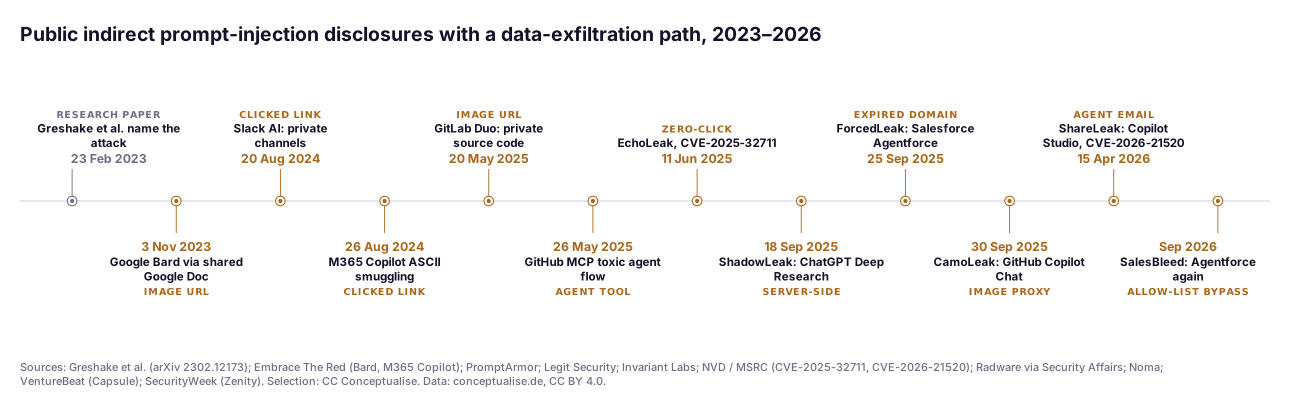
The timeline is a selection, not a census: named researchers, working exfiltration, production products. Six chains went public between May and September 2025, as connectors and agent tools shipped. The shift since is from client-side image tricks to agent actions; ShadowLeak and ShareLeak never needed the user's browser. We left out Varonis's Reprompt (January 2026) and SearchLeak (June 2026), where the prompt arrives in a crafted Copilot link the victim clicks rather than in retrieved content.
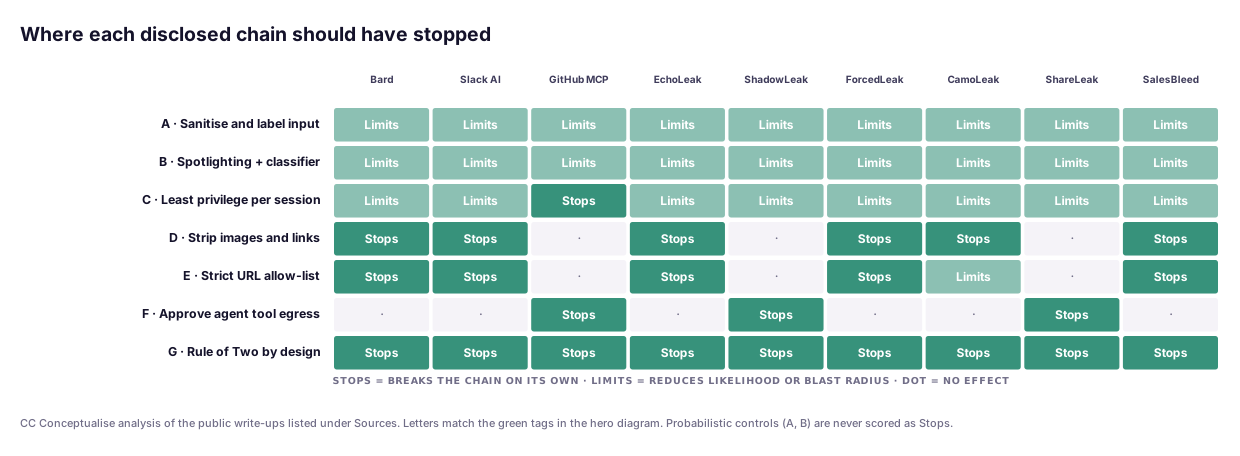
The grid is our analysis of the public write-ups. A and B, the controls vendors talk about most, only limit. D and E, controlling what output can render and where it can point, stop six of nine. The three they miss, GitHub MCP, ShadowLeak and ShareLeak, all left through an agent tool, and only F catches them. You need both layers.
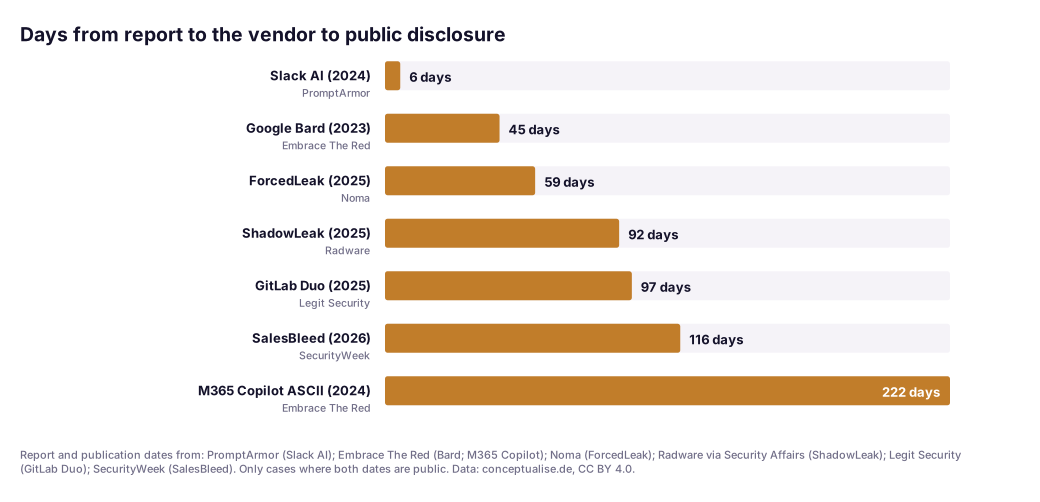
The median is 92 days; the 2024 Microsoft 365 Copilot chain took 222. For a SaaS buyer that means the chain in your vendor's assistant is usually closed before you hear of it, and you could not have patched the model anyway. Permissions, rendering, connectors and approvals are what you control in that window.
In a recent engagement…
This year we reviewed an email-triage agent for a European manufacturer, built on a low-code agent platform. It read the shared customer-service mailbox, looked the sender up in the CRM, drafted a reply and posted a Markdown summary to Teams. Each piece was sensible. Together they were the lethal trifecta: anyone could write to the mailbox, the agent could read every CRM account, and Teams rendered images.
The team's first instinct was a better system prompt and a classifier. We kept both but did not count them as the fix. We split the agent in two. A reader takes untrusted mail and emits a structured, plain-text classification, with no CRM access and no outbound channel. A responder works only from that output, reads the CRM and needs a human click to send anything outside the company. The Teams summary became plain text with one link from a fixed template. The hard part was not technical: getting the business to accept "one click to send" instead of "fully autonomous".
The checklist
Run it per assistant or agent, not per platform.
| # | Question | If yes | Control |
|---|---|---|---|
| 1 | Can outsiders write content this assistant reads (email, forms, tickets, public repos, web)? | Every session carries hostile input | A, B; design for G |
| 2 | Can the same session read data that author should not see? | Two legs of the trifecta | C: scope per session, labels, oversharing clean-up |
| 3 | Does output render images, HTML or link previews anywhere (chat, Teams, Slack, mail)? | Outbound channel, even with zero clicks | D: plain text or sanitised rendering |
| 4 | Does an allow-list contain proxies, redirectors, user-content hosts or wildcards? | Assume it is a bypass | E: exact hosts, quarterly review, expiry alerts |
| 5 | Can the agent send mail, open PRs, call webhooks or browse? | Server-side egress your network never sees | F: approval for external actions, egress allow-list |
| 6 | Do you log tool-call sequences with the input that triggered them? | Otherwise you cannot detect or investigate | Per-session tracing; alert on untrusted → private → outbound |
One warning: "Always allow" undoes F within a week. Keep approvals for actions that leave the organisation, and rare enough that people read them.
Governance for European enterprises
No EU law names indirect prompt injection. Several apply to its consequences.
- GDPR. Exfiltrated personal data is a personal data breach: 72 hours to notify the supervisory authority under Article 33. You remain controller even when the flaw is in a vendor's assistant.
- NIS2. Essential and important entities must assess whether it is a significant incident. In Germany, under the NIS2UmsuCG in force since 6 December 2025, that starts a 24-hour early warning to the BSI.
- Cyber Resilience Act. If you sell a product with digital elements that embeds an assistant, an actively exploited injection flaw in it falls under Article 14 reporting, applicable since 11 September 2026.
- EU AI Act. Article 15(5) requires high-risk systems to resist "adversarial examples or model evasion" and "confidentiality attacks". For Annex III systems that now applies from 2 December 2027 under Regulation (EU) 2026/1744: a design target, not yet a duty for most deployers.
- BSI baseline. Its five measures (input sanitisation, trust-boundary separation, hardened system prompt, model selection and reasoning, and an egress filter that blocks exfiltration links and checks a canary token) map onto A, B, D and E and make a sensible minimum to cite in a German audit.
A pragmatic adoption path
- Week 1: inventory the trifecta. List every assistant, copilot, custom agent and MCP client, and mark untrusted input, private data and outbound channels, counting rendered images and link previews.
- Week 2: close the cheap egress. Turn off external image rendering and link unfurling for assistant output where the platform allows. Strip proxies and wildcards from allow-lists and set domain-expiry alerts.
- Weeks 3–4: scope the data. Clean up oversharing in indexed sources, apply sensitivity labels and limit agents to one repository, mailbox or record set per session.
- Month 2: gate the actions. Require approval for external mail, webhooks, public repository writes and browsing, as in our human-in-the-loop guide.
- Month 3: test and watch. Add indirect-injection cases to your LLM red-teaming suite, alert on the toxic sequence and rehearse who decides within 24 hours whether GDPR, NIS2 or CRA reporting applies.
The verdict
Four years of disclosures teach one lesson. Indirect prompt injection is a design problem with a model-shaped trigger. Every chain got past the probabilistic layer, and every chain was finally stopped by something deterministic: no image rendering, a corrected allow-list, a narrower scope, or a human confirming an outbound action.
Assume the model will be hijacked, and make sure a hijacked session cannot both see your data and talk to the world. If you do one thing this quarter, find the assistants that hold all three legs of the trifecta and remove one.
If you want a second pair of eyes, our AI team runs this seven-stage walkthrough against your own assistants and agents as a short, fixed-scope review. You leave with the checklist filled in and a ranked list of sessions to split.
FAQ
What is indirect prompt injection?
An attacker plants instructions in content an AI system will later read, such as an email, a web form, a GitHub issue or a shared document, and the model follows them with the user's permissions. The attacker never talks to the model directly. Greshake and colleagues named the attack in February 2023; OWASP lists prompt injection as LLM01.
What was EchoLeak (CVE-2025-32711)?
A zero-click indirect prompt injection in Microsoft 365 Copilot, published on 11 June 2025. One crafted email was pulled into context when the user later asked Copilot a question, and Copilot leaked internal data through an image URL. The researchers bypassed Microsoft's XPIA classifier, link redaction and the content security policy. Microsoft scored it 9.3 and fixed it server-side.
Can a prompt-injection classifier stop these attacks?
Not on its own. Classifiers and spotlighting are probabilistic, and EchoLeak got past Microsoft's XPIA classifier. Microsoft's own guidance pairs them with deterministic controls, such as data governance and blocking known exfiltration techniques, plus explicit user consent for actions. The UK NCSC warned in December 2025 that prompt injection may never be mitigated the way SQL injection was.
What is the lethal trifecta or the Agents Rule of Two?
The same design rule under two names. Simon Willison's lethal trifecta (June 2025) is private data, untrusted content and external communication. Meta's Agents Rule of Two (October 2025) says a session should have at most two of: untrustworthy inputs, access to sensitive systems or private data, and the ability to change state or communicate externally. Every chain in this teardown needed all three.
Is a successful indirect prompt injection reportable in the EU?
It can be. Personal data leaving your tenant is a GDPR breach with a 72-hour notification duty under Article 33. NIS2 entities must assess whether it is a significant incident, which in Germany starts a 24-hour early warning to the BSI. If the assistant is part of a product you sell, Cyber Resilience Act Article 14 reporting has applied since 11 September 2026; our CRA reporting runbook covers that path.
What should we do first?
Inventory every assistant and agent that combines untrusted input, private data and an outbound channel, counting image rendering and link previews as outbound. Remove one of the three legs, render output as plain text or through a strict allow-list without proxies, and require approval for outbound tool calls. Then log tool-call sequences, not just single calls. Our guide to securing AI agents against prompt injection and tool abuse covers the wider threat model.
Sources
All sources checked on 15 November 2026. Timeline dates are the researchers' first public write-up unless stated.
Tier A: primary, advisory and regulatory
- NVD, CVE-2025-32711 (M365 Copilot; published 11 Jun 2025; Microsoft CVSS 9.3): https://nvd.nist.gov/vuln/detail/CVE-2025-32711
- Microsoft Security Update Guide, CVE-2025-32711: https://msrc.microsoft.com/update-guide/vulnerability/CVE-2025-32711
- NVD, CVE-2026-21520 (Copilot Studio; published 22 Jan 2026; CVSS 7.5): https://nvd.nist.gov/vuln/detail/CVE-2026-21520
- Microsoft MSRC, "How Microsoft defends against indirect prompt injection attacks" (Jul 2025): https://www.microsoft.com/en-us/msrc/blog/2025/07/how-microsoft-defends-against-indirect-prompt-injection-attacks
- UK NCSC, "Prompt injection is not SQL injection (it may be worse)" (8 Dec 2025): https://www.ncsc.gov.uk/blog-post/prompt-injection-is-not-sql-injection
- BSI, "Basisschutz gegen Indirect Prompt Injections in dokumentbasierten LLM-Chats", v1.0 (dated 14 Sep 2026): https://www.bsi.bund.de/SharedDocs/Downloads/DE/BSI/KI/Basisschutz_Indirect-Prompt-Injections_LLM.pdf
- BSI, "Evasion Attacks on LLMs – Countermeasures in Practice" (Nov 2025): https://www.bsi.bund.de/SharedDocs/Downloads/EN/BSI/KI/Evasion_Attacks_on_LLMs-Countermeasures.pdf
- OWASP GenAI, LLM01:2025 Prompt Injection: https://genai.owasp.org/llmrisk/llm01-prompt-injection/
- Regulation (EU) 2024/1689 (AI Act), Article 15: https://eur-lex.europa.eu/eli/reg/2024/1689/oj/eng
- Regulation (EU) 2016/679 (GDPR), Articles 32–33: https://eur-lex.europa.eu/eli/reg/2016/679/oj/eng
- Regulation (EU) 2024/2847 (Cyber Resilience Act), Article 14: https://eur-lex.europa.eu/eli/reg/2024/2847/oj/eng
Tier B: research and researcher disclosures
- Greshake et al., "Not what you've signed up for" (arXiv 2302.12173, 23 Feb 2023): https://arxiv.org/abs/2302.12173
- Reddy and Gujral, "EchoLeak: The First Real-World Zero-Click Prompt Injection Exploit in a Production LLM System" (arXiv 2509.10540): https://arxiv.org/abs/2509.10540
- Brodt, Feldman, Schneier and Nassi, "The Promptware Kill Chain" (arXiv 2601.09625): https://arxiv.org/abs/2601.09625
- Embrace The Red, Google Bard data exfiltration (3 Nov 2023): https://embracethered.com/blog/posts/2023/google-bard-data-exfiltration/
- Embrace The Red, M365 Copilot prompt injection and ASCII smuggling (26 Aug 2024): https://embracethered.com/blog/posts/2024/m365-copilot-prompt-injection-tool-invocation-and-data-exfil-using-ascii-smuggling/
- PromptArmor, data exfiltration from Slack AI (Aug 2024): https://promptarmor.com/resources/data-exfiltration-from-slack-ai-via-indirect-prompt-injection
- Legit Security, remote prompt injection in GitLab Duo (20 May 2025): https://www.legitsecurity.com/blog/remote-prompt-injection-in-gitlab-duo
- Invariant Labs, GitHub MCP exploited (26 May 2025): https://invariantlabs.ai/blog/mcp-github-vulnerability
- Radware, ShadowLeak (Sep 2025): https://www.radware.com/blog/threat-intelligence/shadowleak/
- Noma Security, ForcedLeak (25 Sep 2025): https://noma.security/blog/forcedleak-agent-risks-exposed-in-salesforce-agentforce/
- Legit Security, CamoLeak (30 Sep 2025): https://legitsecurity.com/blog/camoleak-critical-github-copilot-vulnerability-leaks-private-source-code
- Varonis, Reprompt (with June 2026 SearchLeak update): https://www.varonis.com/blog/reprompt
- Simon Willison, "The lethal trifecta for AI agents" (16 Jun 2025): https://simonwillison.net/2025/Jun/16/the-lethal-trifecta/
- Meta AI, "Agents Rule of Two" (31 Oct 2025): https://ai.meta.com/blog/practical-ai-agent-security/
Tier C: news and vendor commentary, directional
- The Hacker News, EchoLeak (12 Jun 2025): https://thehackernews.com/2025/06/zero-click-ai-vulnerability-exposes.html
- Security Affairs, ShadowLeak timeline (18 Sep 2025): https://securityaffairs.com/182334/hacking/shadowleak-radware-uncovers-zero-click-attack-on-chatgpt.html
- The Register, ForcedLeak (26 Sep 2025): https://www.theregister.com/2025/09/26/salesforce_agentforce_forceleak_attack/
- VentureBeat, ShareLeak and PipeLeak (Capsule Security, 15 Apr 2026): https://venturebeat.com/security/microsoft-salesforce-copilot-agentforce-prompt-injection-cve-agent-remediation-playbook
- SecurityWeek, SalesBleed (Zenity Labs, 25 Sep 2026): https://www.securityweek.com/salesbleed-flaws-in-salesforce-agentforce-enabled-zero-click-data-exfiltration/
Topics