SBOM and VEX Triage: 54 CVE Findings, 1 Urgent Fix
SBOM and VEX in practice: a reproducible scan shows how reachability and VEX turn 54 scanner findings into 3 tickets, and what the CRA expects from you.
On 15 April 2026, NIST announced that the National Vulnerability Database will enrich only CVEs that are in CISA's Known Exploited Vulnerabilities catalogue, used in US federal software, or classed as critical software. Everything else is lowest priority and not scheduled for immediate enrichment. The reason, in NIST's words: CVE submissions rose 263% between 2020 and 2025. Jerry Gamblin's annual review counted 48,185 CVEs published in 2025 alone, up 20.6% on the year before.
Meanwhile the EU's Cyber Resilience Act (CRA) makes the software bill of materials (SBOM) part of the technical documentation. Run a scanner over one and you get a CVE list that is long, mostly irrelevant and growing daily. This article is for the people who have to turn that list into work: CISOs, product security leads, platform engineers and architects. We ran the whole pipeline on a real open-source service and published every number, so you can check our reasoning and rerun it.
TL;DR / Key takeaways
- The scanner is not the triage. On one real Go service, Trivy matched 54 advisories against a 55-component SBOM. Only 11 sat in code the binary actually calls, and they collapsed into 3 upgrade tickets.
- Reachability beats severity. The highest-EPSS finding in the scan, Terrapin (CVE-2023-48795, EPSS 93.5%), is not compiled into the binary at all. Severity and EPSS rank the vulnerability, not your product.
- VEX makes the decision stick. Record every "not affected" with a machine-readable justification, feed it back to the scanner, and the 43 never come back. We did, and the rescan dropped from 54 to 11.
- Keep three artefacts separate. SBOM per release, VEX per vulnerability decision, CSAF advisory per fix. Germany's BSI TR-03183-2 forbids putting vulnerability data into the SBOM itself.
- The CRA expects the whole chain. SBOM (Annex I Part II(1)), no known exploitable vulnerabilities (Part I(2)(a)), disclosure of fixed vulnerabilities (Part II(4)), reporting since 11 September 2026, the rest from 11 December 2027.

Download: Editable draw.io file · Open in diagrams.net · Chart data (CSV)
Why this matters now
The volume problem is structural, not seasonal. 48,185 CVEs in 2025 is roughly 130 a day. NIST says it enriched a record of about 42,000 in 2025 and still could not keep pace; backlogged CVEs published before 1 March 2026 are now "Not Scheduled". If your triage waits for an NVD CVSS score, it now waits indefinitely for most findings.
The CRA makes SBOMs a legal artefact. Regulation (EU) 2024/2847, Annex I Part II point 1, requires manufacturers to "identify and document vulnerabilities and components contained in products with digital elements, including by drawing up a software bill of materials in a commonly used and machine-readable format covering at the very least the top-level dependencies". Annex I Part I point 2(a) requires products to be "made available on the market without known exploitable vulnerabilities". Note the word exploitable. A CVE that matches a component name is known. Whether it is exploitable in your product is the question VEX answers. Article 64(2) puts breaches of Annex I and Articles 13 and 14 at up to EUR 15 million or 2.5% of worldwide turnover.
Germany has already set the technical bar. BSI TR-03183-2 version 2.1.0 (20 August 2025) requires CycloneDX 1.6 or later, or SPDX 3.0.1 or later. It requires recursive dependency resolution, beyond the CRA's top-level minimum, states that it is "required not to include vulnerability information in an SBOM", and recommends CSAF, including its VEX profile, for that information. Article 13(24) lets the Commission set the SBOM format by implementing act; as of 15 November 2026 we have found no adopted act, so the BSI guideline is the most concrete reference in the DACH region.
Our CRA reporting runbook covers the 24-hour clock live since 11 September 2026. This article covers the daily work that keeps you from needing it.
The funnel, stage by stage
Numbers match the figure's callouts; counts in brackets come from our scan, described below.
① SBOM: generate it in the build, not after
An SBOM produced by scanning a source repository after the fact describes what might ship. One produced in the pipeline, from the exact artefact you release, describes what did ship. Generate it per release and per artefact, sign it, and store it next to the artefact with the same retention. Our Azure DevOps supply-chain guide shows signing and attestation.
Three practical rules:
- Use package URLs (purls) everywhere. VEX statements, scanners and advisories all match on purl. An SBOM without them cannot be triaged automatically.
- Resolve the full transitive tree. The CRA's legal minimum is top-level dependencies; the BSI asks for recursive resolution, and every attacker uses transitive ones.
- Keep vulnerability data out. The SBOM for a release is static. Vulnerability status is not. Mixing them means re-issuing the SBOM every time an advisory lands.
(Our sample: 55 components, CycloneDX 1.7, generated by Trivy 0.76.1.)
② Scan: match continuously against stored SBOMs
Scanning at build time only tells you about yesterday's advisories. Re-scan the stored SBOMs of every supported release whenever new advisory data arrives. Matching a component list takes seconds and needs no source code. Feed the scanner from more than NVD: the OSV database and GitHub advisories carry ecosystem-native identifiers and affected version ranges, and vendor CSAF feeds cover commercial components.
This stage produces the long list. Do not send it to engineering.
(Our sample: 54 advisories across 7 modules: 28 high, 24 medium, 2 unrated, no critical.)
③ Reachability: is the vulnerable code there, and is it called?
Most of the noise dies here. A module-level match only says "you depend on a module with a vulnerability somewhere". Ask three better questions:
- Is the vulnerable package compiled into the artefact at all?
- Is the vulnerable function called from your code, directly or transitively?
- Can an attacker control the input that reaches it?
The first two are answered by static analysis. For Go, the official govulncheck tool works at three levels (module, package and symbol) against the Go vulnerability database. For JVM, .NET, Python and JavaScript, commercial SCA tools offer call-graph reachability of varying depth. The third question still needs a human, and it is the one to spend expert time on.
(Our sample: 13 findings in compiled-in packages, 11 in functions that are actually called.)
④ VEX: write the decision down, in a format machines read
A VEX (Vulnerability Exploitability eXchange) statement records, for one vulnerability and one product, one of four statuses defined by CISA's minimum requirements: not affected, affected, fixed or under investigation. Not affected needs a justification. Three formats implement this.
| OpenVEX | CycloneDX VEX | CSAF VEX | |
|---|---|---|---|
| Governance | Community spec (OpenVEX project), v0.2.0 | CycloneDX; 1.6 standardised as ECMA-424, 1.7 current | OASIS standard, CSAF 2.0 (csaf_vex profile) |
| Best for | Pipeline suppression, small and embeddable | Teams already on CycloneDX and Dependency-Track | Published advisories to customers and authorities |
| "Not affected" | not_affected | analysis state not_affected | product status known_not_affected |
| Justification values | component_not_present, vulnerable_code_not_present, vulnerable_code_not_in_execute_path, vulnerable_code_cannot_be_controlled_by_adversary, inline_mitigations_already_exist | code_not_present, code_not_reachable, requires_configuration, requires_dependency, requires_environment, protected_by_compiler, protected_at_runtime, protected_at_perimeter, protected_by_mitigating_control | Same five labels as OpenVEX, as flags |
| Tool support we verified | Trivy --vex, Grype, vexctl, govulncheck -format openvex | Dependency-Track (consumes and produces), Trivy | Trivy (CSAF VEX files); recommended format in BSI TR-03183-2 |
Our recommendation: keep one internal source of truth (OpenVEX or CycloneDX, whichever your tooling speaks) and publish CSAF at the edge. Here is the statement we wrote for the highest-EPSS finding in our scan:
{
  "vulnerability": { "name": "CVE-2023-48795" },
  "products": [{
    "@id": "pkg:golang/github.com/prometheus/node_exporter",
    "subcomponents": [{ "@id": "pkg:golang/golang.org/x/crypto@v0.0.0-20221012134737-56aed061732a" }]
  }],
  "status": "not_affected",
  "justification": "vulnerable_code_not_present",
  "impact_statement": "govulncheck v1.9.0 (GO-2023-2402): vulnerable package not compiled into the binary"
}
Choosing the status is a short decision tree:
The last two justifications are hardest to prove; the OpenVEX spec itself warns that mitigation bypasses are common. Require a named reviewer.
(Our sample: 43 not affected, 41 because the code is not present and 2 because it is not in the execute path; 11 affected.)
⑤ Ticket: one per fix, ranked by exploitation evidence
Engineering does not fix CVEs; it upgrades modules and ships releases. Group affected findings by remediation action, not CVE ID, and rank the groups:
- In CISA KEV: known exploitation; fix now. The catalogue held 1,781 entries on 13 November 2026.
- High EPSS and reachable: FIRST's EPSS estimates the probability of exploitation in the next 30 days. Combined with reachability, it is a strong signal.
- Reachable and exposed: internet-facing, privileged, or handling untrusted input.
- Everything else affected: the next regular dependency update.
When the fix ships, the statement flips to fixed and you publish the fixed vulnerability (CRA Annex I Part II(4)). Article 13(6) also requires you to report component vulnerabilities to the maintainer.
(Our sample: 3 tickets — upgrade golang.org/x/net, golang.org/x/text and opencontainers/selinux — of which 1 is urgent.)
What the numbers say
Method. We wanted a real funnel, so on 15 November 2026 we ran the pipeline on prometheus/node_exporter at tag v1.5.0, released 29 November 2022. We chose an old release on purpose, to let advisories accumulate; this says nothing about current, maintained releases. Steps:
- SBOM:
trivy fs --format cyclonedx(Trivy 0.76.1), giving CycloneDX 1.7 with 55 components. - Scan:
trivy sbomagainst the vulnerability database of 15 November 2026. - Reachability:
govulncheckv1.9.0 in source mode at symbol level,GOOS=linux GOARCH=amd64, Go vulnerability database of 11 November 2026. We joined the results to Trivy's findings via each Go advisory's CVE aliases; all 54 matched. - Exploit signals: CISA KEV catalogue version 2026.11.13 and EPSS scores dated 15 November 2026 from FIRST's API.
- VEX: an OpenVEX document with 43
not_affectedstatements, applied withtrivy sbom --vex. The rescan reported exactly the 11 remaining findings.
We excluded Go standard-library findings: they reflect the toolchain we analysed with, not the 2022 binary, and one rebuild with a patched Go release fixes them all. The data and our OpenVEX file are downloadable.
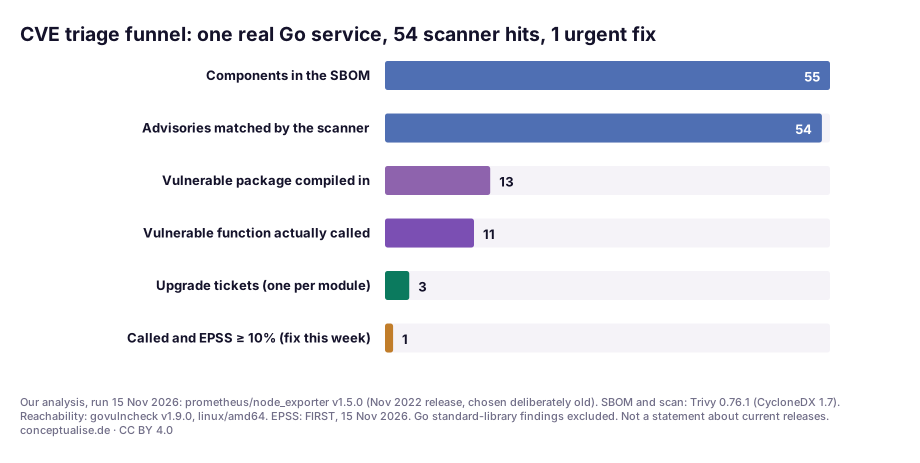
Three observations stand out.
Most findings are not even in the binary. 41 of 54 findings (76%) sit in packages that are never compiled in. golang.org/x/crypto alone produced 23 findings, and none of its vulnerable packages is linked. A module-level scanner cannot see that. It reports the module because go.mod requires it.
Severity did not predict reachability. 7 of 28 high-severity findings were called, and 4 of 24 medium ones. Sorting by CVSS would have put 21 unreachable high findings ahead of 4 reachable medium ones.
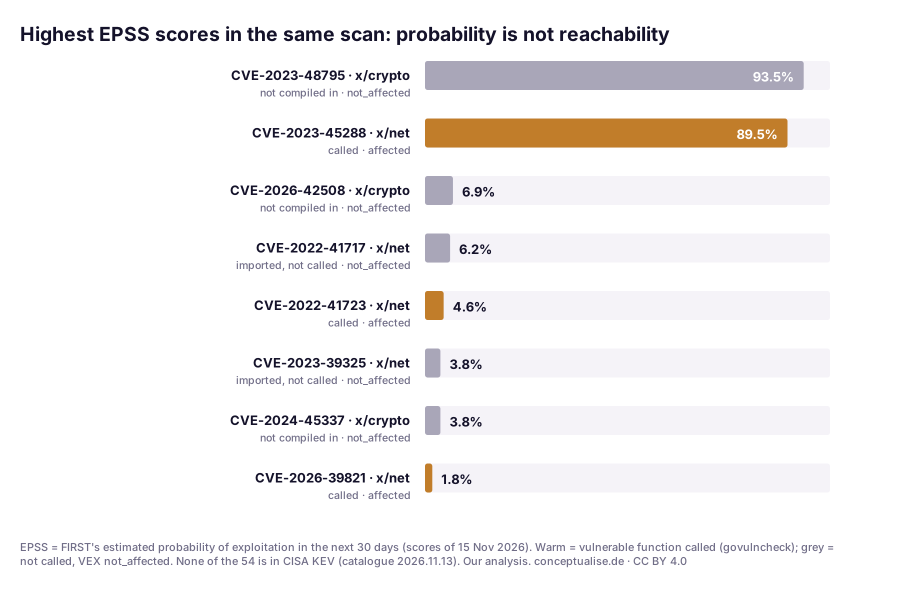
EPSS alone would have sent you the wrong way. The finding with the highest EPSS score, Terrapin in x/crypto/ssh at 93.5%, is not reachable: node_exporter never links the SSH package. The second, CVE-2023-45288 (HTTP/2 CONTINUATION flood in x/net) at 89.5%, is reachable, because the exporter serves HTTP. That is the one urgent fix. No finding was in KEV, which is typical: KEV tells you what to drop everything for, not what to ignore.
Multiply by your estate. Fifty-four findings on one small service becomes roughly 10,000 across 200 such services, with about 2,000 reachable if the proportions held, mostly the same few module upgrades repeated. That is an extrapolation, not a measurement, but it explains why teams that stop at stage ② drown.
Limits. Static reachability can miss calls via reflection, unsafe or plugins, covers only the build configuration you analyse, and is less precise for dynamic languages. Treat vulnerable_code_not_in_execute_path as a reviewed claim and re-run it every release.
In a recent engagement
In a recent engagement with a DACH software manufacturer preparing for the CRA, the vulnerability dashboard had become a battleground. Every container scan produced hundreds of findings per service. Security forwarded the high and critical ones as tickets; engineering closed most as "not applicable" in free-text comments. No scanner could read those comments, so the same findings returned on the next build and the argument restarted.
We did not buy a new tool. We moved SBOM generation into the release pipeline, stored SBOMs per release, and agreed one internal VEX format with justifications both sides accepted, plus one rule: KEV-listed or high-EPSS findings need a named reviewer before they are marked not affected. Within a few release cycles, the open list held only tickets engineering agreed with, and the VEX history became evidence for the CRA technical documentation.
The operating checklist
| # | Control | Evidence it works |
|---|---|---|
| 1 | SBOM generated in CI from the release artefact, with purls, full transitive tree | SBOM digest attached to every release |
| 2 | SBOMs signed and stored for every supported release | Retrieval of an 18-month-old SBOM in minutes |
| 3 | Daily re-scan of stored SBOMs against OSV, GitHub advisories, NVD and vendor CSAF | New advisory → finding within 24 hours |
| 4 | Reachability analysis where the ecosystem supports it | Findings tagged module / package / function |
| 5 | One internal VEX format; justification required for every not_affected | Zero free-text suppressions |
| 6 | Named reviewer for cannot_be_controlled and inline_mitigations claims, and for any KEV or high-EPSS finding | Reviewer field populated |
| 7 | VEX fed back into scanners and the dashboard | Rescan count equals the affected count |
| 8 | Affected findings grouped by fix, ranked KEV → EPSS → exposure | Tickets reference modules, not CVE lists |
| 9 | CSAF advisory with VEX published for each fixed vulnerability | Public advisory URL per fix |
| 10 | Upstream reporting of component vulnerabilities (CRA Art. 13(6)) | Links to upstream issues or advisories |
Governance for European enterprises
Cyber Resilience Act. The SBOM is part of the technical documentation (Annex VII point 2(b)) and must be handed to a market surveillance authority on reasoned request (point 8); Article 13(25) also lets authorities request SBOMs for EU-wide dependency assessments. You need not publish it (Recital 77), but if you share it with users, Annex II point 9 requires you to say where. In a market surveillance inquiry, your VEX history shows that each CVE in the SBOM was assessed, and why.
BSI TR-03183-2 (Germany). Not law, but today's most concrete technical reading of the CRA's SBOM requirement; its four key rules are summarised above.
NIS2. Essential and important entities must address supply-chain security and vulnerability handling (Article 21(2)(d) and (e)). Suppliers' SBOMs and VEX statements are the cheapest evidence to ask for. Our NIS2 supply-chain obligations guide covers the contract clauses.
A pragmatic adoption path
- Weeks 1–2: SBOM at release. Add SBOM generation and signing to the release pipeline of your top five products. Store SBOMs with the artefacts.
- Weeks 3–4: continuous scan. Re-scan stored SBOMs daily. Route findings to a dashboard, not to tickets.
- Weeks 5–6: reachability where cheap. Start with ecosystems that have good tooling, such as Go with govulncheck. Tag every finding with its reachability level.
- Weeks 7–8: VEX as the system of record. Pick a format, define the justification policy and reviewer rule, and feed statements back into the scanner. Publish your first CSAF advisory with VEX.
- Week 9 onwards: tickets by fix, and upstream. Group affected findings into remediation tickets ranked by KEV, EPSS and exposure. Report component vulnerabilities upstream. Pair this with a dependency firewall and cooldown policy so fewer bad versions reach the SBOM at all.
The verdict
An SBOM on its own is an inventory; a scanner on its own is a noise generator. The value lies in between: reachability to cut the list, VEX to make decisions durable, and fix-based tickets that match how engineering ships. On a real service, that took us from 54 findings to one urgent upgrade, with a machine-readable reason for every finding we set aside. The CRA will ask for exactly that reasoning. Teams that build the funnel now will spend 2027 shipping fixes; the rest will spend it arguing over spreadsheets. As the 2026 npm supply-chain attacks showed, the fastest-moving risks in your SBOM are the ones nobody has scored yet.
If you want help designing the SBOM-to-VEX pipeline, choosing formats or preparing CRA technical documentation, our DevSecOps practice builds this with European manufacturers and platform teams.
FAQ
What is the difference between an SBOM and a VEX document?
An SBOM lists the components in a product. A VEX document states, per vulnerability and product, whether the product is affected, not affected, fixed or under investigation, and why if not affected. The SBOM changes per release, VEX whenever an advisory or your analysis changes. That is why BSI TR-03183-2 keeps vulnerability data out of the SBOM and recommends CSAF, including its VEX profile.
Which VEX format should we use: OpenVEX, CycloneDX VEX or CSAF VEX?
Publish CSAF VEX to customers and authorities: it is an OASIS standard and the BSI recommends it. Use CycloneDX VEX if your tooling, such as OWASP Dependency-Track, already runs on CycloneDX, and OpenVEX for lightweight pipeline suppression in Trivy or Grype. The statuses map cleanly, so keep one internal source of truth and convert at the edge.
Does the Cyber Resilience Act require VEX?
Not by name. Annex I requires an SBOM covering at least top-level dependencies, products without known exploitable vulnerabilities, and public disclosure of fixed vulnerabilities. VEX is the most practical evidence that a CVE matched by your SBOM is not exploitable in your product. Most obligations apply from 11 December 2027.
Is reachability analysis reliable enough to mark a CVE as not affected?
It is reliable enough to rank work and often to justify not_affected, within limits. Call-graph tools such as govulncheck can miss calls through reflection or unsafe code, and tooling for dynamic languages is weaker. Record tool, version and scan level in the statement, review KEV-listed or high-EPSS findings by hand, and re-run on every release.
How should we prioritise the CVEs that are reachable?
First anything in CISA's KEV catalogue, then reachable findings with a high EPSS score (the estimated probability of exploitation in the next 30 days), weighted by exposure. Group by fix, not by CVE: in our sample, 11 reachable findings became 3 module upgrades, and only one combined reachability with a high EPSS score.
Do we have to publish our SBOM under the CRA?
No. Recital 77 says manufacturers should not be obliged to make the SBOM public. It belongs in the Annex VII technical documentation and goes to a market surveillance authority on reasoned request. If you share it with users, Annex II point 9 requires you to say where. VEX and CSAF advisories, by contrast, are made to be shared.
Sources
All sources checked on 15 November 2026. The scan data is our own; method and reproduce script are linked above and in the CSV.
Tier A: primary, standards and regulatory
- Regulation (EU) 2024/2847 (Cyber Resilience Act), EUR-Lex: Recital 77; Art. 3(39), 13(6), 13(24), 13(25), 14, 64(2), 71; Annex I Parts I and II; Annex II point 9; Annex VII points 2(b) and 8
- BSI TR-03183-2, Software Bill of Materials, version 2.1.0 (20 August 2025)
- NIST: "NIST Updates NVD Operations to Address Record CVE Growth" (15 April 2026)
- CISA: Minimum Requirements for Vulnerability Exploitability eXchange (VEX), 21 April 2023
- CISA: Known Exploited Vulnerabilities catalogue (version 2026.11.13)
- OpenVEX specification v0.2.0
- CycloneDX specification releases (1.7, October 2025; 1.7.2, September 2026)
- OASIS CSAF 2.0 JSON schema (VEX flags) and CSAF 2.1 drafts
- FIRST: Exploit Prediction Scoring System (EPSS) and EPSS API data of 15 November 2026
- Go: govulncheck documentation and Go vulnerability database
- Directive (EU) 2022/2555 (NIS2), Art. 21(2)(d) and (e)
Tier B: research and analysis
- Jerry Gamblin: 2025 CVE Data Review (1 January 2026)
- The Stack: 2025 saw an explosion in CVEs (5 January 2026)
- Our analysis: prometheus/node_exporter v1.5.0 scan, 15 November 2026 (data, OpenVEX)
Tier C: vendor and tool documentation, directional
Topics