CTEM in Practice: Five Stages Without Five Tools
Run Gartner's CTEM cycle with tools you already own: an owner and tool per stage, real KEV and EPSS data, validation, metrics and a NIS2 and DORA map.
Gartner made a bold prediction for this year. In its August 2023 article How to Manage Cybersecurity Threats, Not Episodes, it said that by 2026 organisations prioritising security investment through a continuous exposure management programme would be three times less likely to suffer a breach. It is now November 2026. We could not find any public study that tests that number. What did change is the industry around it. In November 2025 Gartner published its first Magic Quadrant for Exposure Assessment Platforms, which vendors describe as the successor to its Market Guide for Vulnerability Assessment, and most scanner vendors now describe themselves in CTEM terms.
This article is for the people who must turn that into a working programme: CISOs, heads of vulnerability management and security architects, with an EU and DACH lens. Our thesis: CTEM is an operating model, not a product category. You can run all five of Gartner's stages with the scanner, cloud posture tool, identity tool and ticketing system you already pay for. Buy a platform when joining those tools becomes the bottleneck, not before.
TL;DR / Key takeaways
- Five stages, one loop: scoping, discovery, prioritisation, validation, mobilisation. The first three diagnose, the last two prove and fix. Most programmes stall at mobilisation, not discovery.
- Exposure, not CVE: CTEM covers misconfigurations, identities, attack paths and unknown external assets. A scanner-first programme sees only part of that.
- The funnel is brutal: in our analysis of public data, only 0.44% of the 406,615 CVEs scored by EPSS are in CISA's Known Exploited Vulnerabilities catalogue. Prioritisation is where the leverage is.
- Owners beat tools: each stage needs a named owner and an output. Our figure assigns both, using tools you probably already run.
- Regulators ask for the outcome: NIS2 Article 21 and DORA's RTS Article 10 do not say "CTEM", but a documented CTEM cycle is good evidence for both.

Download: Editable draw.io file · Open in diagrams.net · Chart data (CSV)
Why scanner-first programmes stopped working
The classic loop is scan, sort by CVSS, raise tickets, chase. It fails for three reasons, all worse in 2026.
The volume outgrew the method. On 15 November 2026 the EPSS daily file scored 406,615 CVEs, of which 43,729 carry a 2025 identifier. CVSS describes how bad a flaw could be, not whether anyone is using it. A queue sorted by CVSS is sorted by the wrong key.
Discovery got faster on the attacker side. On 7 April 2026 Anthropic announced Project Glasswing and said its unreleased Claude Mythos Preview model had found thousands of zero-day vulnerabilities, many of them critical, including in every major operating system and web browser. According to IBM, a Gartner First Take of 27 May 2026 said Mythos Preview and Glasswing "require" effective CTEM. More flaws will be found faster; the defender's edge is knowing which ones matter in your estate.
Exposure is wider than CVEs. Our cloud attack paths analysis shows how real breaches chain "low" misconfigurations, over-privileged identities and public storage, none of which a CVE scanner reports. Tools have followed: Microsoft documents Security Exposure Management as an exposure graph across devices, identities, cloud assets and external attack surface, "aligning with Gartner's Continuous Threat Exposure Management (CTEM) approach".
The point is operational: the unit of work moves from "finding" to "exposure", and the success metric from "scanned" to "validated and closed".
The five stages, owned and tooled
Gartner names the five stages but not the owners or tools, which is where programmes go vague. Below is the version we set up with clients; the numbers match the figure callouts.
① Scoping: decide what matters this cycle
Scoping answers one question: which business services and attack surfaces are in this cycle, and why? The output is a one-page scope statement that names the crown jewels, the attack surfaces in play (external, identity, cloud, SaaS, OT) and the business owner who will accept or reject risk.
- Owner: the CISO, with the business owners of the in-scope services. Not the vulnerability management team alone, because only the business can say what "critical" means.
- Tools: service catalogue or CMDB, risk register, a document.
- Common mistake: scoping "everything". Good first scopes are the external attack surface, the identity plane, or one revenue-critical service end to end.
② Discovery: build one exposure inventory
Discovery finds assets and exposures inside the scope: CVEs, misconfigurations, weak identities, exposed secrets, unknown internet-facing assets and vulnerable components in your software.
- Owner: vulnerability management or security engineering.
- Tools: the ones you have. A vulnerability scanner (Microsoft Defender Vulnerability Management, Tenable, Qualys, Rapid7 or Greenbone/OpenVAS), a cloud posture tool (see our Defender for Cloud vs. third-party CSPM comparison), an identity posture view, external attack surface discovery, and SBOMs for what you build.
- The real work: de-duplication and asset ownership. Five tools reporting the same flaw on the same VM is one exposure, not five. An asset without an owner is a finding in itself.
③ Prioritisation: what could an attacker really use?
This is where CTEM earns its keep. Prioritise on four signals together, not on CVSS alone:
- Evidence of exploitation: is the CVE in CISA's Known Exploited Vulnerabilities (KEV) catalogue, or does your threat intelligence show use in the wild?
- Likelihood: the EPSS score, which FIRST describes as a daily estimate of the probability that a published CVE will be exploited within the next 30 days.
- Reachability: is it on an attack path to a crown jewel, internet-facing, or reachable by a low-privileged identity? This is what attack-path graphs are for.
- Business impact: the criticality tag from stage ①.
Turn the four signals into a decision tree rather than a weighted score. CISA's Stakeholder-Specific Vulnerability Categorization (SSVC) is a good template. It uses decision points such as exploitation status, technical impact, automatability and mission prevalence, and has four outcomes: Track, Track*, Attend and Act. A tree is easier to defend to an auditor than a magic formula.
- Owner: a named exposure management lead, a role many organisations don't have yet.
- Tools: KEV and EPSS feeds (both free), asset criticality tags, and the attack-path features of a tool you may already license. Microsoft Security Exposure Management, for instance, models attack paths and choke points, and can ingest data from ServiceNow CMDB, Tenable, Qualys and Rapid7.
④ Validation: prove it, and check you would see it
Validation asks two questions. Can an attacker actually exploit this exposure in our environment? And would detection and response notice? The output is a short list of proven exposures plus a list of detection gaps, which is just as valuable.
- Owner: red team or pentest, with detection engineering. Validation that never reaches the detection team is a wasted opportunity.
- Tools: targeted penetration tests, and open-source emulation frameworks such as MITRE Caldera, Atomic Red Team and, for cloud control planes, Stratus Red Team. BloodHound Community Edition maps Active Directory and Entra ID attack paths. Commercial breach-and-attack-simulation tools do this continuously; at the start, a quarterly targeted exercise is enough.
- Rule: no destructive validation in production without a change ticket and rollback plan.
⑤ Mobilisation: get it fixed and prove it closed
Mobilisation is where most programmes stall. The VM belongs to one team, the identity to another, the firewall rule to a third. It is a negotiation, not a ticket.
- Owner: platform and application owners, driven through your ITSM, with the exposure lead as the escalation point.
- Tools: ServiceNow or Jira with SLAs per priority class, a risk-acceptance and exception register in which every exception has an expiry date, and a re-test step before a ticket can close.
- Rule: a ticket is closed when the exposure is re-tested, not when someone clicks "resolved". Track mean time to remediate validated exposures and exceptions past expiry. Those are the two numbers your board should see, and our CISO board metrics dashboard shows how to present them.
What the numbers say
To build a chart anyone can check, on 15 November 2026 we downloaded two public datasets: the EPSS daily scores (score date 15 November 2026, model version v2026.06.15) and the CISA KEV catalogue (version 2026.11.13). We then counted how the CVE population narrows. The method is in the build script, and the counts are in the CSV.
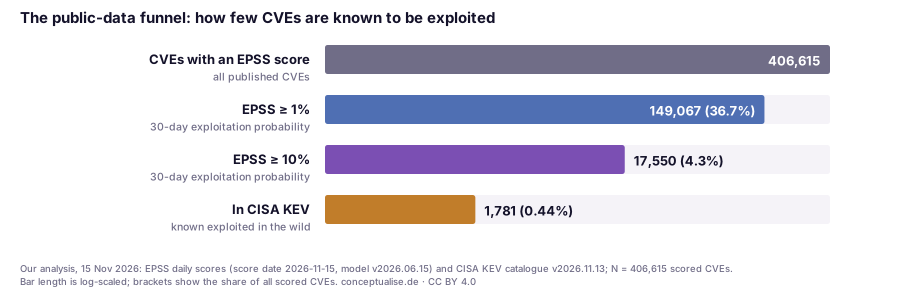
Three readings matter for CTEM design.
The haystack is huge and the needles are few. Of 406,615 scored CVEs, 17,550 (4.3%) have an EPSS score of 10% or more, and 1,781 (0.44%) are in KEV. Among CVEs with a 2025 identifier, 189 of 43,729 are in KEV, also about 0.43%. A programme that tries to fix everything spends nearly all its effort on things nobody is exploiting.
No single signal is enough. Of the 1,781 KEV entries, 1,342 score 10% or more on EPSS. That leaves roughly a quarter of known-exploited CVEs below a 10% EPSS cut-off. If you prioritise on an EPSS threshold alone, you will miss known exploitation. If you prioritise on KEV alone, you only react to what is already being used. Use both, then add reachability and business impact.
The known-exploited list keeps growing. CISA added 245 CVEs to KEV in 2025 and 297 between 1 January and 13 November 2026; 361 entries are flagged for known ransomware use. Prioritisation needs a daily feed, not a quarterly review.
The second chart shows the same logic inside one organisation. It is illustrative: a worked example of how a CTEM funnel narrows, not measured client data.
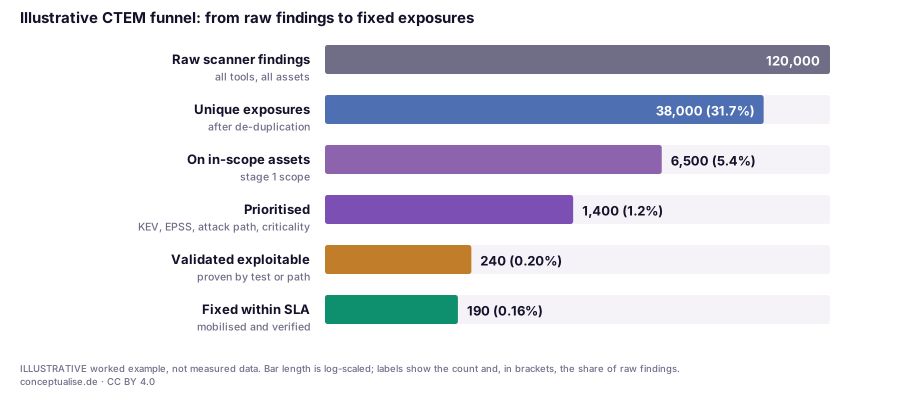
Read it as a design target, not a benchmark. De-duplication and scoping remove most of the noise before a human looks; prioritisation and validation produce a list platform teams accept without arguing. The gap between "validated" and "fixed within SLA" is the mobilisation problem, and the number to manage.
In a recent engagement…
Earlier this year we reviewed the vulnerability programme of a mid-sized European financial services group. On paper it was mature: two commercial scanners, a cloud posture tool, weekly scans and a monthly report of open findings by CVSS. The board saw the count, and the count never went down.
We did not add a tool. We ran one CTEM cycle on one scope: the internet-facing estate plus the identities that could reach the payments platform. Discovery found internet-facing assets that the CMDB did not list, mostly test environments from a past project. Prioritisation on KEV, EPSS and reachability reduced thousands of findings in scope to a shortlist the team could discuss in one meeting. Validation then removed several of those, because compensating controls really did block them. It also surfaced one path nobody had ranked highly: a service principal with standing privileges that a misconfigured pipeline could reach.
The hardest part was mobilisation. Two of the fixes belonged to a platform team whose roadmap had no room. What unlocked it was not the CISO's escalation but an exception register with expiry dates and the business owner's signature. Once the business owner had to re-sign the risk personally at every expiry, the work found room in the roadmap.
Decision table: build the programme, or buy the platform?
| Situation | Our recommendation | Why |
|---|---|---|
| First CTEM cycle, fewer than ~5 security data sources | Build on existing tools | The bottleneck is ownership and scope, not tooling |
| Several scanners reporting the same assets, de-duplication by spreadsheet | Consider an exposure assessment platform or aggregation layer | De-duplication and context are now the bottleneck |
| Mostly Microsoft estate with Defender XDR and Defender for Cloud | Evaluate Microsoft Security Exposure Management first | Builds on the Defender data you already collect; check licensing, and note Microsoft documents it as public cloud only, not sovereign clouds |
| Regulated entity that must evidence testing (DORA, NIS2) | Add continuous or quarterly validation | Regulators ask whether controls work, not how many findings you have |
| Mobilisation SLAs routinely missed | Fix governance first: owners, exceptions with expiry, business sign-off | No tool fixes a missing owner |
And the metrics that replace "open findings":
| Metric | Stage | Good sign |
|---|---|---|
| Share of in-scope assets with a named owner | ①② | Above 95% |
| Validated exposures on paths to crown jewels | ③④ | Falling cycle on cycle |
| Mean time to remediate validated exposures, by priority | ⑤ | Inside SLA for Act and Attend |
| Exceptions past expiry | ⑤ | Zero |
| KEV entries in scope open longer than your SLA | ③⑤ | Zero |
Governance for European enterprises
CTEM is not a legal term in any EU regime. Several regimes still ask for exactly what a CTEM cycle produces.
NIS2. Article 21(2) of Directive (EU) 2022/2555 lists the minimum risk-management measures. Point (e) covers security in acquisition, development and maintenance, "including vulnerability handling and disclosure". Point (f) requires "policies and procedures to assess the effectiveness of cybersecurity risk-management measures". Stage ④ validation is a direct answer to point (f). In Germany these obligations have applied through the NIS2UmsuCG since 6 December 2025. Our guide to NIS2 risk-management measures on Azure maps the full list.
DORA. For financial entities the bar is more specific. Commission Delegated Regulation (EU) 2024/1774, the RTS on the ICT risk-management framework, requires vulnerability management procedures in Article 10. They must include automated vulnerability scanning and assessments, performed "on at least a weekly basis" for ICT assets supporting critical or important functions. Patches and other mitigations must be prioritised, and Article 10(4) adds deadlines for installing patches. DORA Article 25(1) lists the tests a resilience testing programme should include, from vulnerability assessments and scans to scenario-based tests and penetration testing. Article 26 adds threat-led penetration testing at least every three years for the entities it applies to. Discovery covers the weekly scan; the other stages show the scan led to action.
Cyber Resilience Act. If you make products with digital elements, Annex I Part II and Article 14 apply to those products, not to the internal estate CTEM covers. The two meet at SBOMs and actively exploited vulnerabilities; our SBOM and VEX operations guide shows how product-side triage feeds the same prioritisation logic.
Data residency of the tooling. Exposure graphs hold a map of your weaknesses. Check where the tool stores it, who at the vendor can access it, and whether it runs in the sovereign offering you use.
A pragmatic adoption path
- Weeks 1–2: scope and owners. Pick one scope (external attack surface, identity plane or one critical service). Name the exposure lead and the business owner. Write the one-page scope statement.
- Weeks 3–5: one inventory. Pull the scanner, posture and identity data for the scope into one de-duplicated list. Map every asset to an owner, and treat unowned assets as findings.
- Weeks 6–7: decision tree. Write an SSVC-style tree using KEV, EPSS, reachability and criticality. Agree SLAs per outcome with the platform teams before you produce the first shortlist.
- Weeks 8–10: validate the top of the list. Run a targeted pentest or emulation on the shortlist with detection engineering in the room. Record exploitability and detection gaps.
- Weeks 11–13: mobilise and report. Raise tickets with re-test criteria, open the exception register with expiry dates, and give the board the metrics above, not the raw count. Then widen the scope for cycle two.
The verdict
CTEM is worth adopting, but not in the form most vendors sell it. The five stages are a sound discipline: decide what matters, find what's exposed, rank by what attackers can really use, prove it, and get it fixed. None needs a new platform on day one; all need an owner. With fewer than half a percent of CVEs known to be exploited, the programme that wins says "no" to most findings quickly and defensibly. Until de-duplication becomes the bottleneck, spend the budget on the exposure lead and on validation.
If you want help running a first CTEM cycle on one scope, from the scope statement and decision tree to validation with your detection team, our Zero Trust and cybersecurity practice does exactly this with European enterprises. For financial entities, we map the outputs directly to DORA and NIS2 evidence.
FAQ
What are the five stages of CTEM?
Gartner's Continuous Threat Exposure Management cycle has five stages: scoping, discovery, prioritisation, validation and mobilisation. The first three work out what could hurt you; the last two prove that an exposure is real and get it fixed. The cycle then repeats with a fresh scope.
How is CTEM different from vulnerability management?
Vulnerability management starts from a scanner and tries to patch findings by severity. CTEM starts from business scope, covers exposures that are not CVEs (misconfigurations, identities, attack paths, external assets), asks whether an attacker could actually use each one, and measures closed and validated exposures rather than scan counts.
Do we need to buy a CTEM platform?
Not to start. Most organisations already own a vulnerability scanner, a cloud posture tool, an identity tool and an ITSM system. CTEM is the operating model that joins them. An exposure assessment platform or attack-path tool becomes worth buying once de-duplication and context across tools is the bottleneck, usually in the second or third cycle.
How do EPSS and CISA KEV fit into CTEM prioritisation?
EPSS estimates the probability that a CVE will be exploited in the next 30 days; CISA KEV lists CVEs with evidence of exploitation in the wild. In our analysis of the 15 November 2026 data, only 1,781 of 406,615 scored CVEs (0.44%) were in KEV, and about a quarter of KEV entries scored below 10% on EPSS, so use both signals together with asset criticality.
Does NIS2 or DORA require CTEM?
Neither names CTEM. NIS2 Article 21(2)(e) and (f) require vulnerability handling and procedures to assess whether your security measures work. DORA's RTS on ICT risk management (Delegated Regulation (EU) 2024/1774, Article 10) require automated vulnerability scanning, at least weekly for assets supporting critical or important functions, and patch deadlines. A CTEM cycle is good evidence for both.
How long does it take to stand up a CTEM programme?
A first cycle on one well-chosen scope, such as the external attack surface or one critical business service, takes about 90 days with existing tools. Expect the second cycle to be faster and broader. Programmes that start with the whole estate tend to stall in discovery.
Sources
Checked on 15 November 2026. Gartner's research pages are paywalled; where we cite Gartner, we say through which source.
Tier A: primary, regulatory and datasets
- Directive (EU) 2022/2555 (NIS2), EUR-Lex: Art. 21(2)(e) and (f)
- Regulation (EU) 2022/2554 (DORA), EUR-Lex: Art. 24–26
- Commission Delegated Regulation (EU) 2024/1774 (RTS on ICT risk-management framework), EUR-Lex: Art. 10
- Regulation (EU) 2024/2847 (Cyber Resilience Act), EUR-Lex: Art. 14, Annex I Part II
- CISA Known Exploited Vulnerabilities catalogue (JSON feed, catalogue version 2026.11.13)
- FIRST: Exploit Prediction Scoring System (EPSS) and the daily scores file at epss.empiricalsecurity.com (score date 2026-11-15, model v2026.06.15)
- CISA: Stakeholder-Specific Vulnerability Categorization (SSVC)
- Anthropic: Project Glasswing (7 April 2026)
Tier B: research and analysis
- Gartner, How to Manage Cybersecurity Threats, Not Episodes (21 August 2023), prediction as quoted by Pentera: Implementing a CTEM operation
- Gartner, Magic Quadrant for Exposure Assessment Platforms (10 November 2025), Gartner document page; scope and the shift from the VA Market Guide as described in The Hacker News (21 January 2026)
- Gartner, First Take: Claude Mythos and Project Glasswing… (27 May 2026), as cited by IBM: What is CTEM?, which also describes the five stages
- conceptualise.de analysis of EPSS and KEV data, 15 November 2026: method in
marketing/build/blog/mk_ctem_continuous_threat_exposure_management.py, counts in data.csv
Tier C: vendor and directional
- Microsoft Learn: What is Microsoft Security Exposure Management? (updated 10 November 2026)
- The Hacker News piece above is a contributed article by an XM Cyber employee; we use it only for the Magic Quadrant's scope, not for its statistics.
Topics