Multi-Cloud AI Architecture Without the Egress Bill
Models in one cloud, data in another: we price the three ways to connect them at November 2026 list prices and show when data gravity should win.
On 12 January 2027, eight weeks from today, cloud providers in the EU lose the right to charge you for leaving. Article 29 of the Data Act ends switching charges, including the egress fees that made moving terabytes painful. Many teams read that as "egress is going away". It isn't. The same regulation lets providers keep charging egress, at cost, when you run two clouds side by side. That is what most multi-cloud AI estates do.
More of them are heading there. In October 2025, CIO Dive reported Gartner's prediction, made at its IT Symposium/Xpo, that by 2030 more than 60% of enterprises will run intensive AI model activity in one cloud while pulling in data from another. This article is for the people who must connect the two without a surprise on the invoice: CTOs, cloud architects and FinOps leads.
TL;DR / Key takeaways
- Gravity beats bandwidth. The cheapest egress is the one you never trigger. If a suitable model runs where your data lives, bring the model to the data.
- Ship derived data, not raw data. Filter, de-identify, chunk and embed at the source. Query-time retrieval moves kilobytes; nightly full re-syncs move terabytes.
- Private links are not automatically cheaper. At list prices, a 10 Gbps dedicated interconnect beats internet egress only above roughly 98 TB a month, a managed multicloud link only above roughly 371 TB.
- The Data Act ends switching charges, not parallel-use egress. Article 29 bans switching charges from 12 January 2027; Article 34(2) still allows egress at cost for in-parallel use.
- Meter every flow. Egress surprises are a visibility problem first. Tag cross-cloud flows and alert on data-transfer spend.

Download: Editable draw.io file · Open in diagrams.net · Chart data (CSV)
Why this matters now
Model choice has fragmented across clouds. The model your team benchmarks best often lives, with the features you need, in one provider's catalogue only.
Multi-cloud also keeps disappointing. In May 2025 Gartner predicted that more than 50% of organisations will not get the expected results from their multicloud implementations by 2029, citing a lack of interoperability between environments. Egress is part of that friction, and it hides well in a data-transfer line nobody owns.
And the rules moved. The Data Act (Regulation (EU) 2023/2854) has applied since 12 September 2025, and the big three already waive egress for customers who leave: Google since January 2024, AWS since March 2024 and Azure through a credit process. None of that helps if you stay in both clouds.
The pattern, layer by layer
① Map the data-gravity zone
Data gravity is the observation that large, frequently changing datasets (document stores, data lakes, logs, transaction tables) pull applications towards them.
Draw the zone boundary around that data and treat it as a billing boundary as much as a trust boundary. Anything that crosses it is metered by the source cloud; ingress into the model cloud is generally free. Your first artefact is an inventory of every flow across it.
② Process at the source, ship derived data
The most expensive cross-cloud flows we see are not inference but pipelines that copy raw data to the model's cloud so it can be indexed there. Move the processing to the data instead:
- Filter and de-identify in the data cloud. Data that never leaves needs no transfer budget and no transfer assessment.
- Chunk and embed at source. Run the embedding model next to the documents and ship vectors, or keep the vector index there and send only retrieved chunks at query time.
- Sync deltas, not snapshots. A nightly full copy of a 20 TB corpus is 600 TB a month of egress. A change feed is usually a small fraction of that.
Query-time retrieval is cheap by comparison: a million RAG queries sending 20 KB of context each move about 20 GB, under two dollars at internet list price (our illustration). Our context platforms guide covers that retrieval layer.
③ Choose the wire
Once you know the derived volume, there are three realistic wires in the same metro, typically Frankfurt for DACH:
- A · Public internet egress. No set-up, pay per GB. AWS Frankfurt lists $0.09 per GB for the first 10 TB after 100 GB free, falling to $0.05 above 150 TB. Azure lists $0.087 for its first paid European tier, Google's Premium Tier $0.12 per GiB for the first TiB to Europe.
- B · Dedicated interconnect. Your own ports on both clouds, joined at a colocation facility. For AWS to Google: a Direct Connect port ($2.25 per hour at 10 Gbps) and Direct Connect data transfer out ($0.02 per GB in Europe), plus a Google Cross-Cloud Interconnect connection ($5.60 per hour at 10 Gbps) and a VLAN attachment ($0.10 per hour).
- C · Managed multicloud interconnect. AWS Interconnect – multicloud provisions a private link to another cloud from the AWS side, billed hourly by bandwidth and tier with no per-GB charge. AWS's published example is $12.33 per hour for 10 Gbps at Tier 1. Google bills its side as a Partner Cross-Cloud Interconnect transport at $19.00 per hour for 10 Gbps, also with no per-GB charge. As of today AWS lists Google Cloud as a partner and Azure as preview.
In the opposite direction, Google's Data Transfer Essentials bills intra-organisation traffic from Google Cloud to another cloud at a reduced rate, currently no charge. It runs only over external IP connectivity, has no SLA, and Google points mission-critical services to Cross-Cloud Interconnect instead.
④ Put a gateway and a cache on the model side
Every request to the model cloud should pass through one AI gateway that routes, rate-limits, logs and caches. A semantic cache stops you paying twice: for the tokens and for the context you shipped to build the prompt. See our semantic caching architecture and AI gateway pattern.
The gateway is also where you enforce inference geography. An EU region does not always mean EU inference: Anthropic's documentation for Claude in Microsoft Foundry lists Global Standard and US Data Zone Standard deployment types. For analytics, Microsoft Fabric's OneLake shortcut caching keeps files read from Amazon S3 or Google Cloud Storage for 1 to 28 days to reduce cross-cloud egress.
⑤ Meter and govern egress
Tag every cross-cloud flow with an owner and use case, alert on data-transfer spend in both clouds and review the top flows monthly. Most surprises we see sat in the bill for weeks first.
What the numbers say
We built a small cost model from published list prices, checked on 15 November 2026. Scenario: data in AWS Frankfurt, model in Google Cloud Frankfurt, traffic from AWS to Google, no discounts, no colocation cross-connect fees, one 10 Gbps link without redundancy. Inputs and outputs are in the CSV.
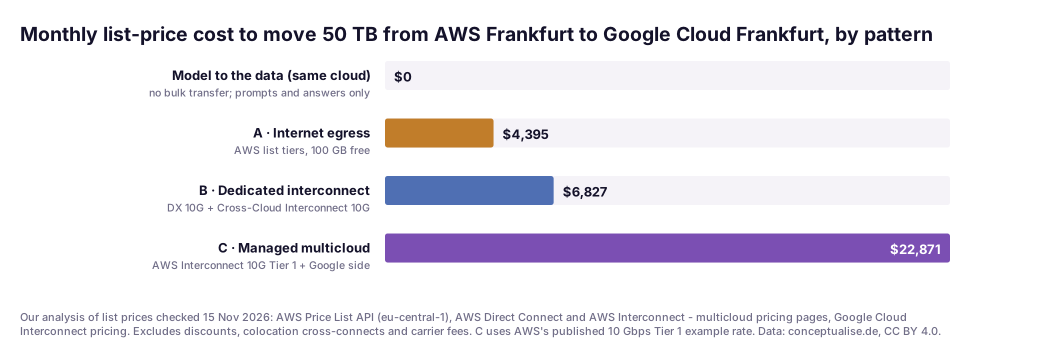
At 50 TB a month the internet is the cheapest wire at about $4,395. The dedicated interconnect costs about $6,827, of which roughly $5,800 is port and connection fees you pay whether data flows or not. The managed link costs about $22,871 at the Tier 1 example rate, all of it fixed.
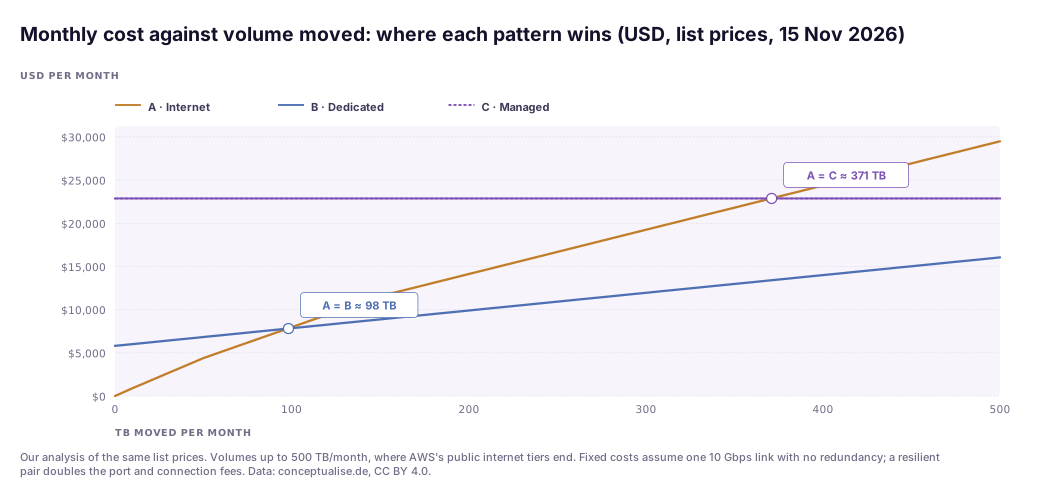
Internet and dedicated cross at about 98 TB a month, internet and managed at about 371 TB. The dedicated path stays cheaper than the managed one up to about 834 TB on a single link. Three readings:
- Below about 100 TB a month, choose the wire for security and latency, not price. Don't sell a private link to finance as a saving.
- The managed link sells simplicity, not cheap gigabytes. No colocation contract, no cross-connects. Price it against the network-engineering effort it saves.
- Resilience doubles the fixed part. A redundant pair pushes every break-even point to the right.
Discounts change the absolute numbers, and Tier 1 is AWS's example rather than a published Frankfurt rate. The shape holds: fixed-cost links need volume.
In a recent engagement…
A DACH organisation we worked with this year kept its documents and data warehouse in AWS and had standardised on a model family hosted in a second cloud. The first design was the whiteboard default: a nightly job copied the full document corpus to the model cloud, where an indexing service re-embedded everything.
It worked, and nobody saw the cost for two billing cycles: egress landed untagged in a shared platform account, while the AI team saw only token costs.
The fixes were unglamorous. Embedding moved next to the documents. The nightly copy became a change feed. The vector index stayed in the data cloud, and the gateway retrieved chunks at query time. A planned interconnect "to save egress" no longer paid off once the volume dropped, so it was deferred.
The decision table
| Your situation | Pattern | Why |
|---|---|---|
| A suitable model runs in the data's cloud and region | Model to the data | No bulk transfer, simplest governance |
| Model only elsewhere, derived data under ~100 TB/month | Process at source + internet egress (A) | Cheapest at list price; add private endpoints and TLS policy |
| Derived data well above ~100 TB/month, steady | Dedicated interconnect (B) | Low per-GB rate amortises the ports |
| No network team or colocation contract, private path required | Managed multicloud interconnect (C) | No per-GB fee, no cross-connects |
| Data in Google Cloud, model elsewhere, non-critical sync | Check Data Transfer Essentials | Reduced rate, currently no charge, internet path only |
| Leaving a provider entirely | Exit programme + Data Act Art. 29 | Switching charges banned from 12 Jan 2027 |
Governance for European enterprises
Data Act. The regulation counts data egress charges as switching charges. Article 29 allows only reduced, cost-based switching charges until 12 January 2027 and none afterwards. For in-parallel use, Article 34(2) says providers "may impose data egress charges, but only for the purpose of passing on egress costs incurred, without exceeding such costs". Ask each provider how its parallel-use pricing reflects cost.
GDPR. Cross-cloud transfer inside the EU is not a third-country transfer, but global inference routing can be. Record where inference runs per deployment.
DORA. For financial entities, the second cloud is an ICT third-party service supporting the AI function. Put it in the register of information and in exit planning. Our cloud exit plan runbook makes that plan testable, and our vendor lock-in spectrum scores how portable each layer is.
A pragmatic adoption path
- Week 1: inventory the flows. Every cross-cloud flow with direction, volume, owner and purpose, from billing exports and flow logs.
- Week 2: tag and alert. Owner and use-case tags on everything that generates egress; data-transfer budget alerts in both clouds.
- Weeks 3–4: move processing to the data. Embedding, filtering and de-identification go into the data cloud. Snapshot copies become change feeds.
- Month 2: put the gateway in front. All model traffic through one AI gateway with semantic caching, logging and an inference-geography check.
- Month 3: choose the wire with real numbers. Rerun the break-even model with your volumes, discounts and resilience needs. Only then sign for an interconnect.
The verdict
Multi-cloud AI is often the only way to use the model you need on the data you have. The mistake is defaulting to "copy everything to where the model is". Data gravity is real, and the bill enforces it.
Bring the model to the data when you can. When you can't, process at the source and ship only what the model needs. Buy a private link for security, latency or volume, not because someone said interconnects are cheaper. And don't wait for 12 January 2027: the Data Act ends switching charges, not the cost of running two clouds at once.
If you want help sizing the flows and choosing the wire, our cloud architecture team runs this as a short, fixed-scope review that ends with your flow inventory and your own break-even numbers.
FAQ
What does it cost to move data from one cloud to another for AI?
At list prices checked on 15 November 2026, moving 50 TB a month out of AWS Frankfurt costs about $4,395 over the internet and about $6,827 over a 10 Gbps dedicated interconnect, which only wins from roughly 98 TB a month. Keeping the model next to the data costs nothing in bulk transfer.
Is a private interconnect always cheaper than internet egress?
No. A dedicated link trades per-GB fees for fixed port fees on both clouds. In our list-price model a single 10 Gbps link beats internet egress only above about 98 TB a month, and redundancy doubles the fixed part. Below that, buy private links for security or latency, not price.
What is AWS Interconnect - multicloud?
A managed private link from Amazon VPCs to another cloud, ordered from the AWS side and billed hourly by bandwidth and tier, with no per-GB fee. The other provider bills its side separately. As of 15 November 2026 AWS lists Google Cloud as a partner and Azure as preview.
Does the EU Data Act abolish egress fees for multi-cloud?
Not for running clouds side by side. Article 29 of Regulation (EU) 2023/2854 bans switching charges, including data egress charges, from 12 January 2027. Article 34(2) still allows egress charges for in-parallel use, limited to passing on the costs the provider incurs. Multi-cloud AI is usually in-parallel use.
Should we move the data to the model or the model to the data?
Move the model to the data whenever a suitable model runs in the data's cloud and region. If it does not, process at the source: filter, de-identify, chunk and embed where the data lives, then ship only derived data and deltas across the wire.
What should European enterprises check before sending data to a model in another cloud?
Check inference geography, not just the deployment region: some model offerings route globally or offer only US data zones. Personal data in prompts follows normal GDPR transfer rules, and DORA entities should register the second cloud as an ICT third-party service.
Sources
All sources checked on 15 November 2026. Prices are public list prices in USD and change often; rerun the model with current prices and your own discounts before deciding.
Tier A: primary, pricing and regulatory
- Regulation (EU) 2023/2854 (Data Act), Articles 2, 29, 34 and 50: https://eur-lex.europa.eu/eli/reg/2023/2854/oj/eng
- AWS Price List API, data transfer, eu-central-1 (publication date 11 Nov 2026): https://pricing.us-east-1.amazonaws.com/offers/v1.0/aws/AWSDataTransfer/current/eu-central-1/index.json
- AWS Direct Connect pricing: https://aws.amazon.com/directconnect/pricing/
- AWS Interconnect – multicloud, product and pricing pages: https://aws.amazon.com/interconnect/multicloud/ and https://aws.amazon.com/interconnect/multicloud/pricing/
- AWS, "Free data transfer out to internet when moving out of AWS" (5 Mar 2024, updated): https://aws.amazon.com/blogs/aws/free-data-transfer-out-to-internet-when-moving-out-of-aws/
- Microsoft Azure bandwidth pricing: https://azure.microsoft.com/en-us/pricing/details/bandwidth/
- Google Cloud network pricing: https://cloud.google.com/vpc/network-pricing
- Google Cloud Interconnect pricing (Cross-Cloud and Partner Cross-Cloud Interconnect): https://cloud.google.com/network-connectivity/docs/interconnect/pricing
- Google Cloud, Cross-Cloud Interconnect overview: https://docs.cloud.google.com/network-connectivity/docs/interconnect/concepts/cci-overview
- Google Cloud, Data Transfer Essentials overview and FAQ: https://docs.cloud.google.com/data-transfer-essentials/docs/overview
- Google Cloud, "Eliminating data transfer fees when migrating off Google Cloud" (12 Jan 2024): https://cloud.google.com/blog/products/networking/eliminating-data-transfer-fees-when-migrating-off-google-cloud
- Microsoft Learn, OneLake shortcuts and shortcut caching: https://learn.microsoft.com/en-us/fabric/onelake/onelake-shortcuts
- Anthropic, Claude in Microsoft Foundry: https://platform.claude.com/docs/en/build-with-claude/claude-in-microsoft-foundry
Tier B: research and analysis
- CIO Dive, reporting Gartner's prediction on cross-cloud AI model activity by 2030 (21 Oct 2025): https://www.ciodive.com/news/ai-drives-cloud-spend-focus/803279/
- CC Conceptualise, egress cost model and break-even analysis (this article): /blog/multi-cloud-ai-data-gravity-egress/data.csv
Tier C: vendor and press, directional
- Gartner, "Top trends shaping the future of cloud" (May 2025), press release as republished by CXOToday: https://cxotoday.com/press-release/gartner-identifies-the-top-trends-shaping-the-future-of-cloud/
- Availability labels such as "preview" on the AWS and Google product pages above are vendor statements and a snapshot as of the date checked.
Topics