Enterprise Tech Radar 2027: Adopt, Trial, Assess, Hold
Our tech radar 2027 for European enterprises: 40 technologies across AI, cloud, security and engineering, each placed in Adopt, Trial, Assess or Hold.
On 15 November 2026, a typical European enterprise architecture board has more on its desk than it can review. In October, Gartner published its top strategic technology trends for 2027, including AI context platforms, AI agent identity, agent coding harnesses and sovereign tech. Thoughtworks released Volume 35 of its Technology Radar in November. Meanwhile the EU moved its own dates: the AI Act's high-risk obligations were pushed back, Cyber Resilience Act reporting went live, and the Data Act's ban on cloud switching charges arrives in January.
Trend lists tell you what is new. They don't tell you what to do on Monday, or what to stop doing. This radar is for the people who make those calls: CTOs, CISOs, enterprise architects and platform leads. It places 40 technologies and practices in four rings, with a one-line reason for each and a link to the article where we argue it in full.
TL;DR / Key takeaways
- Boring wins Adopt. Most of our 13 Adopt entries are configuration and discipline rather than new products: gateways, federated identity, cooldowns, immutable backups, tested exit plans. The best 2027 investments are rarely the newest.
- AI moves into the platform. An AI gateway, evaluation suites in CI and MCP behind OAuth are Adopt. Open-ended autonomous agents on core processes are Hold. The difference is who owns the control flow.
- Security is the most settled quadrant. Four entries in Adopt, four in Trial, one each in Assess and Hold. The open questions in security are about identity for agents, not about whether MFA works.
- Regulation now places blips. The CRA puts SBOM and VEX in Adopt, DORA puts tested exit plans there, and an unfinished Cloud and AI Development Act keeps sovereign cloud offers in Assess.
- Hold is the most useful ring. Six entries, from SMS codes to self-reported AI productivity. Stopping new starts frees more budget than any Trial.

Download: Editable draw.io file · Open in diagrams.net · Chart data (CSV)
How to read this radar
The format comes from Thoughtworks, which has published its Technology Radar twice a year for well over a decade and encourages others to build their own. We borrow the shape only. We ask one question: what should a regulated European enterprise with a Microsoft-heavy estate, a few hundred engineers and a NIS2 or DORA obligation do in 2027?
The four rings mean exactly this:
| Ring | What it means for your teams | What it needs |
|---|---|---|
| Adopt | The default. Use it unless you have a written reason not to | A standard, a template and an owner in the platform team |
| Trial | Ready for real workloads, on a limited number of them | A named owner, success criteria and a review date |
| Assess | Worth a time-boxed spike. Nothing in production depends on it | A question to answer and a deadline to answer it |
| Hold | No new starts. Existing use continues while you plan the exit | An exit plan for what already exists |
One note on naming. Thoughtworks' current radar calls its fourth ring Caution. We keep Hold, because in an enterprise portfolio the useful instruction is not "be careful" but "stop starting new things with this".
Each blip needed named evidence (a standard, a regulation, a study or our own measurement), a view from our 2026 engagements on whether teams can run it, and a European angle. There is no survey and no vendor input behind this radar. Ring placements are our analysis.
Why 2027 needs a different radar
First, AI agents moved from demos into the estate, and the bill arrived. Gartner predicted in June 2025 that more than 40% of agentic AI projects will be cancelled by the end of 2027, citing escalating costs, unclear business value and inadequate risk controls. In its 2027 trends, Gartner predicts that by 2028, 25% of enterprise security breaches will trace back to AI agent abuse. Both are forecasts, but they point the same way: the hard part of AI in 2027 is the platform around the model, not the model.
Second, the software supply chain became the attack surface of choice. In 2026, attackers went after npm maintainers, CI tooling and publishing pipelines, from axios in March to the Mini Shai-Hulud waves in April and May. Every malicious version with a public removal time in our teardown was pulled within 41 hours, so the cheapest defence was waiting. Registries changed defaults too: npm 12, generally available since 8 July 2026, no longer runs dependency install scripts unless you approve them.
Add the regulatory calendar and you get a radar where many entries are not new technology at all. They are practices that became cheap enough, or mandatory enough, to be the default.
The radar, quadrant by quadrant
Numbers match the blips in the figure. Each row links to the article where we argue the placement in full.
① AI & data
| # | Blip | Ring | Why, in one line |
|---|---|---|---|
| 1 | AI gateway for every model call | Adopt | One place for identity, quotas, logging, routing and EU data-zone choice. Every other AI control plugs into it (reference architecture) |
| 2 | Evals and red-teaming in CI | Adopt | A model upgrade or prompt change is a release. Without a regression suite it is an unreviewed one (playbook) |
| 3 | MCP with OAuth, behind a gateway | Adopt | MCP is the tool protocol everyone ships. Adopt it with the 2026-07-28 authorization rules, never as anonymous servers (deep dive) |
| 4 | Durable execution for agents | Trial | Long-running agents need checkpoints, retries and human waits. Pick the engine your platform team can run (comparison) |
| 5 | Semantic caching | Trial | Real savings, real risk. Thresholds are a trade between hit rate and wrong answers (experiment) |
| 6 | Small models for narrow tasks | Trial | Route small tasks to small models through the gateway. Self-hosting only pays at very high volume (TCO model) |
| 7 | Voice agents for contained flows | Trial | Narrow contact-centre flows work now, if you budget latency per hop and disclose the AI (architecture) |
| 8 | AI context platforms | Assess | Gartner's 2027 trend is the right direction, but the products are young. Start with semantics you already own (explainer) |
| 9 | GraphRAG and agentic retrieval | Assess | Wins on multi-hop and corpus-wide questions, ties or loses on single facts. Route by question type (benchmark review) |
| 10 | Open-ended agents on core processes | Hold | Bounded agents inside workflows, yes. Letting a model own the control flow of order-to-cash, no (decision framework) |
Our strongest AI view: the gateway is the platform. Every serious control here needs a single choke point: per-agent identity, token budgets, model routing, prompt logging and the choice between global and EU data-zone deployments. Teams that let each product call model APIs directly rebuild those controls five times.
MCP belongs in Adopt with a condition attached. The 2026-07-28 specification made the core stateless and tightened authorization: clients must check the authorization server's issuer, and Dynamic Client Registration is deprecated in favour of Client ID Metadata Documents. An OAuth-protected server behind a gateway is a sound default. An unregistered server on a developer laptop is the opposite, the problem our shadow MCP guide addresses.
The Hold on blip 10 is narrower than it sounds. We are against open-ended autonomy where the path cannot be written down and a wrong step is expensive, not against agents. Reliability compounds against long chains: at 95% per step, a 20-step chain completes only about 36% of the time. Put a deterministic workflow in charge and give the agent a bounded island inside it.
② Cloud & platforms
| # | Blip | Ring | Why, in one line |
|---|---|---|---|
| 11 | Policy-as-code landing zones | Adopt | Guardrails that deny bad configurations beat diagrams that describe good ones (policy-as-code guide) |
| 12 | Private subnets, explicit egress | Adopt | New Azure VNets are private by default for API versions after 31 March 2026; existing ones are not. Fix the old estate on purpose (reference architecture) |
| 13 | Tested cloud exit plans | Adopt | DORA requires exit strategies for critical ICT contracts, and the Data Act bans switching charges from 12 January 2027 (runbook) |
| 14 | Cell-based architecture | Trial | Turns blast radius into a design number. Worth it for multi-tenant platforms, overkill for internal apps (guide) |
| 15 | vLLM and KServe on Kubernetes | Trial | Production-capable but fast-moving. Pin versions and upgrade through a canary (AKS guide) |
| 16 | Internal developer platforms | Trial | Golden paths pay off when they encode the guardrails above. A portal without paved roads is just a catalogue (Backstage on Azure) |
| 17 | EU sovereign cloud offers | Assess | Real options now exist, but the legal yardstick (CADA) is still a proposal. Score per workload (comparison) |
| 18 | Models in one cloud, data in another | Assess | Sometimes unavoidable. Ship derived data, not raw data, and meter every flow (egress patterns) |
| 19 | Kubernetes as the default for everything | Hold | Kubernetes earns its cost for platforms and GPU inference. For a CRUD API, a managed container service is cheaper to run (comparison) |
| 20 | Recovery via the provider's control plane | Hold | If recovery needs to launch, call a management API or sign in during the incident, it competes with every other customer (outage anatomy) |
The cloud quadrant is about defaults. Blip 12 is the clearest example: Microsoft's private-subnet default applies only to new virtual networks, so most enterprises now run two estates, one private by default and one that quietly keeps default outbound access. Adopt means aligning the old one deliberately, on your schedule.
Blip 20 is the Hold we argue most often. In AWS's October 2025 event, the DNS fault was repaired in under three hours, but some services took more than 14 to recover, because recovery itself depended on overloaded control planes. A runbook that says "launch new instances in another region" competes with thousands of others at that moment. Pre-provision, cache and pre-wire instead: static stability.
Sovereign cloud stays in Assess, not Hold. The AWS European Sovereign Cloud opened its first region, in Brandenburg, on 14 January 2026. The Commission proposed the Cloud and AI Development Act on 3 June 2026, with four assurance levels. Until the levels are law, assess offers against your own workload classification rather than against a vendor's sovereignty label. Our CADA explainer maps the levels to controls.
③ Security
| # | Blip | Ring | Why, in one line |
|---|---|---|---|
| 21 | Workload identity federation | Adopt | GitHub, GitLab, Azure DevOps, Kubernetes, AWS and Google Cloud can all federate to Entra. Block new secrets, then revoke the rest (guide) |
| 22 | Phishing-resistant MFA | Adopt | NIST SP 800-63B-4 requires a phishing-resistant option at AAL2 and a phishing-resistant authenticator at AAL3 (passkeys with Entra) |
| 23 | Immutable, isolated backups | Adopt | Only a locked immutable vault is irreversible. Put backup-deletion approval in a different tenant (Azure design) |
| 24 | Detection-as-code | Adopt | Version, test and deploy detections like software. Expect to own the Sigma-to-Sentinel field mapping (pipeline) |
| 25 | Token protection and ITDR | Trial | Passkeys stop the phishing relay, not the theft of a token issued afterwards. Coverage is still partial (playbook) |
| 26 | CTEM | Trial | Prioritise exposures, not CVE counts. The loop works with tools you already own (CTEM in practice) |
| 27 | DSPM before Copilot rollout | Trial | Copilot surfaces what users can already see. Find the oversharing before a prompt does (DSPM, Copilot clean-up) |
| 28 | Hybrid post-quantum TLS (ML-KEM) | Trial | ML-KEM is standardised in FIPS 203 and OpenSSL 3.5 offers the hybrid group by default. Enable it where your stack allows (migration plan) |
| 29 | Dedicated enterprise browsers | Assess | Governed Edge or Chrome covers managed devices. A dedicated browser earns its place for BYOD, contractors and VDI replacement (analysis) |
| 30 | SMS and voice one-time codes | Hold | NIST restricts them and states that out-of-band authentication is not phishing-resistant. AiTM proxies relay them in real time |
Security is the most settled quadrant. Nothing in its Adopt ring is new; what changed is that the excuses ran out. Every major CI system can present a signed token to Entra, passkeys work across the major platforms, and regulators now ask for the outcome.
The Trial ring is where the attacker moved. Adversary-in-the-middle phishing steals the session, not the password, so blip 25 follows blip 22. It stays in Trial because coverage is uneven: Token Protection is generally available for native applications, while browser coverage remains limited.
Blip 28 is in Trial because the standard is done and the defaults are moving. NIST published ML-KEM as FIPS 203 in August 2024, and OpenSSL 3.5 (April 2025) offers X25519MLKEM768 in its default TLS key shares. Enabling it is cheap. The expensive part is the inventory of everything that can't, which our crypto-agility roadmap covers.
The quadrant's open question cuts across all four, so it is not a single blip: identity for AI agents. Agents choose at run time what to call, which breaks the assumptions behind both user and service accounts. Our working answer is in the agent identity guide: no stored secrets, token exchange at every hop, and the act claim as the audit trail.
④ Engineering practices
| # | Blip | Ring | Why, in one line |
|---|---|---|---|
| 31 | Dependency cooldowns | Adopt | Every 2026 malicious npm version with a public removal time was gone within 41 hours. A seven-day minimum release age, with a security fast lane, skips them (teardown, dependency firewalls) |
| 32 | GitHub Actions hardening | Adopt | Pin actions to commit SHAs, scope tokens and keep untrusted code away from secrets. Both tj-actions and Trivy worked by moving tags (20 controls) |
| 33 | SBOM and VEX operations | Adopt | The CRA expects an SBOM. VEX is how a scanner's 54 hits became 11 real ones in our test (SBOM + VEX) |
| 34 | SLSA Build L3 provenance | Trial | Attestations alone give Level 2. Level 3 needs isolated signing and a verifier that checks it (recipe) |
| 35 | Sandboxed AI coding agents | Trial | Agents raise the secret-leak rate and act from the workstation. Sandbox them and remove ambient credentials (controls) |
| 36 | Agent-ready API design | Trial | Idempotency, typed errors and predictable pagination matter more when the caller is a model that retries (guidelines) |
| 37 | AI-assisted strangler-fig migration | Trial | Coding agents speed up slice-by-slice migration. Characterisation tests keep them honest (approach) |
| 38 | LLM triage of SAST findings | Assess | The best published designs cut false positives sharply, but every gain cost recall. Let the model rank, not delete (evidence review) |
| 39 | Self-reported AI productivity | Hold | In METR's 2025 trial, developers were 19% slower with AI while believing they were 20% faster (measurement) |
| 40 | Long-lived package publish tokens | Hold | npm revoked classic tokens in December 2025. Trusted publishing over OIDC, scoped to one workflow and branch, replaces them |
This quadrant has the clearest link between evidence and ring. Blip 31 is a timing argument. The community now detects malicious packages within hours, but your npm install is faster still. A cooldown turns the community's speed into your protection, at the cost of non-security updates arriving a week later. pnpm 11 now holds new versions for a day by default, and Yarn 4.15 does the same for new projects; npm's min-release-age is off unless you set it.
Blip 32 is Adopt because the gap is still wide: in our sample of 200 public repositories, only 30.5% pinned every action to a commit SHA.
Blip 34 sits in Trial because provenance tells you where a package was built, not whether it is safe. In May 2026, malicious TanStack packages carried valid build provenance, because the attacker controlled the real pipeline.
Blip 39 starts arguments. In METR's 2025 randomised trial, 16 experienced open-source developers took 19% longer on 246 real issues with AI tools, yet believed they had been 20% faster. METR now calls the result out of date for current tools. The measurement lesson is not: if your AI business case rests on what developers report, you have not measured it.
What the numbers say
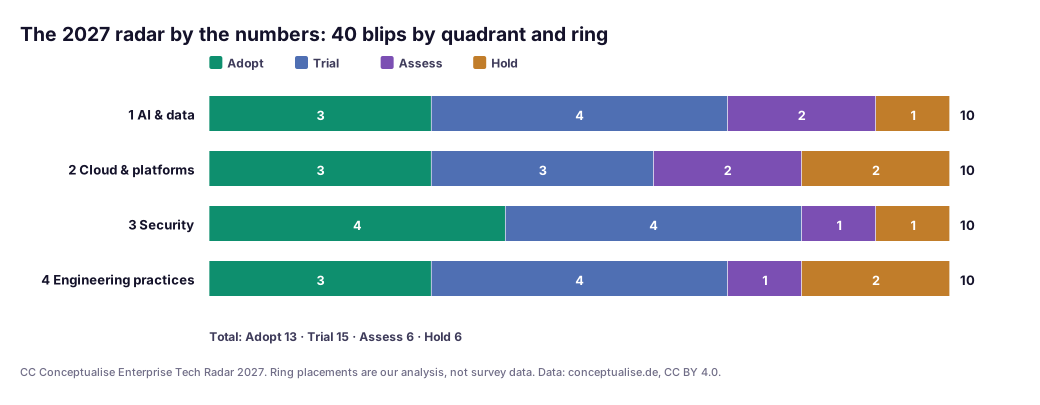
Thirteen Adopt, fifteen Trial, six Assess and six Hold. The radar is weighted towards doing, deliberately: most enterprises we see have more Assess work open than they can finish, and too little in Adopt that is actually enforced.
Security has the most in Adopt (four) and, with engineering, the fewest in Assess (one): the controls are known and the problem is rollout. AI and data has the most in Trial and Assess combined (six of ten), because the tools move faster than the evidence. Cloud and engineering each carry two Holds, all of them defaults that used to be reasonable.
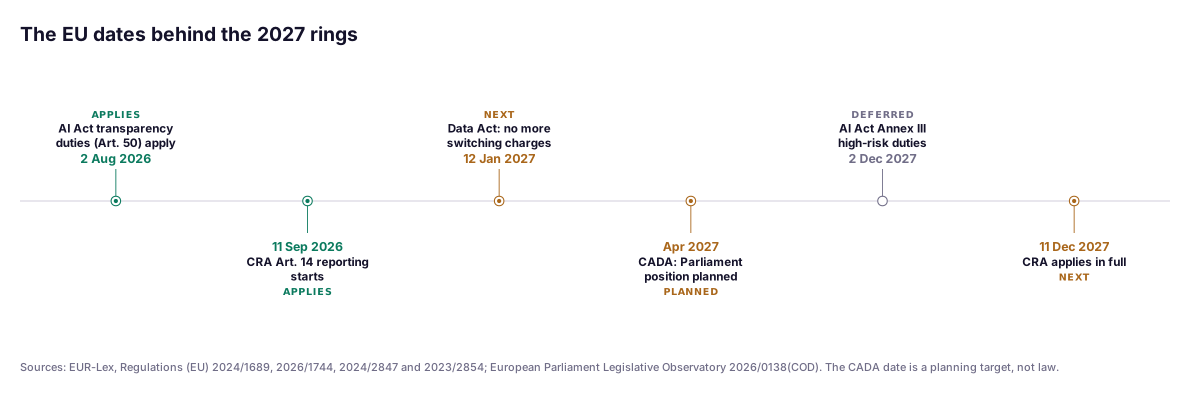
The second chart is the regulatory calendar behind several placements. A blip that depends on a date already in force goes to Adopt. A blip that depends on a deferred or merely planned date, such as the Annex III obligations or Parliament's position on the Cloud and AI Development Act, stays in Assess.
In a recent engagement…
Earlier this year we reviewed the technology governance of a European industrial group. It had a radar, carefully built two years earlier, long, and mostly ignored.
Nothing had ever left it, so it had become a list of everything anyone had mentioned. The Hold ring was almost empty, because nobody wanted to be the person who told a team their choice was wrong. Trial entries had no owners and no review dates, so many had sat in Trial since the first edition. And the radar had no link to the guardrails. A team could pick a Hold technology and nothing in the pipeline or landing zone would notice.
We did three things. We cut the radar to the entries that a team had actually asked about in the past year. We gave every Trial entry an owner and a review date, and every Hold entry an exit plan. And we tied Adopt and Hold to enforcement: Adopt items became landing-zone templates and pipeline defaults, and a few Hold items became policy denials. The shorter radar became the document architects actually opened before a design review.
Decision checklist: moving a blip between rings
Use this when you build or update your own radar. A blip moves only when its evidence changes.
| Move | Question to answer | Evidence we accept | Typical blocker |
|---|---|---|---|
| New → Assess | Is there a concrete problem this would solve for us? | A named use case and a sponsor | Curiosity without a problem |
| Assess → Trial | Did a time-boxed spike answer the question? | A written spike result with a cost and risk view | Nobody owns the result |
| Trial → Adopt | Does it work on real workloads and can the platform team support it? | Two or more production uses, a runbook, a template | No one funded the paved road |
| Adopt → Hold | Is there a better default, or did the risk change? | Incident data, a regulation, a vendor retirement notice | Sunk cost and existing contracts |
| Anything → Hold | Would we still start this today? | A one-line reason anyone can read | Politeness |
| Hold → off the radar | Has the last use been migrated? | Inventory shows zero | Forgotten long-tail systems |
Record every ring move with its date and reason, and give every Trial entry a review date after which it moves or leaves.
Governance for European enterprises
The radar is not a compliance document, but several placements exist because of law. These are the regimes that genuinely move blips in 2027.
AI Act. Regulation (EU) 2026/1744, the "Digital Omnibus on AI", entered into force on 27 July 2026. It moved the obligations for high-risk systems under Annex III to 2 December 2027 and for Annex I systems to 2 August 2028. The Article 50 transparency duties have applied since 2 August 2026, which is why the voice-agent blip (7) carries a disclosure requirement today. The evaluation suites in blip 2 are the evidence base you will need for high-risk systems in 2027, so build them now.
Cyber Resilience Act. Regulation (EU) 2024/2847 has required manufacturers to report actively exploited vulnerabilities and severe incidents since 11 September 2026, and applies in full from 11 December 2027. That puts SBOM and VEX (33) in Adopt and keeps cooldowns (31) and Actions hardening (32) there too. Our CRA reporting runbook covers the 24/72-hour process.
DORA. Applied to financial entities since 17 January 2025. Article 28(8) requires exit strategies for ICT services that support critical or important functions, and Article 12 expects restorable backups on segregated systems. Those are blips 13 and 23.
NIS2. Article 21 requires risk-management measures, including supply-chain security, access control and the use of multi-factor authentication. In Germany the NIS2UmsuCG has applied since 6 December 2025. Blips 21, 22, 24 and 26 are the controls auditors ask to see.
Data Act. Article 29 ends switching charges from 12 January 2027, which makes tested exit plans (13) cheaper to rehearse. Egress for parallel multi-cloud use (18) can still be charged at cost.
Cloud and AI Development Act. Still a proposal, COM(2026) 502 of 3 June 2026: a planning signal, not an obligation. Hence Assess for sovereign cloud offers (17).
A pragmatic adoption path
If you want your own radar rather than ours, this is the path we use with clients. It takes about a quarter.
- Inventory before opinion (weeks 1–2). List what teams actually run (CMDB, cloud inventory, package manifests, pipelines) plus what they asked the architecture board this year. That is your candidate list.
- Place with reasons (weeks 3–4). Give each candidate a ring, a one-line rationale and named evidence. Our draw.io file is CC BY 4.0 if you want a start. Anything without a reason stays off.
- Make Hold real (weeks 5–6). Pick three to six Hold entries with a visible cost: SMS codes, long-lived publish tokens, recovery runbooks that need the console. Give each an owner and an exit date. This is where the budget comes from.
- Wire Adopt into the platform (weeks 7–10). Every Adopt entry becomes a default: a landing-zone module, pipeline template, policy or package-manager setting. If it cannot be expressed as a default, it is really a Trial.
- Publish and review twice a year (week 12 onward). Publish it internally with a change log. Review in spring and autumn, move only what the evidence moved, and retire Trial entries that missed their review date.
The verdict
The 2027 radar is less exciting than the 2027 trend lists, and it should be. The most valuable moves next year are unglamorous: put a gateway in front of every model, federate every workload identity, wait a week before installing new packages, lock your backups and rehearse your exit. Almost all of it is configuration you already own.
Where we are opinionated, it is about control. Agents yes, but inside workflows. Kubernetes yes, but not for everything. Provenance yes, but not as proof of safety. If you take one thing from this radar, take the Hold ring. Deciding what to stop starting is the cheapest architecture decision you will make in 2027.
If you want to build a radar for your own estate, with your own evidence and enforcement wired in, our software architecture team runs this as a short workshop series. You leave with a radar your teams will actually open, and an editable draw.io file to keep it current.
FAQ
What is an enterprise tech radar?
A tech radar is a one-page map of technologies and practices, sorted into quadrants by domain and into rings by how strongly you recommend them. The format was popularised by Thoughtworks, whose Technology Radar has appeared twice a year for well over a decade. An enterprise radar applies the same idea to one organisation's portfolio. It tells teams what to use by default, what to try on real work, what to explore and what to stop starting.
What do Adopt, Trial, Assess and Hold mean in this radar?
Adopt means the default choice: use it unless you have a documented reason not to. Trial means ready for real workloads with a named owner and a review date. Assess means worth a time-boxed spike, but nothing should depend on it yet. Hold means no new starts: existing use can continue while you plan the exit. Thoughtworks' current radar calls its fourth ring Caution. We keep Hold because it describes a portfolio decision, not a warning.
Which technologies should European enterprises adopt in 2027?
Our Adopt ring has 13 entries. The ones with the broadest impact are an AI gateway in front of every model call, evaluation and red-team suites in CI, workload identity federation instead of stored secrets, phishing-resistant MFA, immutable and isolated backups, dependency cooldowns, GitHub Actions hardening, SBOM and VEX operations, and tested cloud exit plans. Most of them are configuration and discipline rather than new products.
Why are autonomous AI agents on Hold?
Open-ended agents that decide their own path through a core business process are on Hold, not agents in general. Reliability compounds against long chains of model decisions, and costs are several times those of a chat. Gartner predicted in June 2025 that more than 40% of agentic AI projects will be cancelled by the end of 2027. Bounded agents inside a deterministic workflow, with evaluations, budgets and approval on writes, sit in Adopt and Trial instead.
How does EU regulation affect the 2027 radar?
Regulation decides several placements. Cyber Resilience Act reporting has applied since 11 September 2026 and the rest applies from 11 December 2027, which pushes SBOM and VEX into Adopt. DORA's exit requirements put tested exit plans in Adopt. The AI Act's Annex III high-risk obligations were deferred to 2 December 2027 by Regulation (EU) 2026/1744, while the Article 50 transparency duties have applied since 2 August 2026. The Cloud and AI Development Act is still a proposal, which is why EU sovereign cloud offers sit in Assess.
How do we build our own tech radar?
Start from your existing estate, not from trend reports. List what teams actually use, add what they ask for, and place each entry with a one-line rationale and named evidence. Give every Trial entry an owner and a review date, and make Hold mean no new starts. Publish the radar, review it twice a year, and treat each ring move as a decision with a record. Our CC BY 4.0 draw.io file is a starting template.
Sources
All sources checked on 15 November 2026. Ring placements are CC Conceptualise analysis. Figures quoted from our own deep-dive articles are documented, with their sources, in those articles.
Tier A: primary, standards and regulatory
- Regulation (EU) 2026/1744 (Digital Omnibus on AI), amending Regulation (EU) 2024/1689: https://eur-lex.europa.eu/eli/reg/2026/1744/oj/eng
- Regulation (EU) 2024/1689 (AI Act), Article 50: https://eur-lex.europa.eu/eli/reg/2024/1689/oj/eng
- Regulation (EU) 2024/2847 (Cyber Resilience Act), Articles 14 and 71: https://eur-lex.europa.eu/eli/reg/2024/2847/oj/eng
- Regulation (EU) 2022/2554 (DORA), Articles 12 and 28: https://eur-lex.europa.eu/eli/reg/2022/2554/oj/eng
- Directive (EU) 2022/2555 (NIS2), Article 21: https://eur-lex.europa.eu/eli/dir/2022/2555/oj/eng
- Regulation (EU) 2023/2854 (Data Act), Article 29: https://eur-lex.europa.eu/eli/reg/2023/2854/oj/eng
- European Commission, Proposal for the Cloud and AI Development Act, COM(2026) 502: https://digital-strategy.ec.europa.eu/en/library/proposal-cloud-and-ai-development-act-cada
- European Parliament Legislative Observatory, procedure 2026/0138(COD): https://oeil.europarl.europa.eu/oeil/en/procedure-file?reference=2026%2F0138%28COD%29
- NIST SP 800-63B-4, Digital Identity Guidelines: Authentication and Authenticator Management: https://pages.nist.gov/800-63-4/sp800-63b.html
- NIST FIPS 203, Module-Lattice-Based Key-Encapsulation Mechanism Standard: https://csrc.nist.gov/pubs/fips/203/final
- OpenSSL 3.5 release notes: https://openssl-library.org/news/openssl-3.5-notes/
- Model Context Protocol, "The 2026-07-28 Specification": https://blog.modelcontextprotocol.io/posts/2026-07-28/
- Microsoft Learn, Default outbound access in Azure: https://learn.microsoft.com/en-us/azure/virtual-network/ip-services/default-outbound-access
- Microsoft Learn, Token Protection in Conditional Access: https://learn.microsoft.com/en-us/entra/identity/conditional-access/concept-token-protection
- GitHub changelog, npm install-time security and npm 12 (8 Jul 2026): https://github.blog/changelog/2026-07-08-npm-install-time-security-and-gat-bypass2fa-deprecation
- Thoughtworks, Technology Radar (Volume 35, November 2026) and FAQ: https://www.thoughtworks.com/radar and https://www.thoughtworks.com/radar/faq
Tier B: research and analysis
- Gartner, "Gartner Identifies the Top Strategic Technology Trends for 2027" (press release, October 2026): https://www.gartner.com/en/newsroom/press-releases/2026-10-20-gartner-identifies-the-top-strategic-technology-trends-for-2027
- TechEdgeAI, syndicated Gartner 2027 trends release (full list of ten trends and predictions): https://techedgeai.com/gartner-identifies-the-top-strategic-technology-trends-for-2027/
- Gartner, "Gartner Predicts Over 40% of Agentic AI Projects Will Be Canceled by End of 2027" (25 Jun 2025): https://www.gartner.com/en/newsroom/press-releases/2025-06-25-gartner-predicts-over-40-percent-of-agentic-ai-projects-will-be-canceled-by-end-of-2027
- METR, "Measuring the Impact of Early-2025 AI on Experienced Open-Source Developer Productivity" (10 Jul 2025): https://metr.org/blog/2025-07-10-early-2025-ai-experienced-os-dev-study/
- CC Conceptualise deep dives linked in the radar tables, each with its own tiered sources (npm teardown, GitHub Actions sample of 200 repositories, SBOM and VEX test, semantic-caching experiment, hyperscaler outage analysis)
Tier C: vendor, directional
- AWS News Blog, "Opening the AWS European Sovereign Cloud" (14 Jan 2026): https://aws.amazon.com/blogs/aws/opening-the-aws-european-sovereign-cloud
- Thoughtworks, Build Your Own Radar: https://www.thoughtworks.com/radar/byor
Topics